How Maori Activists & Their Lawyers Reinvented New Zealand’s
Treaty of Waitangi
For the South Pacific country of New Zealand, the treaty entered into in 1840, between the British Government and Maori chiefs, provided the “permission slip” for the formation of a British colony. For this to occur, 540 chiefs across the length and breadth of New Zealand ceded their sovereignty to Queen Victoria, so that they could sit in the shadow of the Queen and be protected by Her.
The reason the chiefs chose this course of action, after careful deliberation and years of discussion within their tribes, included : fear of invasion by the French, a need to stop constant inter-tribal warfare and a strong desire for the much-needed institution of law & order.
For the people of New Zealand, the Treaty of Waitangi was the equivalent of the Declaration of Independence of the United States of America, and their brilliant, follow-on Constitution & Bill of Rights that later defined how affairs were to be conducted within the newly formed Republic of the United States.
Both the New Zealand Treaty of Waitangi and the United States Declaration of Independence were the founding or preliminary documents of the two countries and both were drafted with great care over several days, with the participation and input of many learned individuals, in order to achieve the required clear and precise tenets, upon which successful, abundant and caring nations are launched into existence.
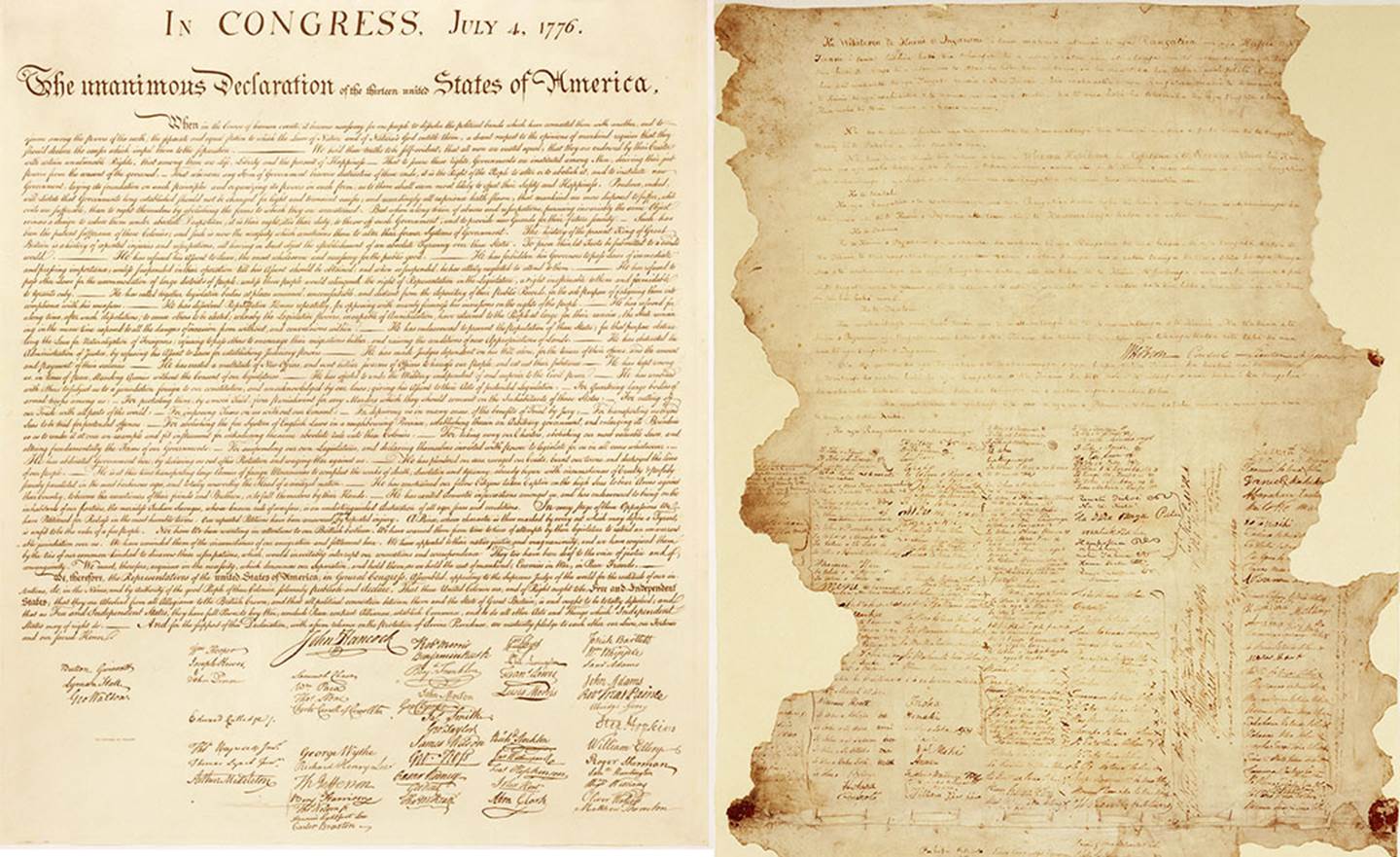
The United States of America Declaration of Independence sits alongside New Zealand’s Tiriti o Waitangi. Each represented beginning or foundation documents from which two new nations, each with a new direction, sovereignty and egalitarian laws came into being. Americans have had to be ever-vigilant, battling constantly against tyrannical forces in order to preserve the tenets and scope of their founding principles. New Zealanders lost that battle in the 1980s - 90s against the globalist forces.
In the case of New Zealand’s Treaty of Waitangi / Te Tiriti o Waitangi the final, defining, binding, legislative text was solely in the Maori language and this fact was affirmed by Lieutenant-Governor William Hobson, the British emissary sent to New Zealand to secure a treaty with the Maori chiefs.
New Zealanders would never have any problems with the Maori-language text, as it is benign, all-encompassing and guarantees equality under the law to all, with no special rights for one group over another. It was never a race-based text and, despite dissenting, modern-day views from certain self-interest groups, was a perfect translation of the Final English draft.
Americans would consider it abhorrent and repugnant to witness words, ideas, meanings or intents of their founding document being altered, and any such tampering would unleash such an angry hue & cry of protest from the common people that the meddling interlopers would have to swiftly back off.
And yet New Zealanders, up until 1975 and after 135-years of knowing what the Treaty of Waitangi truly meant, were increasingly led-to-believe (conned-into-thinking) that the Treaty of Waitangi had an altogether different meaning to that which many generations of New Zealanders, both Maori & European alike, had accepted as established, documented, historical fact.
Whereas Americans still have to be constantly vigilant and fight hard to preserve their rights under the US Constitution, New Zealand’s Treaty of Waitangi has, sadly, fallen victim to the guile of activists and their lawyers and has been severely crippled. The reinvention of meaning and subsequent erosion of rights has been ongoing and relentless during the past 50-years, wherein a benign, clear text of unification has been drastically transformed into a Maori-supremacist imposed formula for apartheid or separatism.
Here is a documented account of how most New Zealanders lost their inalienable rights guaranteed under the Articles of the Treaty of Waitangi:
Firstly, let’s review a well-known, ALL IMPORTANT historical fact from 1840, as well as an outstanding discovery that occurred 149-years later in 1989.
LOSS OF THE FINAL ENGLISH DRAFT, THE MOTHER DOCUMENT FROM WHICH TE TIRITI O WAITANGI WAS TRANSLATED.
It is openly acknowledged by our Treaty of Waitangi historians and experts that The Final English Draft of the treaty, which provided the text for the Maori translation, went missing sometime in February 1840.
From historical references and written testimonials of those directly involved, we know that the Final English Draft document was in the handwriting of British Resident, James Busby. Captain William Hobson (who later became New Zealand’s first Governor) handed the Final English draft to Reverend Henry Williams ‘at 4 p.m. on the 4th of February 1840’ for translation overnight into Te Tiriti O Waitangi (the Maori language text).
It was absolutely essential that the Maori chiefs heard, considered and fully understood the British proposal in their own language before deciding whether or not they would cede their sovereignty to Queen Victoria
In mid-March 1989 an English language version of the Treaty of Waitangi was found in Pukekohe, South Auckland, when members of the Littlewood family were sorting out the estate of their recently deceased mother, Ethel Littlewood.
DIRTY TRICK NUMBER 1 … WITHHOLDING INFORMATION FROM THE PUBLIC ABOUT THE FIND OF “THE FINAL ENGLISH DRAFT OF THE TREATY OF WAITANGI & ITS AUTHOR”.
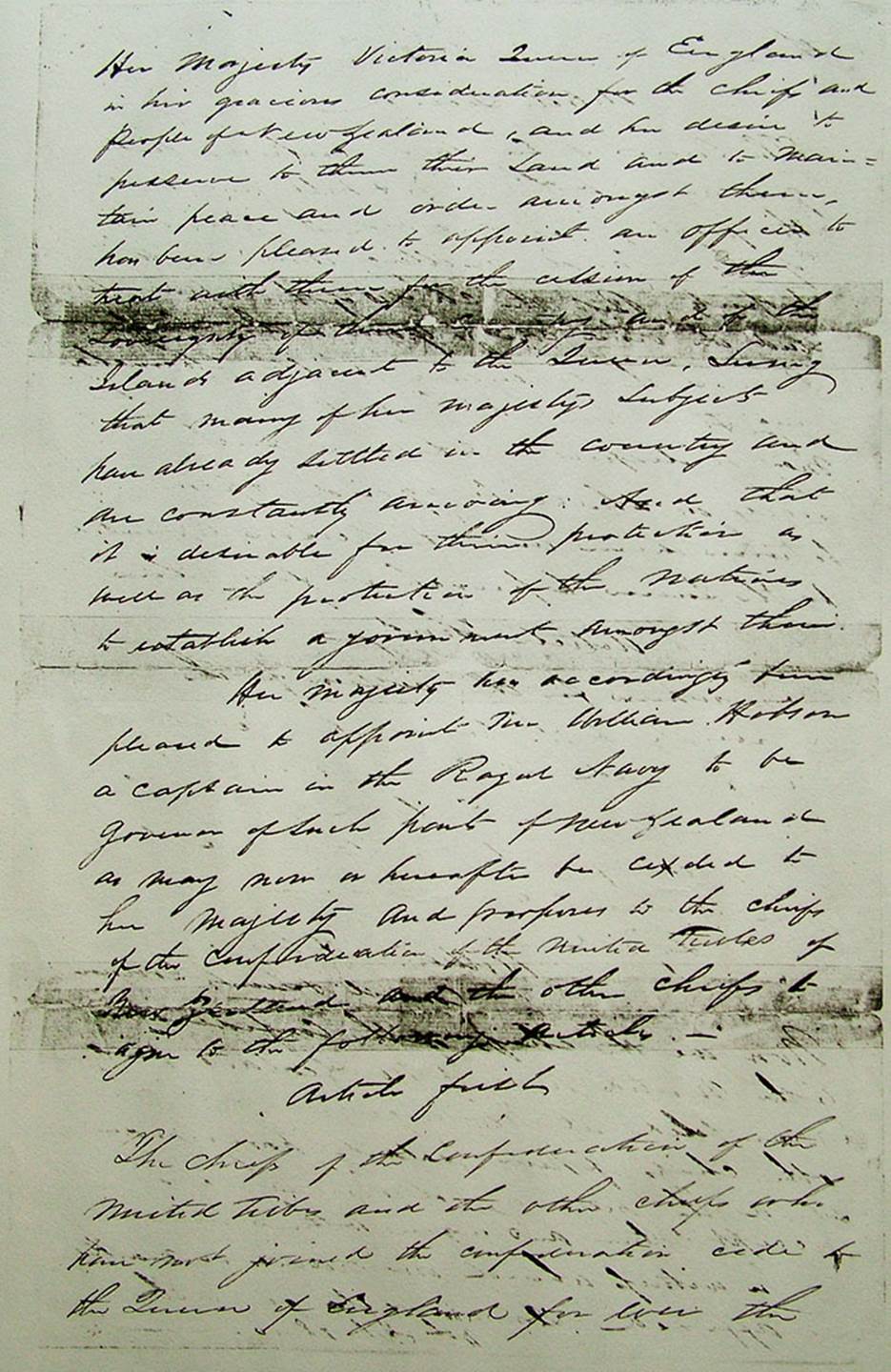
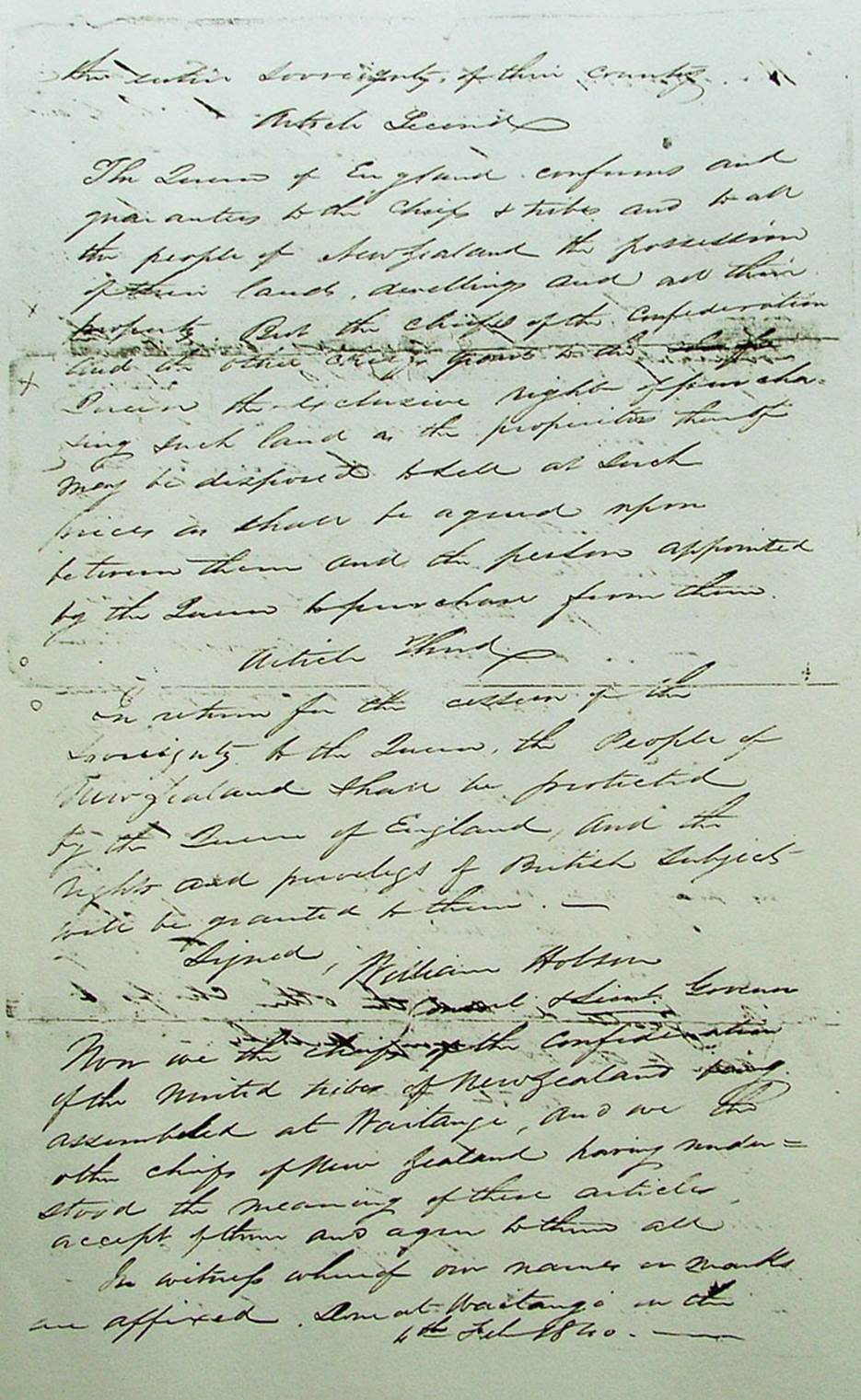
When first found amongst Littlewood family papers, the old sheet was cracked along the fold lines and had, at some point, been cellotaped by a family member to hold it together in one piece.
This old sheet of paper has, subsequently, been identified to be in the handwriting of British Resident, James Busby by New Zealand’s leading handwriting expert of documents from the early colonial era, Dr. Phil Parkinson of the Alexander Turnbull Library. We know from historical records that the original “Final Draft” had to be in the handwriting of James Busby, as he acted as the secretary on the 4th of February 1840 when the Final Draft text was decided upon and created.
The New Zealand Government has continued to withhold the fact that James Busby is the author, as that would alert the public to the fact that the Final English Draft, the mother document of Te Tiriti o Waitangi, has been found.
An astounding feature of this newly found document is that it is dated the 4th of February 1840. It is also written on very old paper, bearing a W. Tucker 1833 watermark. The paper stock was owned by James Reddy Clendon, US Consul and the only individual in New Zealand ever known to have used that watermarked brand of English paper was Clendon.
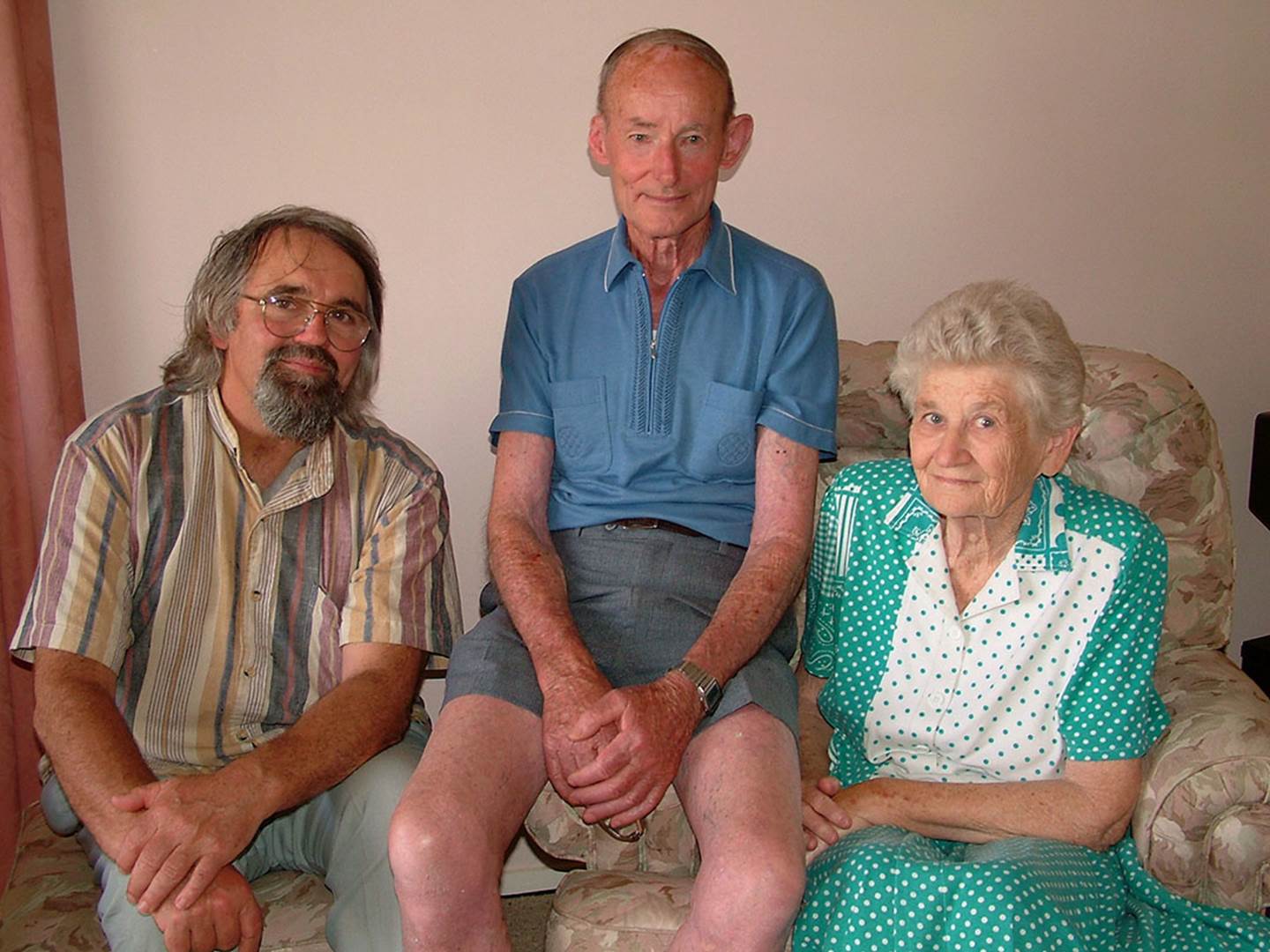
John & Barbara Littlewood with the author in 2003 - 4 very graciously shared all of the information they had, photocopies of the “Littlewood Treaty” document, newspaper clippings, historical information, genealogy, and events surrounding the finding of the document amongst family papers in 1989, as well as placing it into the care of Archives New Zealand in September 1992. John passed away in November 2015 and Barbara a year later.
John Littlewood and his sister, Beryl were sorting through papers from their mother’s deceased estate in March 1989, when Beryl found the English language copy of the Treaty of Waitangi in an envelope marked, Treaty of Waitangi. There was a family tradition that John’s great-grandfather was somehow involved with the Treaty of Waitangi and, subsequent to the find, John spent two years trying to find out the significance and provenance of the document, before lodging it with Archives New Zealand.
Because of the due diligence of generations of the Littlewood family, the all-important fragile paper document was preserved. The New Zealand people owe the Littlewood family a debt of gratitude for their care & keeping safe of the most sought after, lost historical document of the colonial era.
WAS THIS THE MISSING FINAL ENGLISH DRAFT OF THE TREATY OF WAITANGI, LOST FOR 149-YEARS?
For over 150-years, when the document finally came back into the public arena (1992), generations of historians and politicians had been searching and "hoping against hope" that the "final English draft" of the treaty would finally and belatedly turn up. That it even survived is a miracle and a credit to the Littlewood family, whose consideration and respect, accorded to a fragile piece of paper, kept it safe, in their possession, for at least a hundred and thirty six years or longer.
As stated, James Busby is, positively and without dispute, the author of the Littlewood Treaty document. He's also the undisputed individual who penned the final English draft of the Treaty of Waitangi on the 4th of February, 1840.
For over 150-years before the Littlewood document came to public attention in 1992, we had been looking for a piece of paper with the following attributes:
- It had to say exactly what Te Tiriti O Waitangi said and be set out in the same way. Sentences and words had to mirror each other in perfect reflection. There had to be approximately the same "word weight" per sentence. The English text found had to look and sound, convincingly, like the mother document to Te Tiriti O Waitangi. That is: It had to have a Preamble, three Articles, Hobson's name and title, an Affirmation section for the signatory chiefs and the final date.
That the Littlewood document qualifies admirably in complying to this perfect layout and content, is beyond question.
- It had to be on paper that preceded the signing of the treaty in 1840 and that paper had to be identifiable as stock in use at the Bay of Islands in February 1840. If the paper was from an orphan stock, then that would cast doubt upon the authenticity of the document.
Clendon's W. Tucker 1833 watermarked stock fulfils these necessary criteria admirably.
- The paper had to have a pedigree traceable back to one of the founding fathers who drafted the treaty and, ultimately to Busby and Hobson.
The Littlewood document's pedigree is impeccable and fully traceable to Clendon, Busby and, in consideration of Clendon's "official" request, back to Hobson himself.
- The author of the hand-written text had to be James Busby, British Resident.
That attribute of the Littlewood document is also beyond dispute.
- It had to bear the date, the 4th of February 1840, as that's the day the final English draft was written.
It is clearly signed off, 4th Feb 1840.
One would have to scratch one's heads in bewilderment...if this document doesn't satisfy our mainstream historians as the elusive and long sought after final English draft, under all of the clinically stringent, qualifying criteria, then what ever would or could satisfy them?
In view of the weight of evidence supporting the document's authenticity as the final draft, one would have to conclude that it is, simply, not considered politically convenient or expedient to recognise it for what it truly is and that factor, undoubtedly, constitutes the real underlying issue.
It's also significant that the New Zealand Government has never allowed for a general release of photographs of the document. The Littlewood family had to be supplied with with black & white, poor quality photocopies, but the colour photos in circulation had to be acquired by more back-door methods and then leaked into the public arena against the wishes of the authorities.
During late 1992 and for years thereafter those asking for photographs were refused on the basis that the document was "too fragile", even though it had undergone preservation and had already been photographed in high resolution by Preservation Services at the New Zealand National Archives.
It was also misrepresented as a "back-translation" from the Maori language text, even though its signed-off, date (the 4th of February 1840) showed it had been written before there was a Maori language translation (the 5th of February 1840).
In this matter our historians and forensic scientists are seriously derelict in their duty to the people of New Zealand and three decades of deliberate foot-dragging, silence, misrepresentation, misinformation or pretending that the document does not exist, shows the contempt state-employees have for the public who pay their wages.
It's a simple and innocent enough task to tell the public officially the full, forensic status of the document, who wrote it and what is the true significance of the date on it ... or is that somehow inconvenient and counterproductive to a preferred agenda?
By the 1850’s, at least, James Reddy Clendon, Police Magistrate, was using Littlewood’s legal services for conveyance work and this explains how solicitor, Henry Littlewood, gained possession of the Final English Draft of the treaty.
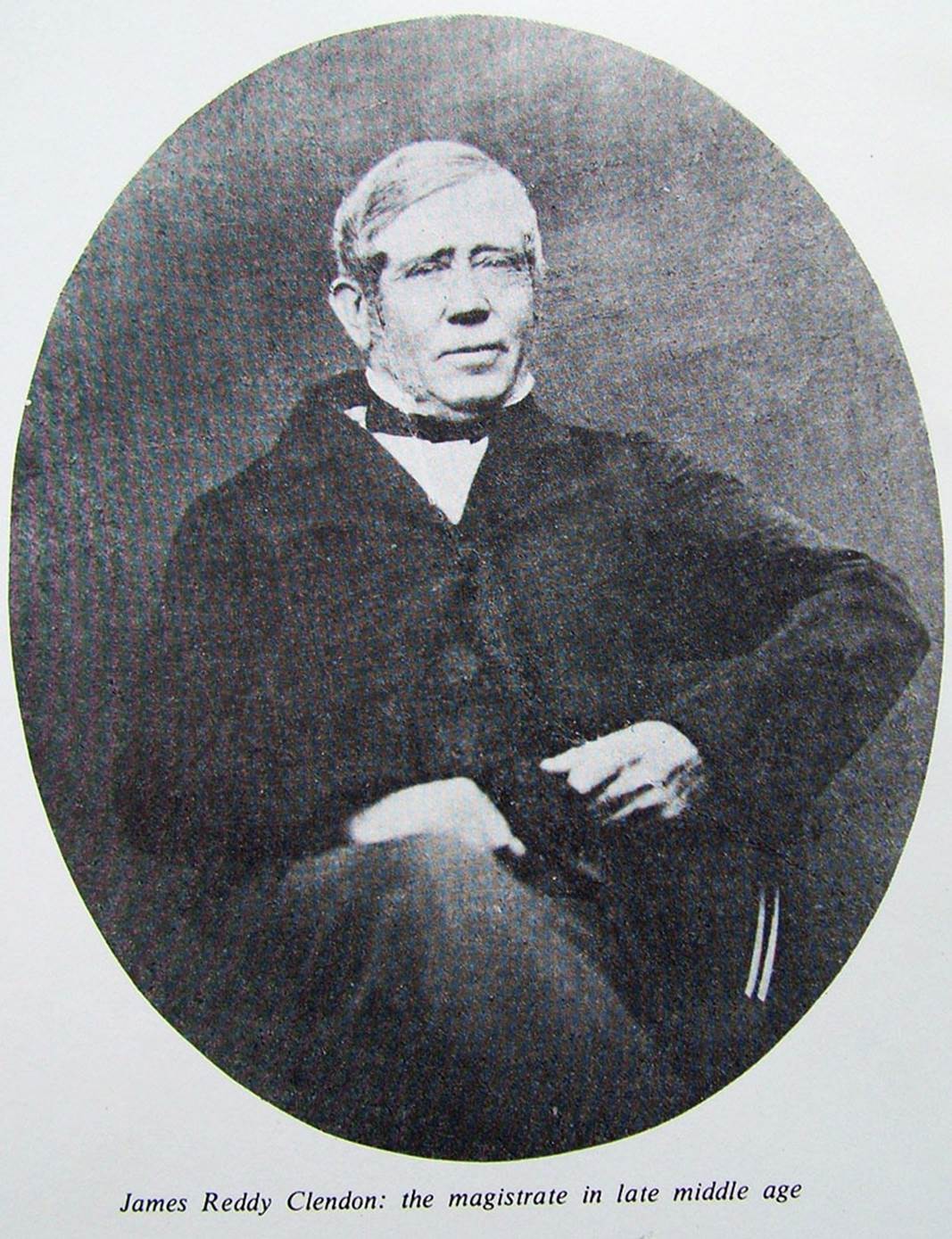
The records of Surveyor-General, Felton Mathew would suggest that James Reddy Clendon was issued the Final English Draft of the Treaty of Waitangi, on or about the 13th of March 1840. Unfortunately, Clendon never returned the document to the New Zealand Colonial Secretary, Willoughby Shortland, but retained it for many years until lodging it with his solicitor, Henry Littlewood.
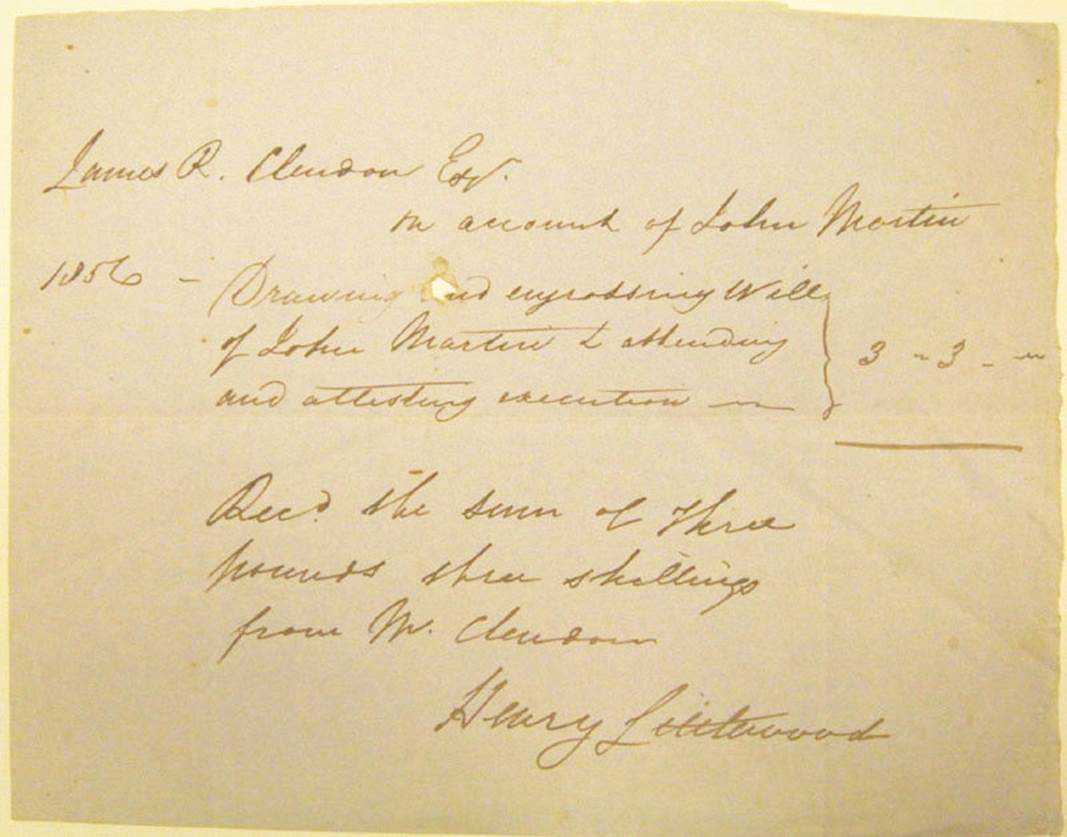
A receipt issued in 1856 by solicitor Henry Littlewood, John & Beryl Littlewood’s great-grandfather, to James Reddy Clendon, for conveyancing work related to the will of John Martin. In 1839 through to 1841 Clendon, in residence at the Bay of Islands, had been appointed by the United States Government to act as their Consul. He was to report on the comings & goings of US whaling ships, as well as any significant events, such as annexation of New Zealand by the British Crown as a colony.
We now know from historical documents that Clendon had been loaned the English language Final Draft original by Lieutenant Governor William Hobson, upon Clendon’s official request to the Colonial Secretary. It had been forwarded to Clendon in his official capacity as U.S. Consul.
Clendon even issued a receipt on the 25th of March 1840, stating he had received the Treaty-related documents requested, supplied in both the Maori and English languages, which he needed to forward to John Forsyth, US Secretary of State in Washington DC.
The handwritten, Maori language copy, issued by the official translator, Reverend Henry Williams, is still found within the Clendon House papers, Auckland Public Library Special Collections. Clendon's transcribed copy in English is in the US National Archives, Washington DC and can be seen on microfilm (See: Auckland Institute and Museum Library: Micro # 51. Despatches from the U.S. Consul to the Bay of Islands and Auckland, 1839-1906: Roll 1, May 27, 1839 - Nov. 30, 1846, also available at the University of Auckland Library).
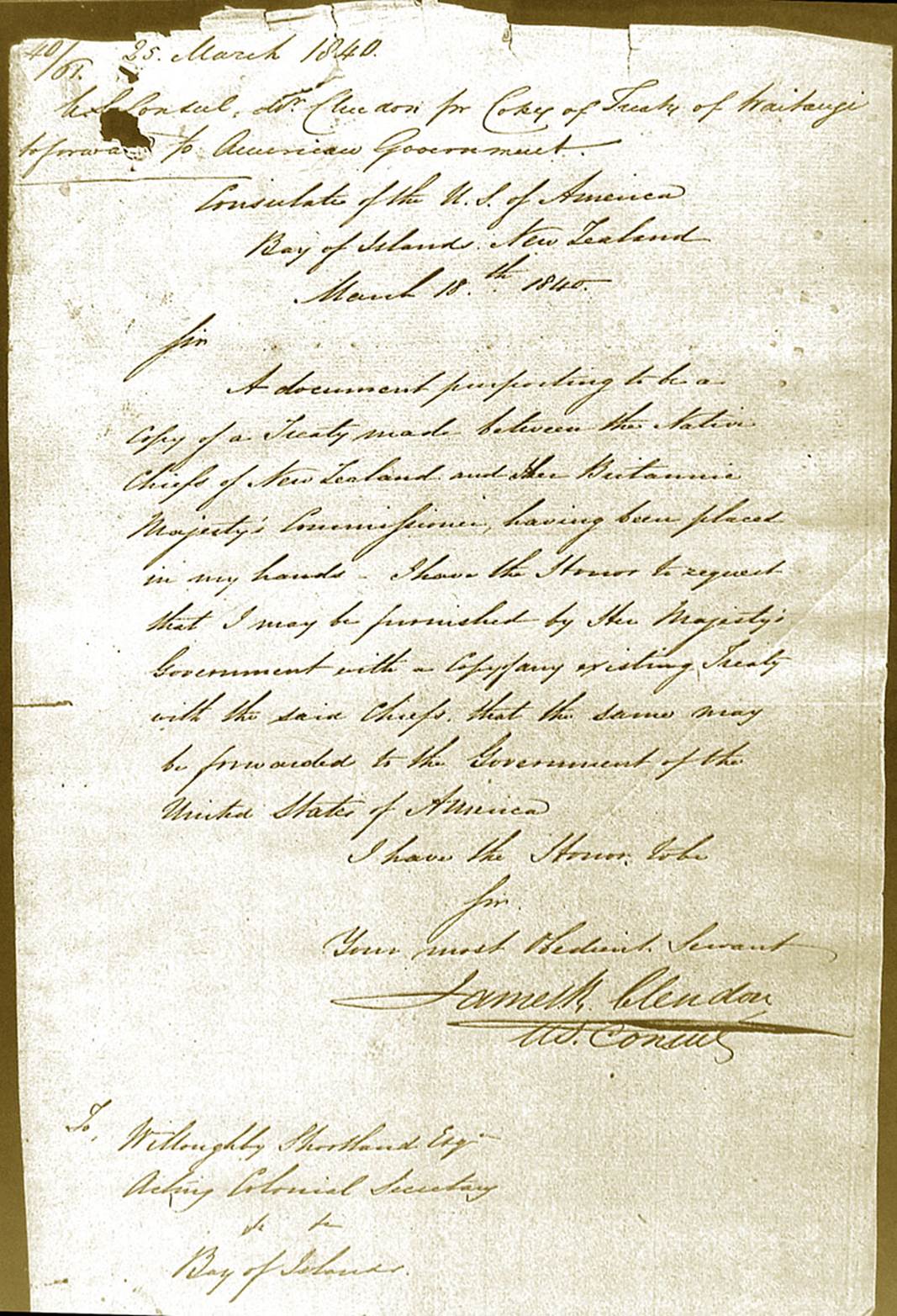
Because the Maori chiefs at The Bay of Islands had decided to cede sovereignty to Queen Victoria and form a British colony, US Consul Clendon was obliged to inform his superiors in Washington DC and needed the Treaty-related documents. These were supplied in both the Maori and English languages under an official consular request made by Clendon to the newly formed New Zealand colonial government.
In the above receipt to the NZ Colonial Secretary he acknowledges receiving the items requested, which included the Final Draft English text. The same two language texts were supplied by Clendon to US Antarctic explorer, Commodore Charles Wilkes and recorded as despatched materials in the USS Vincennes letter book, as well as being sent to the USA, again, in Wilkes’ Despatch 64 enclosure to his superiors.
Compelling paper-trail evidence would lend credence to the fact that the document, which in recent years has been dubbed the "Littlewood Treaty" by our historians, was the same English language treaty document supplied to James Reddy Clendon by the Hobson government, in fulfilment of an official consular request, on or about the 13th of March 1840.
We know that Surveyor General, Felton Mathew, in company with James Stuart Freeman, Hobson's private secretary, visited Clendon on the 11th of March 1840, five days after H.M.S Herald arrived back at the bay with a paralysed Hobson on board. Something, quite apart from discussions about purchase of Clendon's Okiato estate by the government, compelled Felton Mathew to return to Clendon on the 13th of March 1840, with whom he had "some business" to conduct.
In this instance he doesn't appear to have done any further exploratory work on the property, as he and Freeman had done two days before, but left there to go and visit the American Schooner, Flying Fish to "chat" with the Captain and Lieutenant, returning to the Colonial Secretary's cottage at Kororareka at dusk.
It's significant that Clendon had officially requested complete treaty documentation from the Colonial Secretary, Willoughby Shortland, who had remained at the Bay while other members of Hobson's staff (and including Reverend Henry Williams) had been away to the Thames between February 21st and March 6th 1840 aboard H.M.S. Herald.
When H.M.S. Herald left for Australia on the 12th of March, both Felton Mathew and James Stuart Freeman moved in to live with Shortland at the two-room cottage at Kororareka, It's plausible to assume that in the interim day since Mathew's last visit to Clendon, Shortland had taken out of records the final English draft that Hobson had read at Waitangi and carried with him to the other venues, including to the Thames (Hauraki Gulf, Auckland Isthmus). This "final English draft" was to be given to United States Consul, James Reddy Clendon in response to his formal consular request to the New Zealand Government.
Alternatively, Reverend Henry Williams would, most assuredly, have attended with the others to wish the Herald "bon voyage" to HMS Herald on the 12th and Williams could well have made Clendon's requested "official Maori" copy available on that day for delivery by Felton Mathew to Clendon on the morrow.
Although the "official" or "final draft English text" would, ultimately, be sent in Wilkes' despatch No. 64 a little over two weeks later, it makes sense to assume that Clendon, at that moment, intended to send it with the US vessell, The Flying Fish, one of the ships of Captain Wilkes' scattered and battered squadron, fresh from exploring the "icy land" of Antarctica. It was in the bay at the time undergoing repairs.
At that time, Clendon had no idea that Wilkes', aboard the U.S.S. Vincennes, (squadron flagship), would sail into the bay on the 29th of the month to find his lost ships.
Felton Mathew had also been obliged to go to see Reverend Henry Williams at Paihia on the 10th of March 1840, 'for the purpose of transacting a little business', after which he returned to the Herald in the dark. Felton Mathew appears to have acted as a primary messenger during this chaotic time for the government, with Hobson paralysed, and Shortland having had a "falling out" with Cooper.
The main point is:
There is clearly recorded interaction between Felton Mathew, Reverend Henry Williams, James Stuart Freeman, Willoughby Shortland and James Reddy Clendon during the second week of March 1840, when James Reddy Clendon had his consular request to the government fulfilled and satisfied.
In his despatch No. 6, sent on the 20th of February 1840, U.S. Consul Clendon had promised the U.S. Secretary of State, John Forsyth, that:
'when Captain Hobson returns from the Southward', Clendon would 'apply officially' for the correct English and Maori texts of the treaty to be supplied 'for the purpose of sending it to the Government of the United States'.
We know that Clendon received what he had officially requested before the 18th of March 1840. Circumstantial evidence would suggest that on the 13th of March 1840, Felton Mathew, a senior member of Hobson's staff, gave Clendon both the "final English draft" (the Littlewood Treaty) and a "True Copy" of the Maori Treaty, hand-written by Reverend Henry Williams, the British colonial government's designated translator.
This pristine Maori language document is officially signed off by James Stuart Freeman, in behalf of the government and still survives amidst the Clendon House Papers at Special Collections, Auckland Public Library.
On the 4th of February 1840, James Busby was acting as secretary in composing the Final English language draft of the treaty. He said this himself in July 1861 (See: Appendix to Journals, E, no. 2, pg. 67).
The only plausible conclusion is that the final English draft (the Littlewood Treaty), dated the 4th of February 1840 was given to Clendon on or about the 13th of March by Felton Mathew to complete the "requested" set of both official Maori and English texts (See: The Unpublished Letters of Felton Mathew to Sarah Mathew, Special Collections, Auckland Public Library).
Here is the Final English Draft text penned by Busby, which was sent to Clendon by Hobson's government. It is seen sitting alongside its transcribed copy, penned by Commodore Charles Wilkes on April 3rd, 1840:
BUSBY’S FINAL DRAFT …4th of February 1840 Her Majesty Victoria, Queen of England in Her gracious consideration for the chiefs and people of New Zealand, and her desire to preserve to them their land and to maintain peace and order amongst them, has been pleased to appoint an officer to treat with them for the cession of the Sovreignty of their country and of the islands adjacent to the Queen. Seeing that many of Her Majesty’s subjects have already settled in the country and are constantly arriving; And that it is desirable for their protection as well as the protection of the natives to establish a government amongst them. |
WILKES’ DESPATCH 64 TREATY ... 3rd of April 1840. |
It can be readily seen that Busby's final English draft of the 4th of February 1840 was available to Commodore Charles Wilkes when he transcribed the text on the 3rd of April 1840 at James Reddy Clendon's premises. Although the transcript shows the Commodore has been a bit inattentive or hurried and left out "of the Sovreignty" in the Preamble, or has abbreviated some words, the text is the same. Wilkes has even copied Busby's spelling mistake for "Sovreignty" on two occasions, leaving out the tell-tale "e". Wilkes has also copied Busby's mistake where he wrote chiefs then crossed it out and inserted Queen. (See Papers of Charles Wilkes 1837-1847, despatch Number 64, Microfilm 1262, University of Auckland Library pp. 142-145 & 163-168).
James Reddy Clendon had also sent Busby’s Final English Draft text to John Forsyth, US Secretary of State, on the 20th of February 1840. He had a transcribed copy in his own handwriting from the 4th of February 1840 at his Okiato, Bay of Islands mansion, where the Final English Draft was completed under the direction of Captain William Hobson. Clendon was, however, unsure if it had undergone changes before, during or after the treaty assembly of the 5th of February.
Hobson had sailed southwards to attend a treaty assembly at Tamaki, Hauraki Gulf, Auckland Isthmus. Clendon awaited the return of (now) Lieutenant-Governor William Hobson to verify that the official English text remained the same as what he had himself transcribed on the 4th of February at his home and on his personal W Tucker 1833 watermarked paper stock. Clendon would have been cognisant of the possibility that translator, Reverend Henry Williams, might have wanted some English text changed in order to render a more precise translation. He also knew that a disruptive outburst by Catholic Bishop Pompallier, at the treaty assembly, calling for guarantees of religious freedom, might have led to an additional Article being added to the existing 3 Articles.
In the interim he sent the English text he had personally transcribed to John Forsyth in Despatch no 6 on the 20th of February 1840, and, upon Hobson’s return, was able to verify the original Final English Draft wording had not changed.
BUSBY’S FINAL DRAFT …4th of February 1840 |
CLENDON’S DESPATCH... 20th of February 1840 |
It can be seen that the English language treaty text Clendon sent to John Forsyth, US Secretary of State in Washington DC, is exactly the same, word-for-word, as the text found by the Littlewood family in 1989. Clendon has been astute in not misspelling the words sovereignty or ceded, has eliminated the crossed-out word chiefs and has added capitalisation where he deemed it appropriate, otherwise the two renditions duplicate each other perfectly.
It is absolutely proven beyond doubt that the exact piece of paper, bearing a Treaty of Waitangi text in English found by the Littlewood family in 1989, was in the hands of Lieutenant-Governor William Hobson, James Reddy Clendon and Commodore Charles Wilkes, respectively, in February, March & April 1840 and transcribed copies of that text still languish in the National Archives of the United States of America.
After over two years of trying to ascertain the significance of the 1989 find, John Littlewood contacted treaty historian, Claudia Orange, who came to his home to see the document. Her first reaction was to state that this ‘could be the lost final draft that went missing in February 1840’. She later convinced the Littlewoods that it should be lodged, with some urgency, into the care & keeping of the New Zealand National Archives, Wellington.
This was done in September 1992, but news of the find was supposed to be withheld from the public. However, a “whistle-blower” in archives alerted the newspapers, much to the chagrin and “irritation” of Minister of Internal Affairs, Mr Lee.
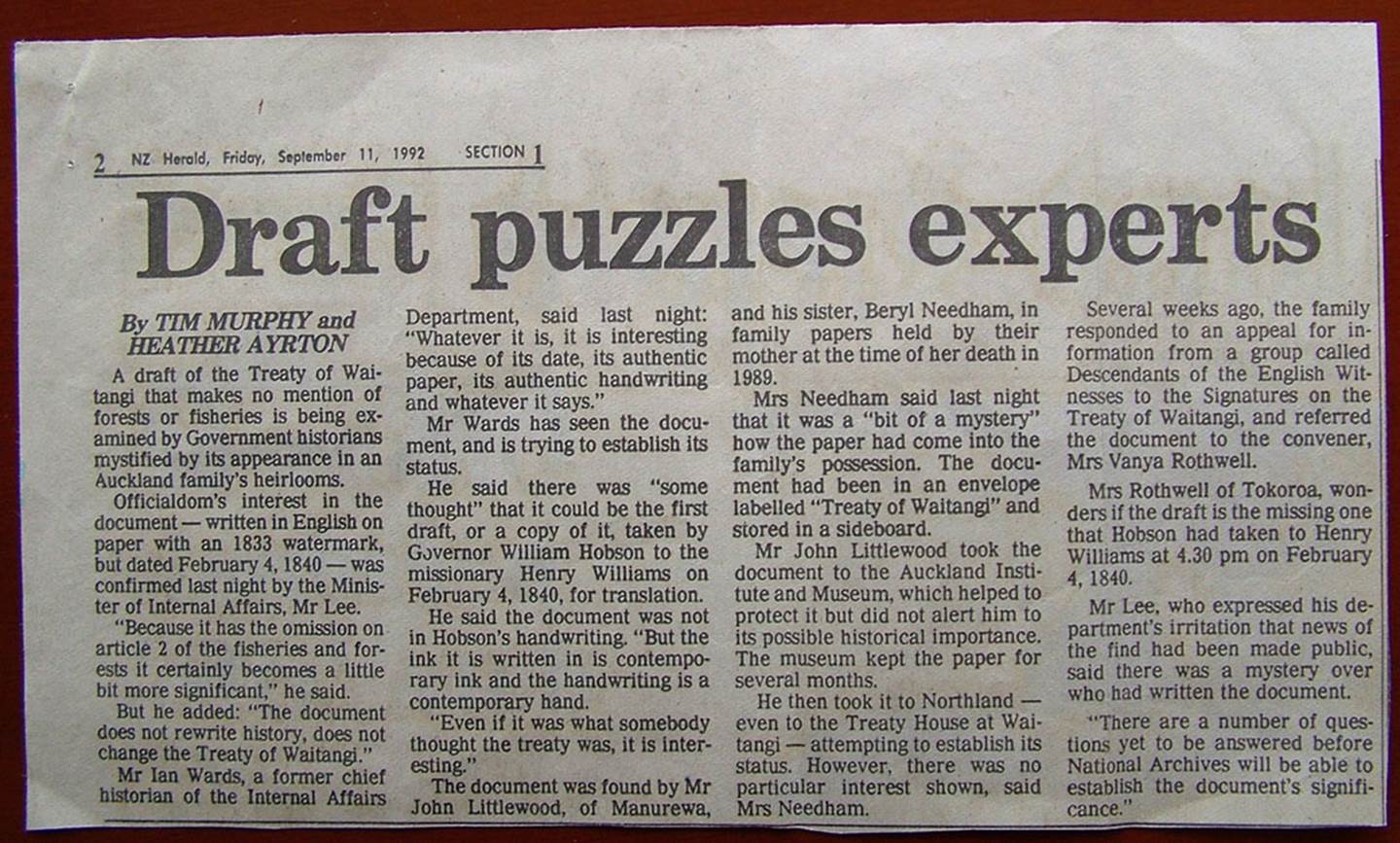
One of several newspaper articles about the Littlewood family’s document find, after a whistle-blower in archives leaked knowledge of the discovery to the media in 1992. Despite an initial burst of strong speculation that it was the "lost" final English draft, the media and our historians went very silent on the subject thereafter and promises to the public of a full forensic analysis were never honoured. This discovery constituted "a most unwelcome find" to the Maori grievance-industry and had to be buried at all cost.
Here are yet other newspaper articles mentioning the newly found, English language treaty document:
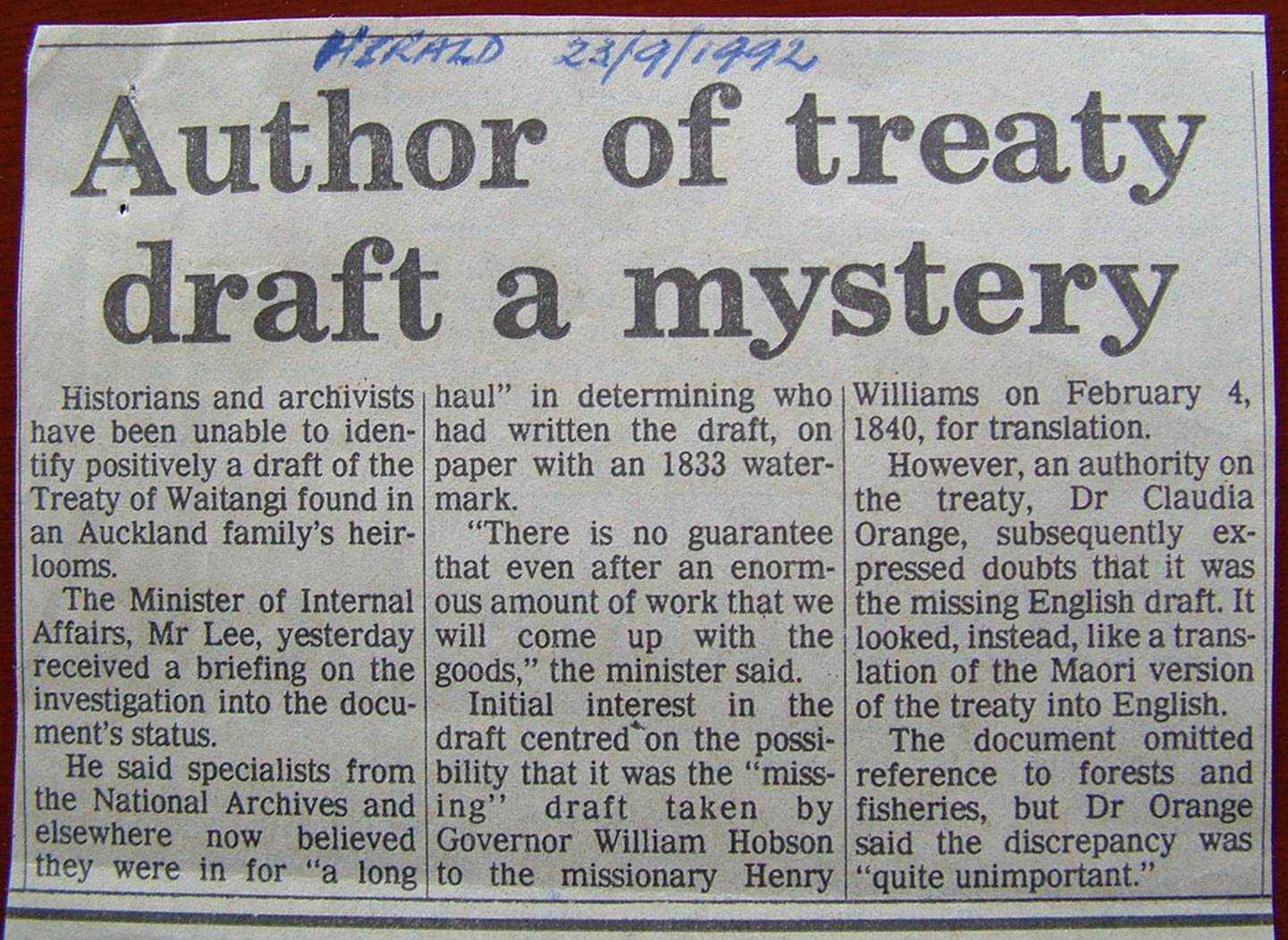
In this article, the “leaked” treaty document, that was never intended to be seen by the general public, is being down-played as to its importance or provenance. Whereas, identifying the person who hand-wrote it was extremely easy, that all-important information did not leak into the public arena for another 11-years.
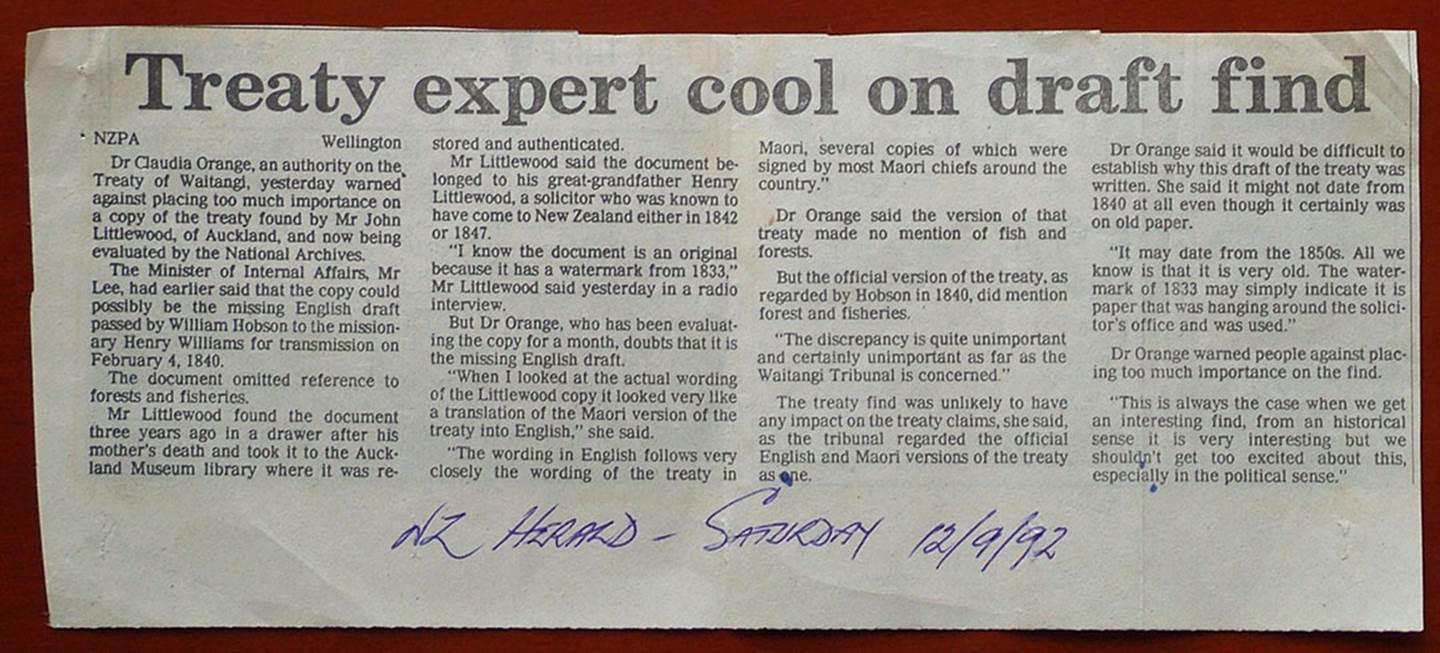
By this time in late 1992, the meaning of the Treaty of Waitangi had been subjected to more than a decade of radical reinterpretation to make it support the political agenda of Maori supremacists, Marxist agendas and justification for multi-national corporation resource-plundering of New Zealand. This discovery of what would be, many years later, proven forensically to be the true Final English Draft had to be down-played and social-engineer historians were brought in to dissuade the public from learning the real significance of the document find.
In October 2003 I commenced in-depth research into the provenance of this suppressed and effectively all-but-forgotten document, spanning two years of investigation. During the period I had multiple interviews with the Littlewood family discoverers and spent considerable time seeking out many rare documents housed at multiple archives, libraries, within private collections or on microfilm, locatable at resource centres around New Zealand, Australia, Great Britain and the United States.
The outcome of this exercise was that I was able to prove, conclusively, that the Littlewood-discovered document was, beyond any doubt, the much sought-after Final English Draft and mother document of the Treaty of Waitangi, from which the Maori language Tiriti o Waitangi was translated.
As a consequence of this fact, the recent-era treaty revisionism, or reinvention of the Treaty of Waitangi since 1975, was proven to be founded upon transparent fraud, as well as unscholarly make-believe and wishful-thinking. The very socially destructive ruse of deliberate misinterpretations of the treaty was pushed and promoted by self-serving Maori activists and their cohorts for monetary or political gain, etc. It had no basis in true history, as attested to by the paper-trail of historical documents.
The newly available information was compiled into a book, titled, The Littlewood Treaty - The True English Text of the Treaty of Waitangi Found, 2005, ISBN 0-437-10140-8. The book, complete with rare documents, is available online at:
http://www.celticnz.org/TreatyBook/Precis.htm
The emergence of this fully documented history into the public arena was very threatening to the lucrative grievance-industry and sent ripples of panic throughout their ranks, resulting in the implementation of damage-control incentives, comprised of re-education or indoctrination programmes like the very expensive Treaty-2-U traveling propaganda roadshow unleashed upon our "bussed-in" schoolchildren during 2006 - 2007.
http://www.treatyofwaitangi.net.nz/Treaty2UPart1.htm
In the aftermath, a gaggle of social-historians, ushered in to do damage-control, were given the impossible task of debunking the new, documented information and were assigned the dubious role to be the great "Defenders of the Faith".
THE ONGOING MEDIA CLAMPDOWN & CENSORSHIP IN SAYING OR WRITING THE TITLE “LITTLEWOOD TREATY’.
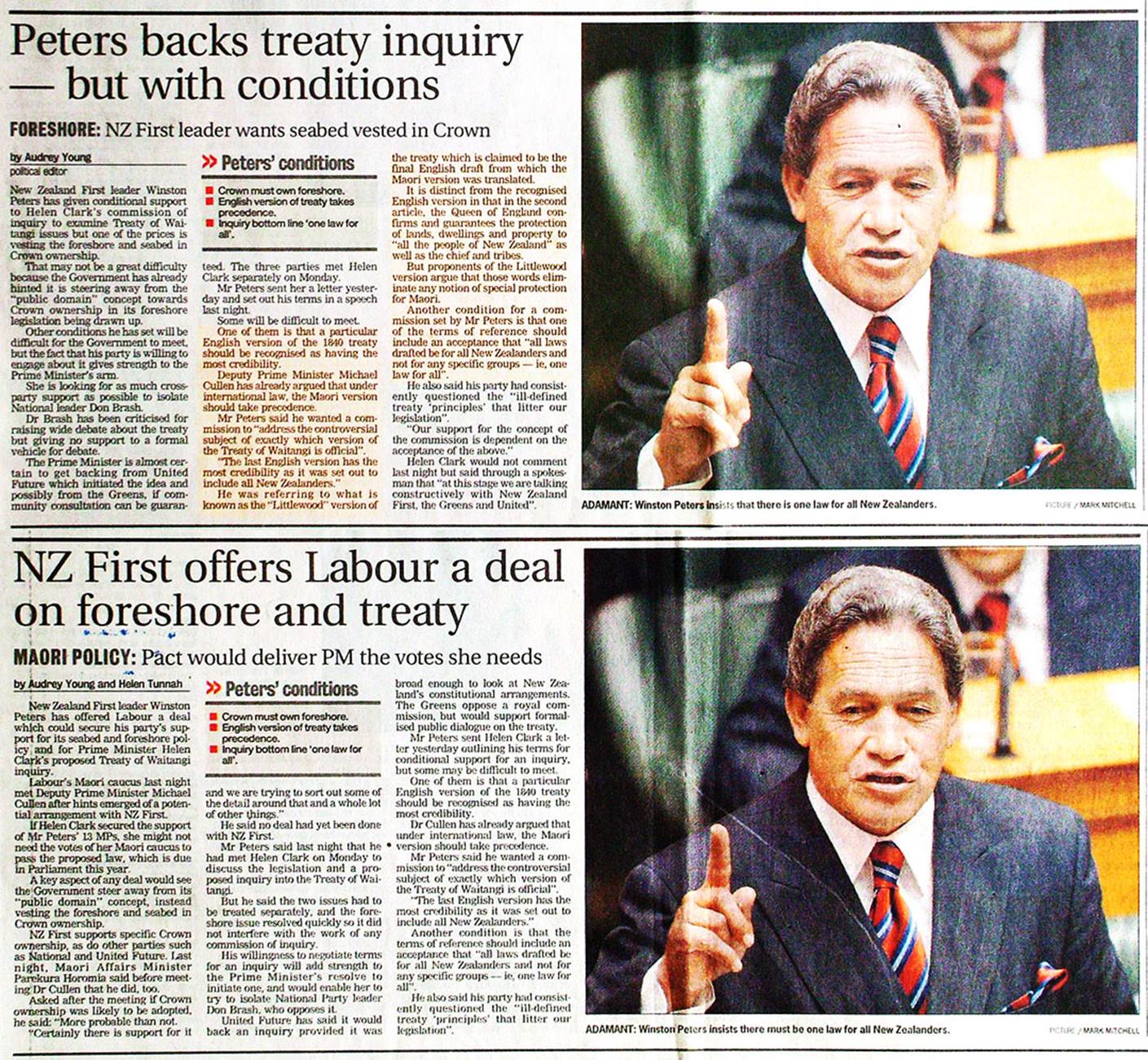
After knowledge of the existence of the Littlewood Treaty document emerged back into public focus in the December 2003 - January 2004 issue of Investigate Magazine, Ian Wishart, editor and talk show host, stated on air that his media colleagues had told him there was a general media ban on saying the words, “Littlewood Treaty”.
Despite this, on the 18th of March 2004 one journalist, Audrey Young, quoted directly from a speech by the Hon. Winston Peters and qualified his statements to show he was talking about the “Littlewood Treaty”. This text went out in an early Herald edition to the Bay of Plenty. The offending “Littlewood Treaty” text was, it seems, discovered by censors and quickly eliminated before the next printed edition.
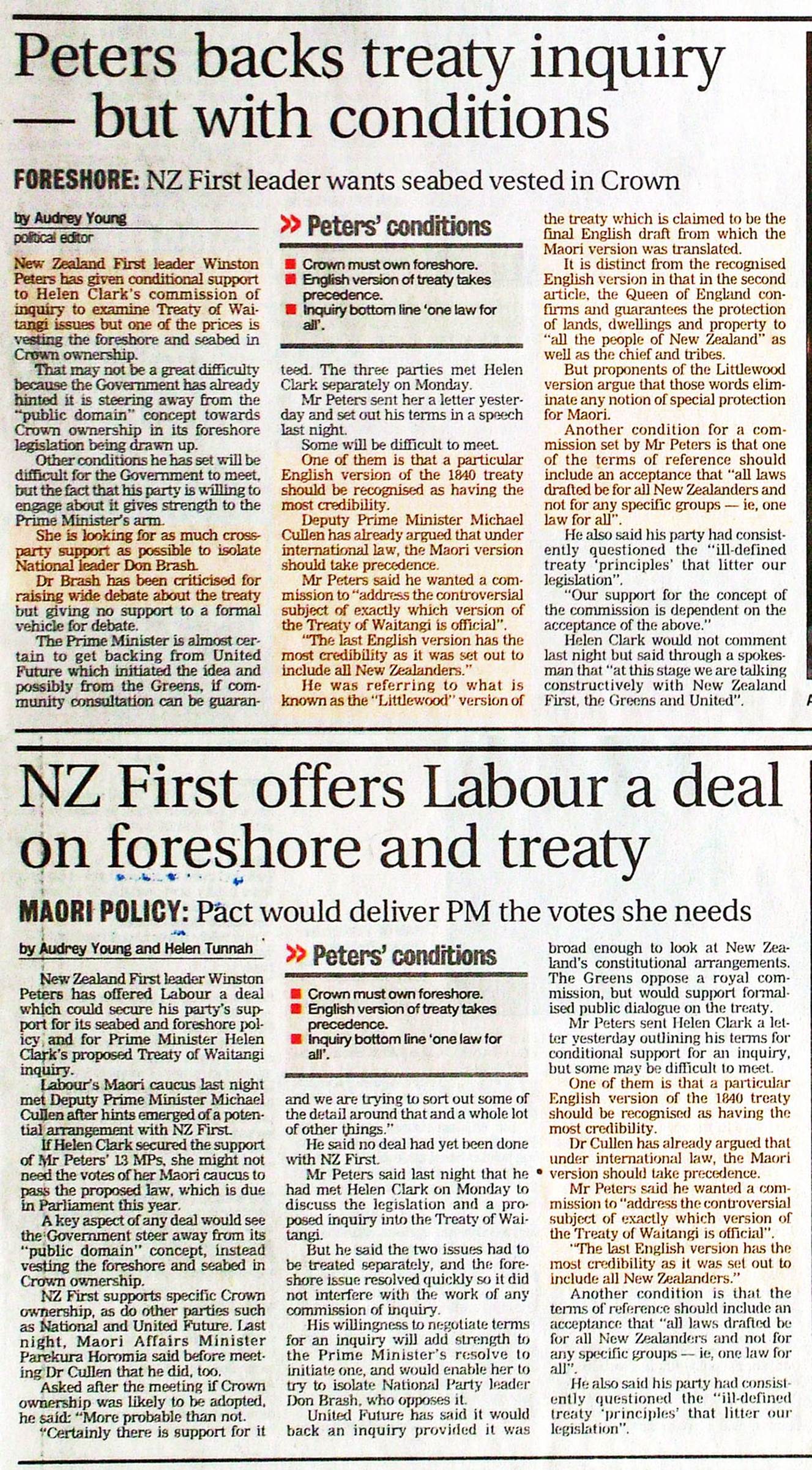
The two articles (early and later editions) remained exactly the same physical size and general layout, except for the later edition’s exclusion of the 3 instances when the “Littlewood Treaty” was mentioned. Filler text was inserted in place of the earlier material, thus changing a dynamic article into something quite nondescript and reasonably sterile.
Most assuredly, the fact that Mr. Peters advocated using an altogether different English version of the treaty as the basis of our legislation, in place of the “official” English version, was immensely newsworthy. If the treaty interpretation we adhered to was, indeed, wrong it was the story of the century for New Zealanders.
Here are the two articles in larger print; one with the dynamic early edition text and the second edition, about an hour later, which had been hurriedly rewritten to strip out and censor any reference to the document found by the Littlewood family in 1989. It appears that journalist, Helen Tunnah, who co-wrote the highly revised second article, was acting in the capacity as an ideological officer doing damage control.
DIRTY TRICK NUMBER 2 … PSEUDO-HISTORIANS TRYING TO CAUSE CONFUSION BY CLAIMING THERE ARE MANY “VERSIONS” OF THE TREATY OF WAITANGI.
Our in-the-pocket, sold-out, main-stream historians, like Claudia Orange, attempted to “muddy the waters” in claiming that there are so many differing “versions” of the Treaty of Waitangi that we can never truly pin down what the true meaning and intent of the original text actually is.
This is a blatant lie, as it was a well-known fact that there’s only one Treaty of Waitangi and it’s in the Maori language. This fact is fully corroborated by long-standing international law, wherein a “treaty” has to be in the native language of the people with whom a treaty is being sought and secured.
THE PRE-EMINENT STATUS OF THE MAORI TEXT OF "TE TIRITI O WAITANGI"
There is only one Treaty of Waitangi.
Lieutenant Governor William Hobson recognised that there is only one legal Treaty of Waitangi text, and it is in the Maori language.
This singular recognition was affirmed by Hobson in his letter of instructions to Major Bunbury, wherein he wrote:
'The treaty, which forms the base of all my proceedings was signed at Waitangi, on the 6th February 1840, by 52 chiefs, 26 of whom were of the Confederation, and formed a majority of those who signed the Declaration of Independence. 'This instrument I consider to be de facto the treaty, and all signatures that are subsequently obtained are merely testimonials of adherence to the terms of the original document' (see: The Treaty of Waitangi, by T.L. Buick, pg. 162).
On the 17th of February 1840 the C.M.S. Mission press produced 200 printed copies of the Maori language treaty, as a paid consignment ordered by Hobson.
There was no production of an "official" English treaty text, as there wasn't one.
Subsequently, ALL of the large, handwritten copies of the Treaty of Waitangi, commissioned and produced by the government, then officially sent to the treaty signing assemblies around New Zealand, were in the Maori language and there were no departures from this strict practice*
*Appendix Note: Some will try to argue that the English language document that received signatures at Waikato Heads on 11/4/1840, as well as at Manukau on 26/4/1840 is an exception, but this is not the case. The only document ever officially issued by the government and intended to be used at Manukau and Waikato Heads now goes by the title of the Kawhia Treaty, which was in the Maori language. Because it did not arrive in time for his meeting, Reverend Robert Maunsell innovated and used a "printed Maori" text for presentation to the assembled chiefs and their tribes-people and allowed overflow signatures to spill onto a ruined Formal Royal Style English copy, produced solely for overseas despatch, which had come into his possession. Later, the Maori text sheet (with 5 signatures) was affixed atop the English sheet and the two unauthorised pieces of paper sent to Hobson as one, with the Maori language sheet representing the text presented and the large, scrap, English sheet merely a repository for overflow signatures.
The above-mentioned departure from the norm will be explained in detail as we proceed.
Treaty Consultant, Brian Easton, noted:
'For further evidence of the low status of the various English versions after the signing of the Tiriti, consider the numerous translations made in the 1840s by those involved in land deals around Auckland.... If everyone was translating the Tiriti, then they are implying the official version in English was non-existent, unimportant, or irrelevant.
‘In the 1840s the general view among settlers seems to have been there was no Treaty of Waitangi, but there was Te Tiriti o Waitangi which had to be translated into English....Ross reports on five versions which Hobson forwarded to his superiors in Sydney and London. There are differences between them’.
The main difference is that three have the Hobson-Busby preamble, two the Freeman one. One omits 'forests, fisheries'. A sixth version attributable to Hobson is in Clendon's letter to the Secretary of State on 7 July, where the preamble is again Freeman's (but 'forests, fisheries' are included)’.
What are we to make of all this? Surely it is that there was no English text of the Tiriti at the time of signing, or shortly after, that Hobson cobbled together what they could after recognizing the lack' (‘Was There a Treaty of Waitangi, and was it a Social Contract?’ Archifacts by Brian Easton, April 1997, p. 21-49).
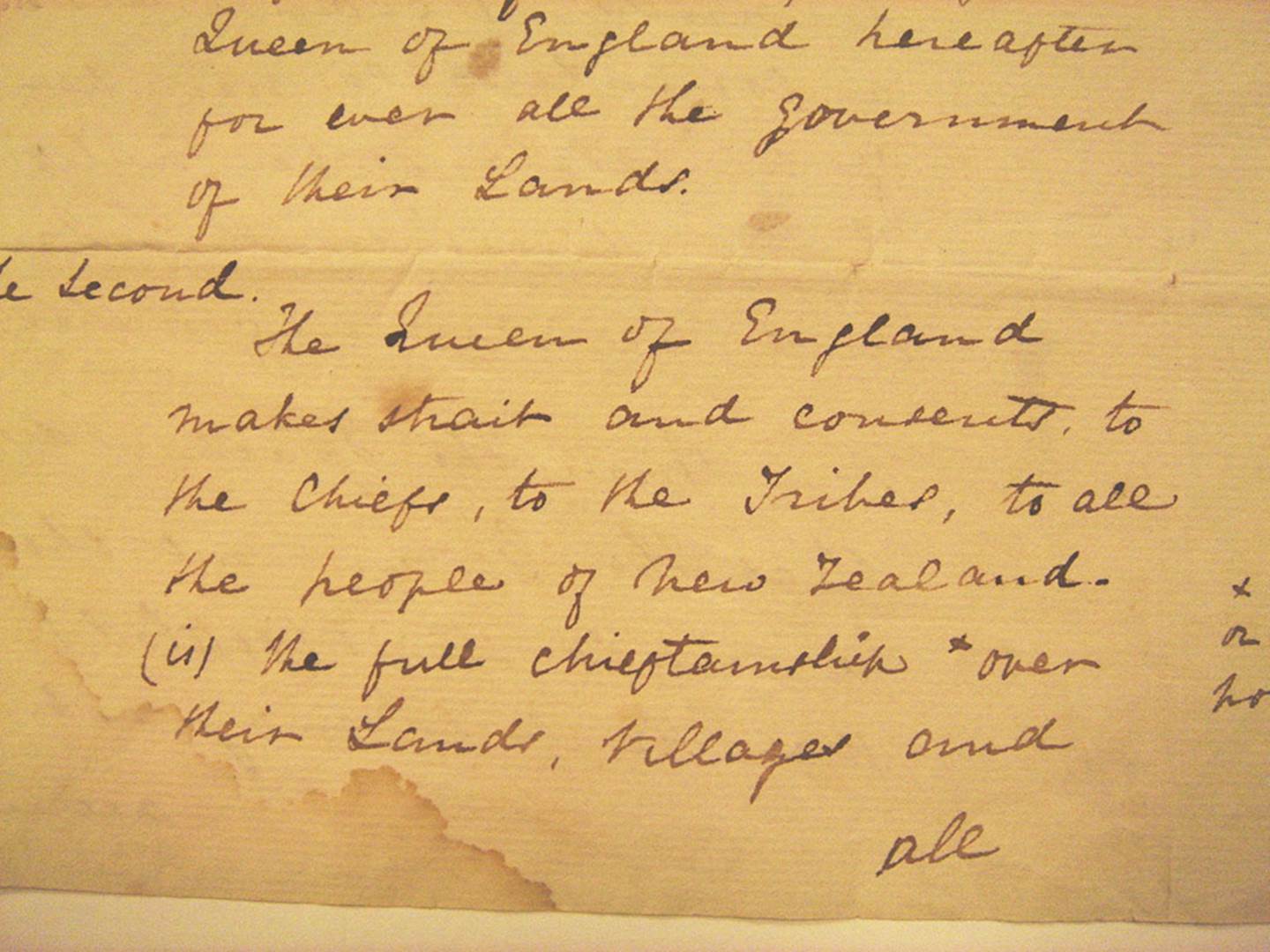
This is a back-translation of the Maori language Tiriti o Waitangi from the 1840s, found in the Clendon House Papers. The very innocent and benign Article II of the treaty, seen in back-translated form as in this example, has been so distorted in its new, modern interpretation, as to be a radical departure from the original intent.
THE MAORI TIRITI O WAITANGI GUARANTEES EQUAL RIGHTS FOR ALL NEW ZEALANDERS.
Article II states:
Ko te Kuini o Ingarani ka wakarite kA wakaae ki nga Rangatira ki nga hapu-ki nga tangata katoa o Nu Tirani - The Queen of England confirms and guarantees to the chiefs and the [families] tribes and to all the people of New Zealand -te tino rangatiratanga o ratou wenua o ratou kainga me o ratou taonga katoa. -the possession of their lands, dwellings and all their property.
In keeping with this unifying theme, as Lieutenant-Governor William Hobson shook hands with each signatory chief at Waitangi on the 6th of February 1840 he said, 'He iwi tahi tatou' -'We are now one people'.
Even the obsolete early "rough draft" notes, written before the "final draft", affirm that Hobson's sole intent from the outset was to establish an all-encompassing, egalitarian society, wherein everyone was subject to the same laws & privileges, with no special rights set aside for any one group over another. In Hobson's handwriting we find:
‘Her Majesty therefore being desirous to establish a settled form of civil Government with the view to avert the evil consequences which must result alike to the native Population and to Her Subjects from the absence of necessary Laws and Institutions alike to the Native Population and to Her subjects…Has been graciously pleased to appoint and authorize me William Hobson…’ (see Facsimiles Of The Treaty Of Waitangi, with Lithographic originals first printed in 1877, Reproduced by A.R. Shearer, Government Printer, 1976).
The categories of English Treaty texts:
- Drafts: There are sixteen pages of rough notes preceding the Maori translation, produced over several days, conceivably from about the 30th of January and dated in Busby's notation to have terminated on the 3rd of February 1840. These developed from very raw preamble concepts and were gradually refined until the drafters were ready to produce the final English draft text on the 4th of February 1840.
In the National Archives at Wellington, twelve pages of these early rough notes were, until recently, on display in the Constitution Room . A further four pages, representing Busby's first composition attempt, are in the collection of the Auckland Institute and Museum. None of these sixteen pages, singularly or in unison, can qualify as a completed final draft, sufficient for the legislators to hand over for translation into the Maori language.
- Final Draft: There is only one known document that qualifies, in every respect, as the final draft. It bears the date of the 4th of February 1840, the same day that Reverend Henry Williams was handed the final draft by Hobson for translation, overnight, into the Maori language. The document is written in ink upon W. Tucker 1833 watermarked paper. It is, as historically required, positively in the handwriting of British Resident, James Busby. It translates perfectly to the Maori Te Tiriti O Waitangi, with only some minor added emphasis being directed more-so to the Maori people in, primarily, Article III.
This document was found amongst the papers of the Littlewood deceased estate of Pukekohe, South Auckland in March 1989.
Treaty historians are in general agreement that the final English draft went missing sometime in February 1840:
(A) Dr. Loveridge in his report states: Ms. Ross noted that the English text used by Henry Williams as the starting-point for the creation of the Maori text “Unfortunately ... does not appear to have survived”, and Dr. Orange could only agree that no trace of “the final English draft” could be found (See: The Treaty of Waitangi, 1987 pp. 36-37).
(See also: Ruth M. Ross, Te Tiriti o Waitangi: Texts and Translations, New Zealand Journal of History 6#2, Oct. 1972, pp. 129-157, particularly pp. 132-136).
(B) Dr. Claudia Orange also wrote on her website:
‘The original draft in English, on which Henry Williams based this Maori translation, has not been found. His original translation, presented to the Waitangi meeting of 5 February, has also disappeared’.
- Back-translations: There were a large number of English versions produced after the 6th of February 1840, by back-translating the Maori text. As Easton observes, this indicates a total lack of a treaty text considered "official" in the English language.
In 1869, due to the loss of the final English draft in February 1840, the New Zealand Government officially requested that a back-translation of the Maori text be formally supplied. It was produced, under this official request, by Mr. T.E. Young of the Native Department. In lieu of the final English draft, this text has always been a perfectly adequate substitute, as it reads and can be interpreted exactly the same as the Final English Draft found by the Littlewood family in 1989.
- Formal Royal-Style copies: In keeping with formalities contemporary to the 1840's, memorial documents, destined to be laid beneath the gaze of royalty, the House of Lords or Parliament, etc., were often embellished in beautiful or flowery language.
Hobson's secretary, James Stuart Freeman, who had been educated at prestigious Eton Public School and Oxford University, England, made up a series of variable, composite, Royal-Style treaty versions for despatch overseas, primarily to Governor Sir George Gipps in Australia or Lord Normanby of the Colonial Office in England. To create these several Formal Royal Style versions, Freeman consulted the rough draft notes, which still contained some very pretentious language, later superseded and discarded in the Final English draft.
This source of text is beyond dispute. We can identify the point of origin for each paragraph, found within the Royal Style variations, amidst the twelve pages of rough draft notes presently held by Archives New Zealand. Historian Ruth Ross, therefore, correctly defined this category of treaty versions for despatch as "composite" versions.
No additional text created after the 3rd of February 1840, other than some linking words added in by Freeman to bind concepts together, can be found in these seven known Formal Royal Style composites. These are a special category, the function of which is similar to poetry. Each one of these versions created by Freeman for overseas despatch was different in wording to a larger or lesser degree.
- The term Formal Royal Style* treaty was, to my knowledge, first coined by Dr. Phil Parkinson who stated:
‘... the formal Royal Style (quite properly employed by Freeman, and not an eccentric case of ‘pride’ as you seem to assert) and sent to Gipps in the despatches of the 5th and 6th February and sent on the 8th February in the Samuel Winter before being forwarded to Normanby on the 19th, now at PRO CO 209/7, 13-15. (Letter to Martin Doutré, 1st November 2004).
- *Appendix Note: A fairly good and easily accessible example of this traditional English preoccupation with highfalutin salutation in memorial documents destined for royalty, aristocracy or high positions and posts within the realm, can be found in the introduction to the King James version of the Bible, wherein it reads, in part:
To the Most High and Mighty Prince James,
by the Grace of God,
King of Great Britain, France, and Ireland,
Defender of the Faith, &c.
The Translators of the Bible wish Grace, Mercy, and Peace,
through Jesus Christ our Lord.
Great and manifold were the blessings, most dread Sovereign, which Almighty God, the Father of all mercies, bestowed upon us the people of England, when first he sent Your Majesty’s Royal Person to rule and reign over us. For whereas it was the expectation of many, who wished not well unto our Sion, that, upon the setting of that bright Occidental Star, Queen Elizabeth, of most happy memory, some thick and palpable clouds of darkness would so have overshadowed this land, that men should have been in doubt which way they were to walk, and that it should hardly be known who was to direct the unsettled State; the appearance of Your Majesty, as of the Sun in his strength, instantly dispelled those supposed and surmised mists, and gave unto all that were well affected exceeding cause of comfort; especially when we beheld the Government established in Your Highness and Your hopeful Seed, by an undoubted Title; and this also accompanied with peace and tranquillity at home and abroad....etc., etc.
ENTER HISTORIAN RUTH ROSS (1920 - 1982).
The Labour political Party of New Zealand had narrowly lost the election in 1969 but were able to gain power in the election of 25th of November 1972. Two prominent long-standing members of the Labour Party were Norman Kirk, who became Prime Minister and Matiu Rata who became Minister of Maori Affairs.
Matiu Rata had introduced a New Zealand Day Bill to Parliament in 1971, but this was not passed. With his political party holding the reins of power in late 1972, however, he introduced the Bill again as a precursor to his far more extensive Waitangi Tribunal Act 1975, which was passed and had a huge, detrimental effect over New Zealand society for the next 40-years plus.
One of Matiu Rata’s ambitions was to bring an English language version of the Treaty of Waitangi into our legislation, to sit alongside the Maori language treaty and be co-equal to it … a seemingly very strange thing for a Maori parliamentarian to want.
For line-by-line accuracy of what the Maori language text said, he should have advocated bringing in the 1869 back translation of Te Tiriti o Waitangi *that had been officially asked for by the New Zealand Government and supplied by the Native Department. However, Matiu Rata was ultimately able to introduce one of the Formal Royal Style composite versions and have it accepted as the Official English text of the Treaty of Waitangi.
*Note: The 1869, NZ Government commissioned, official back-translation mirrors the meaning and intent of Te Tiriti o Waitangi perfectly and in lieu of the actual (lost) Final English Draft, was the only legitimate English language text to place into legislation.
In an atmosphere of submissions to the government from the New Zealand Maori Council, calling for greater observance and honouring of the Treaty of Waitangi, etc., historian Ruth Ross wrote a scholarly article pointing out major discrepancies, contradictions and lost records in the treaty paper-trail from 1840. She, like so many others, had to conclude that, ‘Unfortunately the English text given to Williams does not appear to have survived’.
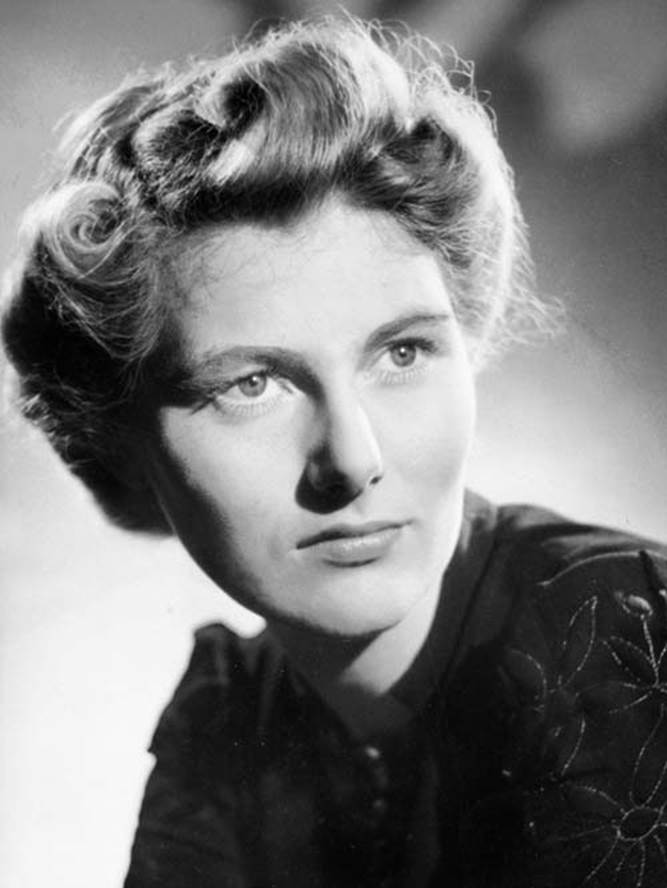
New Zealand historian, Ruth Ross, tried to make sense of the significance of the many Royal Style treaty composites and how or if they related to Te Tiriti o Waitangi Maori language text.
- Historian Ruth Ross makes comparisons between five of these "composite versions", then concludes:
‘A comparison of all five English versions with the Maori text makes it clear that the Maori text was not a translation of any one of these English versions, nor was any of the English versions a translation of the Maori text’ (See: Te Tiriti o Waitangi: Texts and Translations, New Zealand Journal of History, Oct. 1972).
- Despite this very obvious truth, our mainstream treaty historians would, in contradictory and deceptive fashion, have us believe that one of these Formal Royal Style versions was somehow used by Reverend Henry Williams to translate Te Tiriti O Waitangi. While leaving the public with this patently false impression, historians like Claudia Orange still, confusingly, admit in the same breath that the final draft of the 4th of February 1840 was "lost".
Anyone acquainted with the process of translation work would say with conviction that Reverend Henry Williams and his son, Edward Marsh Williams, did not use what is now considered to be the "official" English text for their translation of Te Tiriti O Waitangi.
There are far too many translatable words in the so-called "official" English text, for which Maori language equivalents existed. A whole raft of these words did not end up in the Maori text... words like Europe, United Kingdom, Ireland, Australia, Forests, Fisheries, favour, extension, etc.
At the same time, there were words like Pre-emption that were far too difficult to translate verbatim and, although extant within the so-called "official" English, are conspicuous by their absence in the Maori. Then there were several phrases that could have been accommodated, but weren't... like: "assembled in congress at Victoria in Waitangi" or "may be supposed to exercise or to possess" or "absolutely and without reservation" or "disposed to alienate", etc., which, certainly, don't appear anywhere in the Maori text in any recognisable form.
Moreover, the sentence structure and order in which concepts appear between the two texts is widely diverse and disjointed. As we now compare the so-called "official" English against the Maori Tiriti, we must deduce that the translator would have been in very serious breach of the confidence and trust placed in him by employers requiring a literal translation.
Quite obviously, as historian Ruth Ross correctly concluded, the Williams' father and son team worked from an altogether different final English draft than the nominated "official" English text introduced to sit alongside Te Tiriti o Waitangi in 1975. She had also definitively stated that there’s only one text of the Treaty of Waitangi and it’s in the Maori language. There is no English treaty, only the Final English Draft to act as the mother document to Te Tiriti o Waitangi.
If Ruth Ross had lived long enough to learn of the 1989 rediscovery of the Final English Draft, all would have become crystal clear to her.
The "true & actual" English text that the translators worked from had to be, without any question, worded the same or very near to the same, as the "Littlewood Treaty" document... One needs only to ask any experienced translator and they'll tell you the same thing... there's no way that the Williams' father and son team worked from a "Formal Royal Style" English composite and came up with Te Tiriti O Waitangi text. This is an absolute impossibility and an absurd hypothesis for so-called learned scholars to suggest.
DIRTY TRICK NUMBER 3 … MODERN MAINSTREAM HISTORIANS TRY TO CONVINCE THE PUBLIC THAT TE TIRITI O WAITANGI WAS TRANSLATED FROM AN ENGLISH FORMAL ROYAL STYLE VERSION.
Despite admitting in one breath that the Final English Draft, “Unfortunately ... does not appear to have survived” or “has not been found”, our mainstream treaty historians still, deceptively, tell the public that Reverend Henry Williams’ translation was derived directly from the obsolete, rough draft notes penned between the 31st of January and 3rd of February 1840, whereas we know that the Final English Draft was written on the 4th of February 1840.
Let’s look at the totality of the 16-pages of pre-treaty rough draft notes to see if there is anything in there that could qualify as a complete “Final English Draft”, sufficient to hand to Reverend Henry Williams and his son Edward Marsh Williams for translation into the Maori language Tiriti o Waitangi.
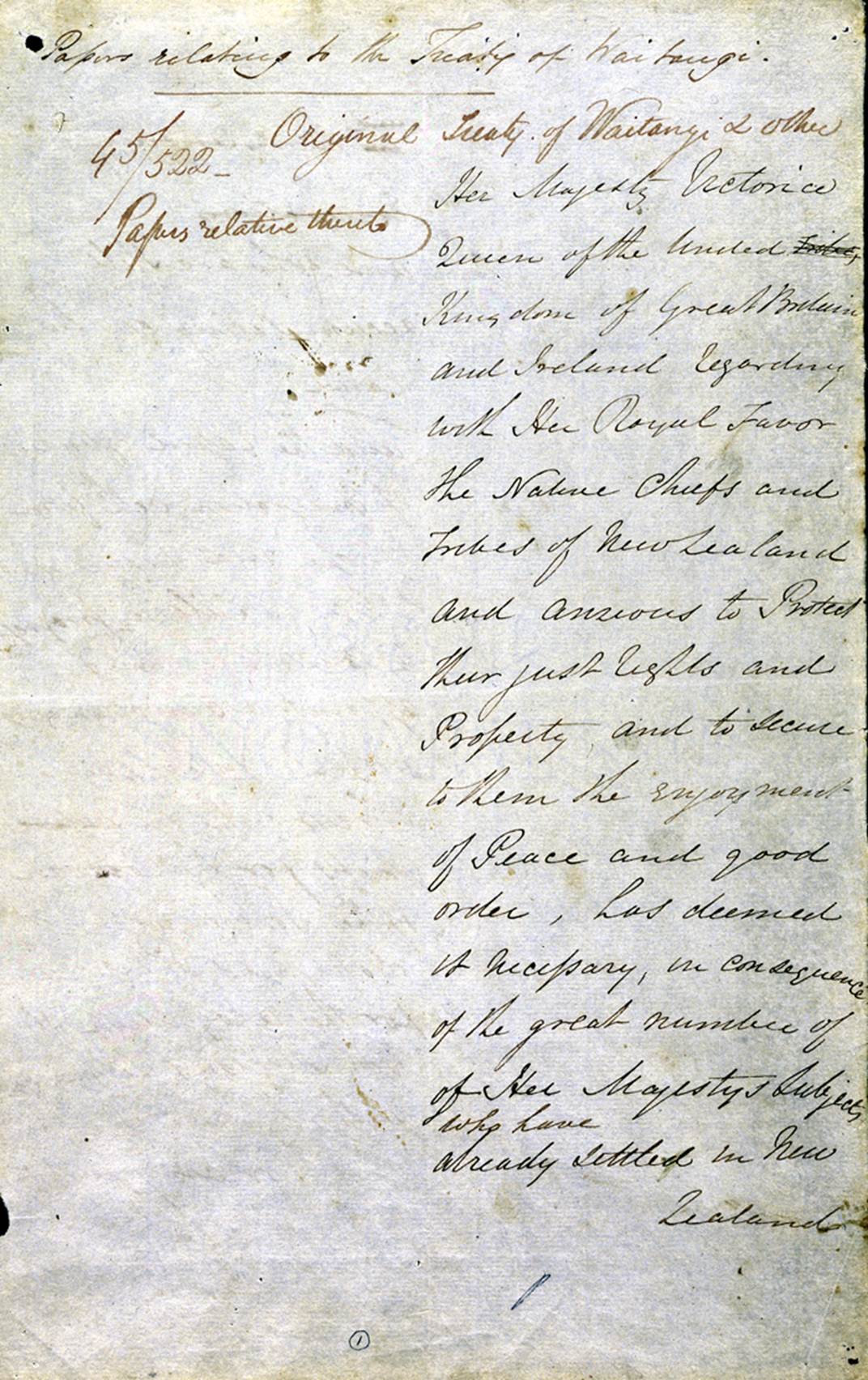
Captain William Hobson’s rudimentary ideas of what he would say in the preamble section of the Treaty of Waitangi. This page was written between the 31st of January and 1st of February 1840.
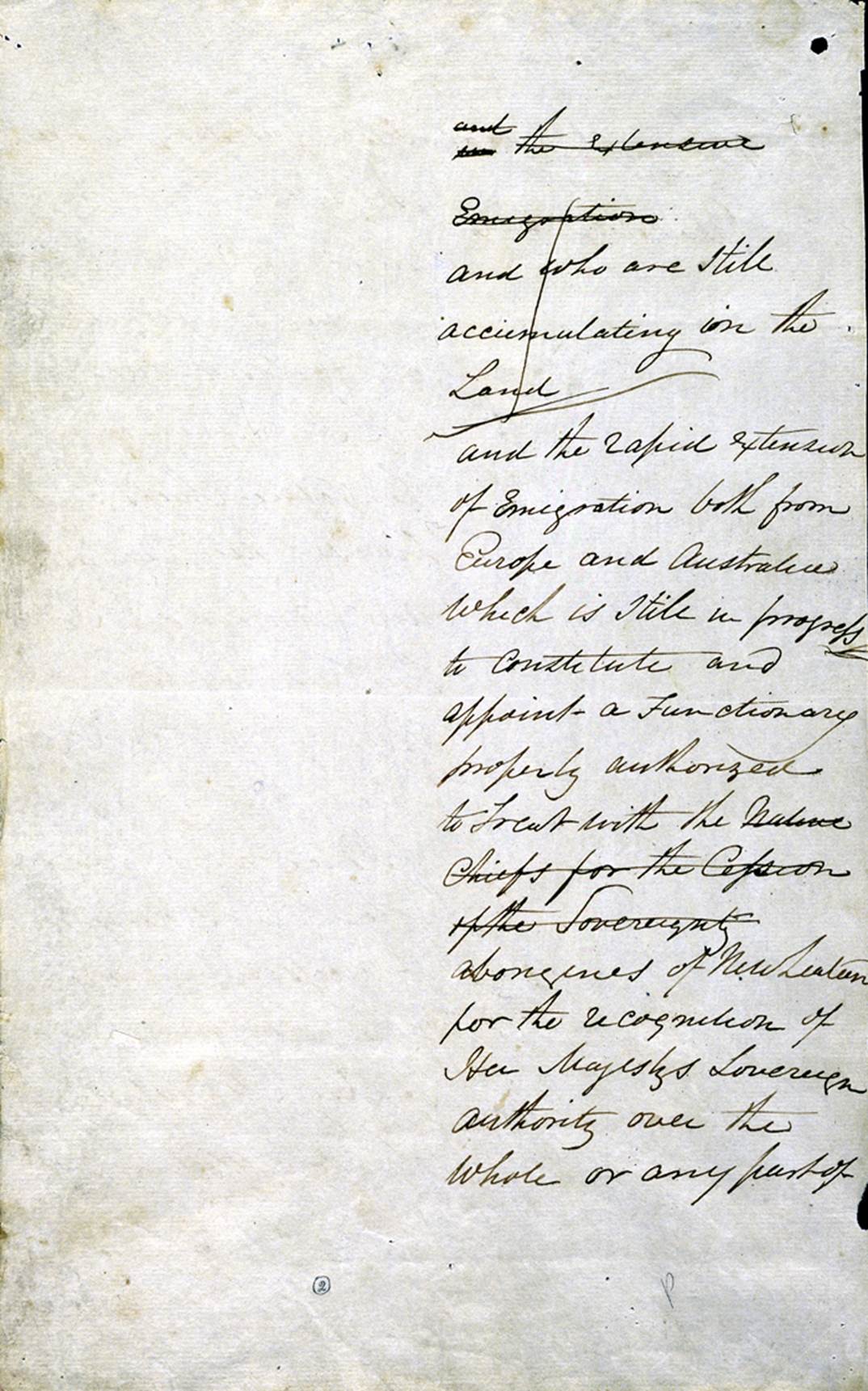
Hobson’s second page of rudimentary ideas related to what is to be said to the chiefs in the final draft. He’s still working on the preamble section, leaving space to the left for additions or text changes.
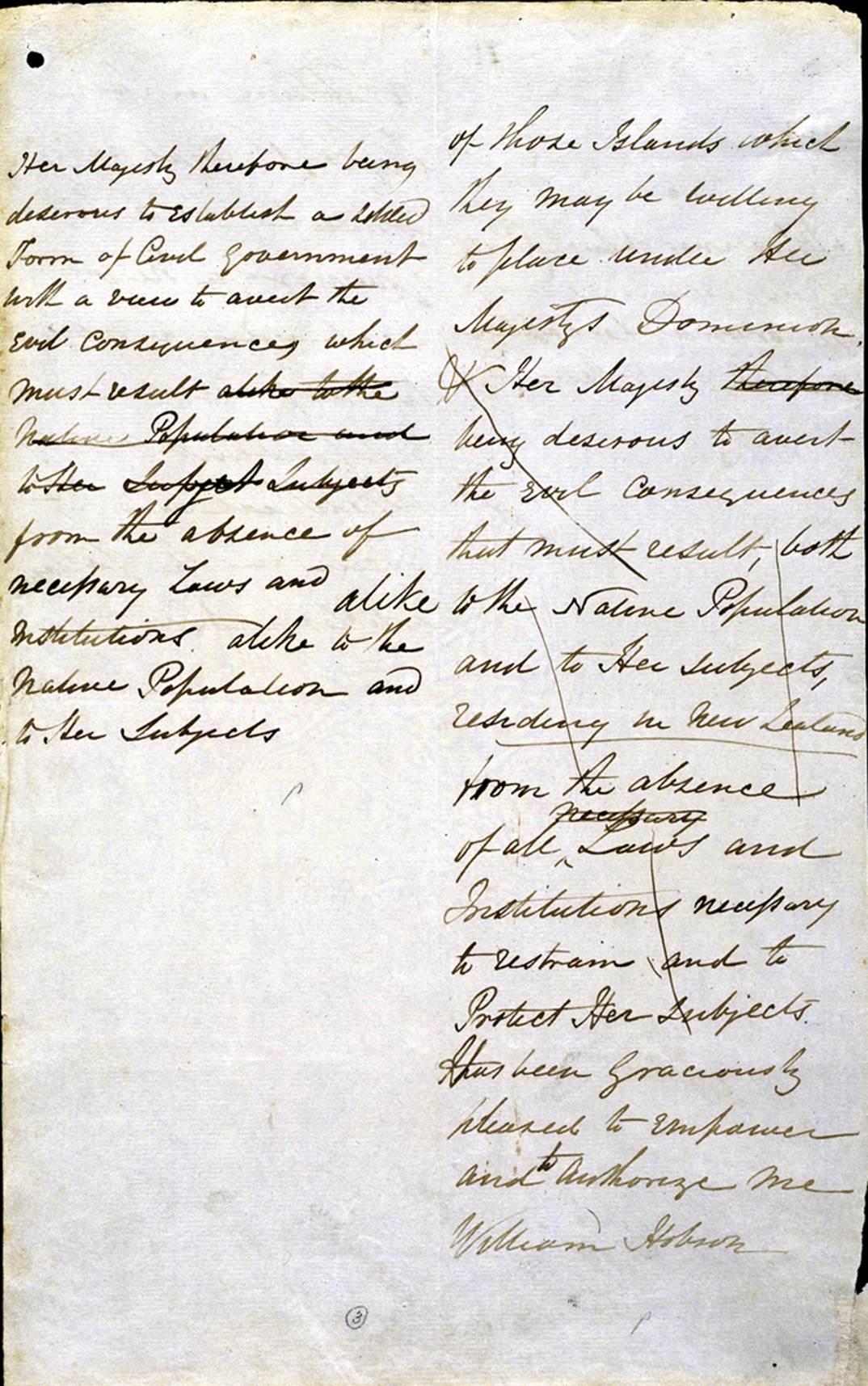
Hobson continues to labour over the wording of the preamble. Note the large sections of crossed out text to the right and possible, alternative, replacement wording to the left.
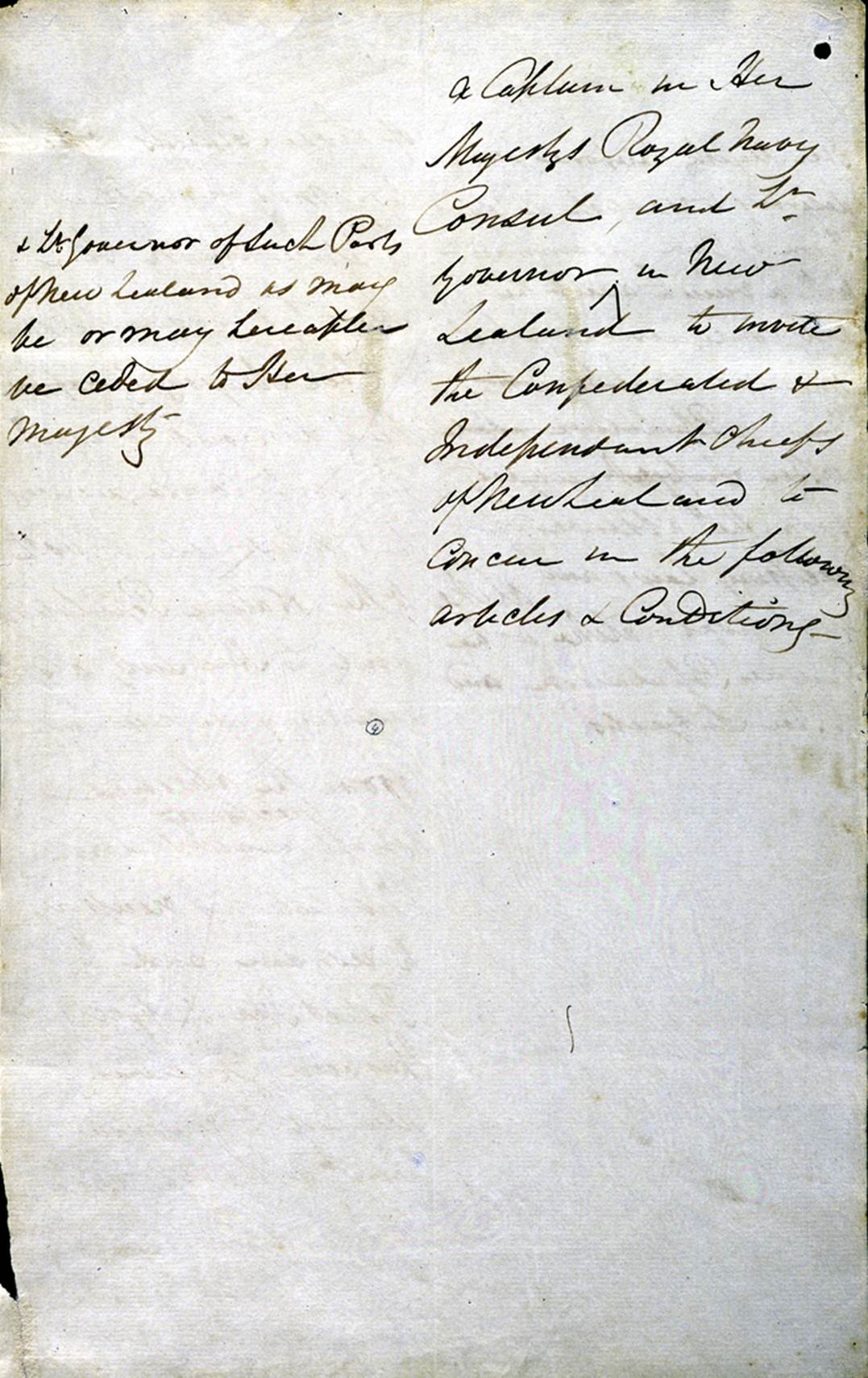
Hobson continues to struggle to write a coherent text. One major impediment was Captain Joseph Nias of the HMS Herald, who was very argumentative and resentful towards Hobson and his incentive. They had a severe argument on the night of Saturday 1st of February, which left Hobson, who was in poor health, suffering from a severe migraine headache and confined to his cot. Incapacitated, he delegated some writing to his secretary, James Stuart Freeman, who authored the next 4 pages of rough draft notes.
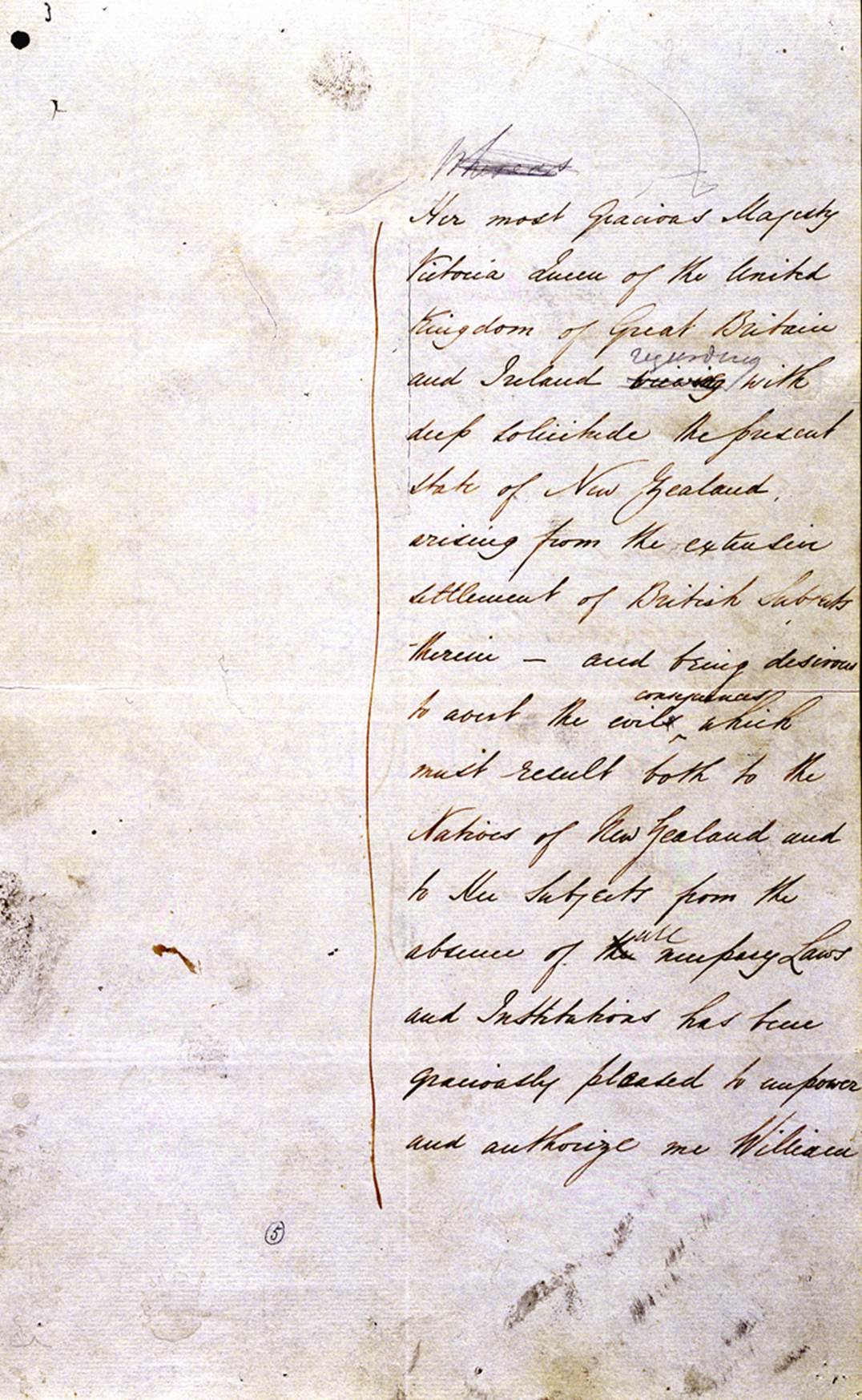
Whereas Hobson got to a point where he was about to introduce Articles for the treaty, James Stuart Freeman did a rewrite, putting in some alternative introductory text for the preamble.
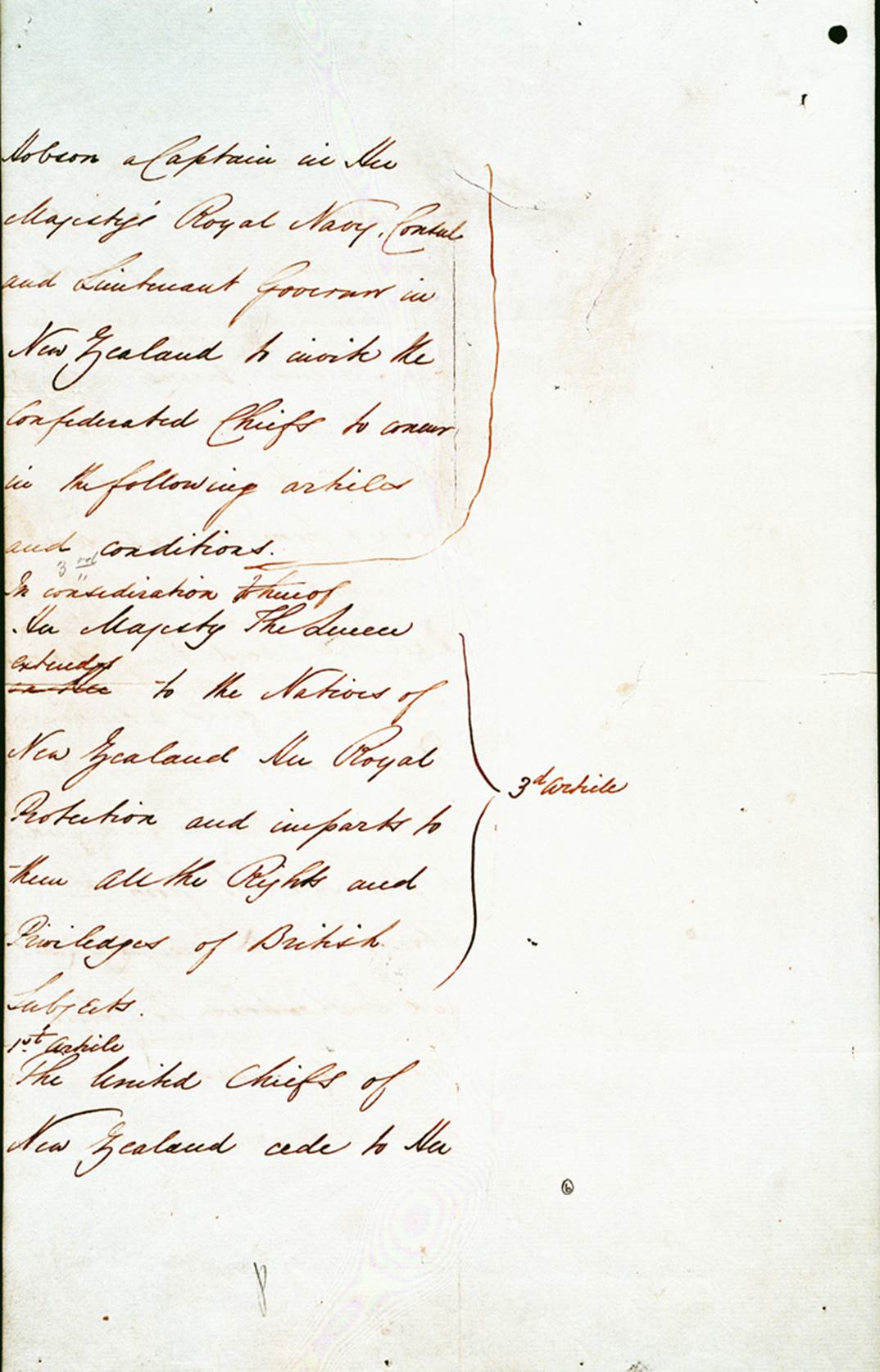
Freeman gets a preamble pretty-much together and begins to introduce very rudimentary text for a couple of Articles.
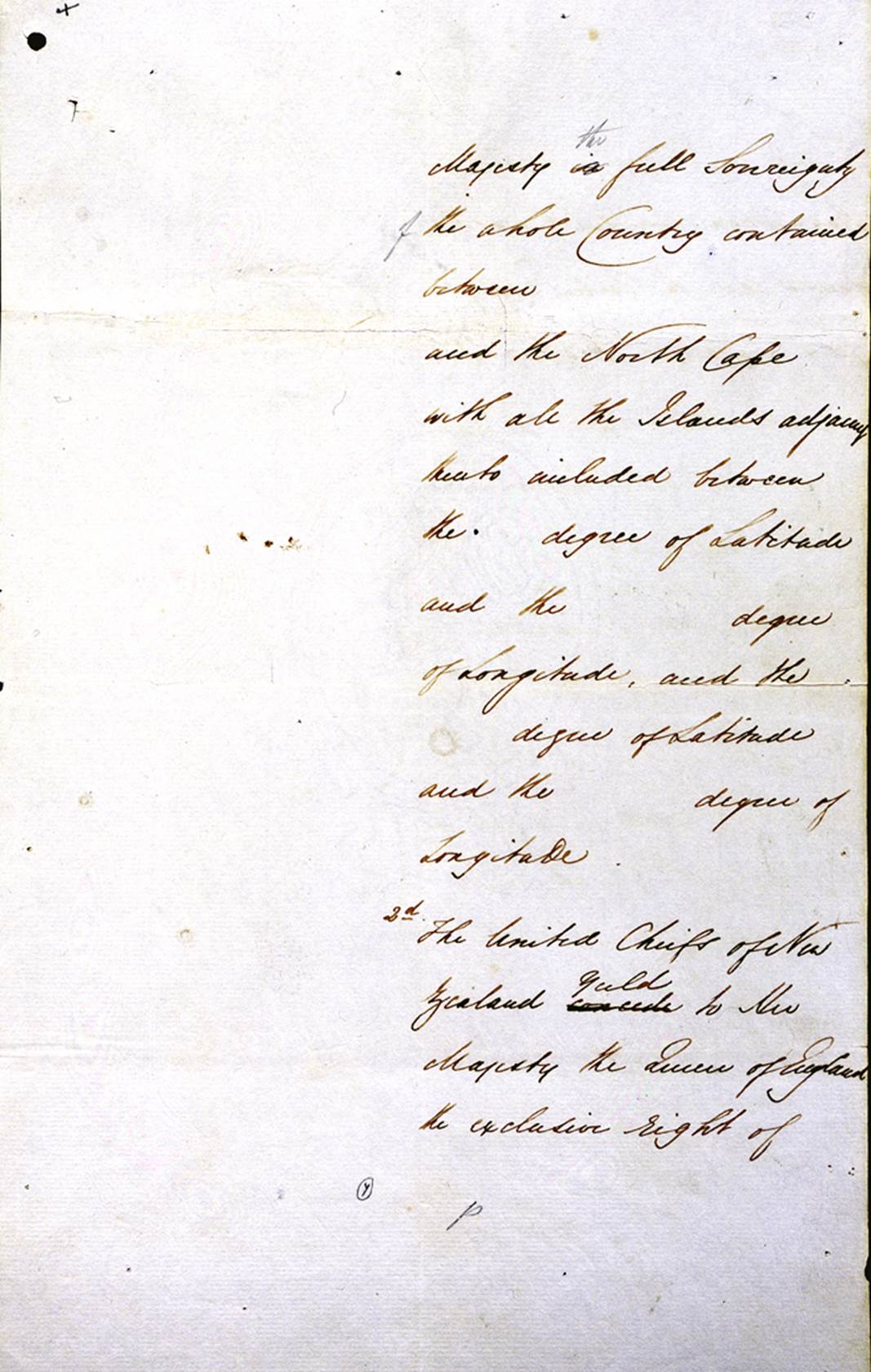
Freeman here pens a series of “latitude – longitude” references that never appeared in the later Treaty of Waitangi text. Clearly, with Hobson ill, the treaty drafting exercise was floundering, with the scheduled meeting before the chiefs only 4-days away.
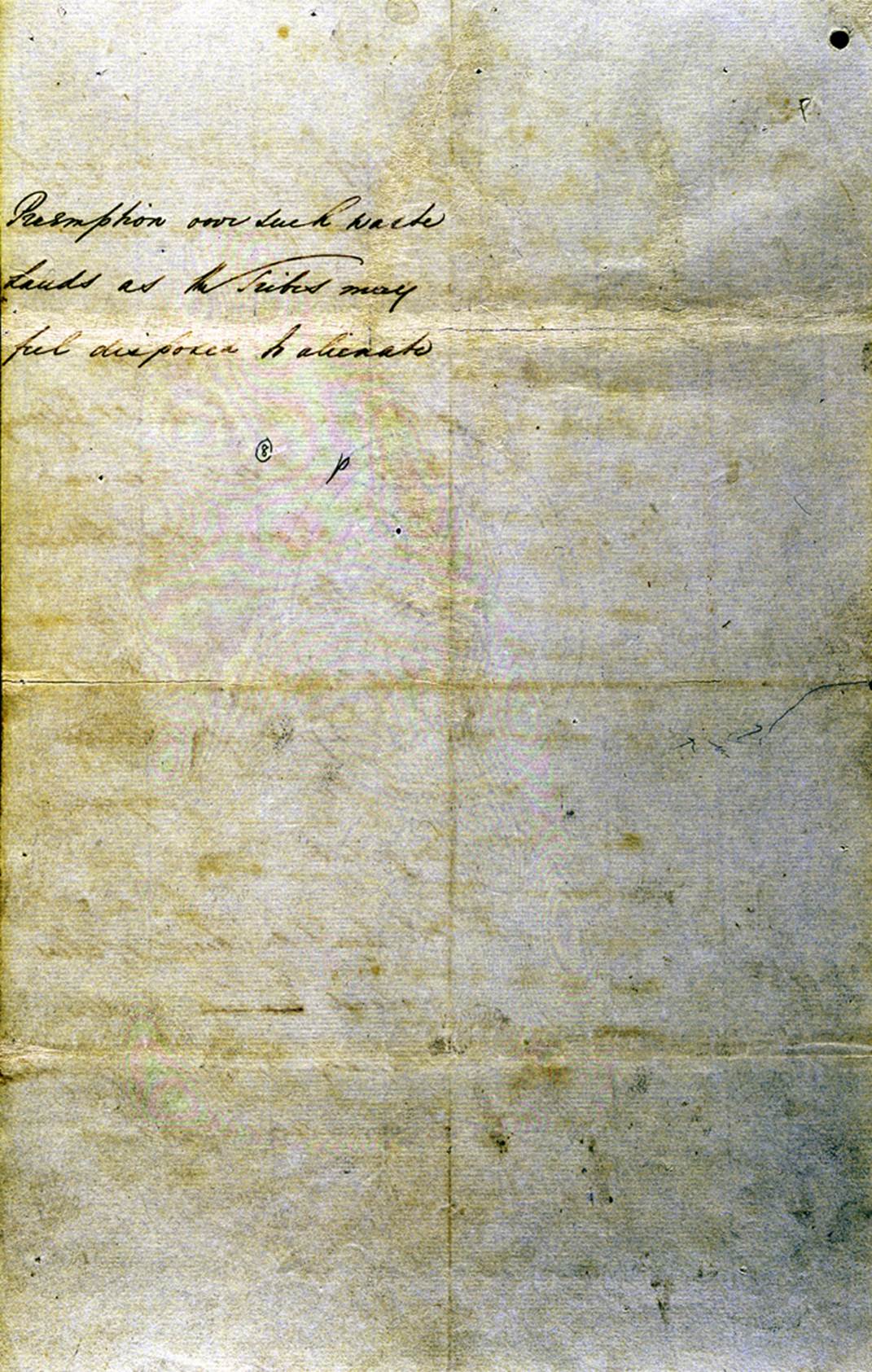
This is as far as Freeman got and Hobson knew he needed a lot of help if he was going to be ready to meet the assembly of chiefs on the 5th of February and present them with a sound, eloquent proposition. Consigned to his cot aboard HMS Herald, he had no option but to call upon the expertise of James Busby, former British Consul who Hobson was replacing.
On the morning of Sunday 2nd of February 1840, he therefore had these scant, disorganised notes sent ashore to Busby, requesting his urgent help in fleshing out the main Articles of the Treaty and providing a final affirmation section, where the chiefs could agree to cede individual sovereignty to Queen Victoria and affix their marks or signatures accordingly.
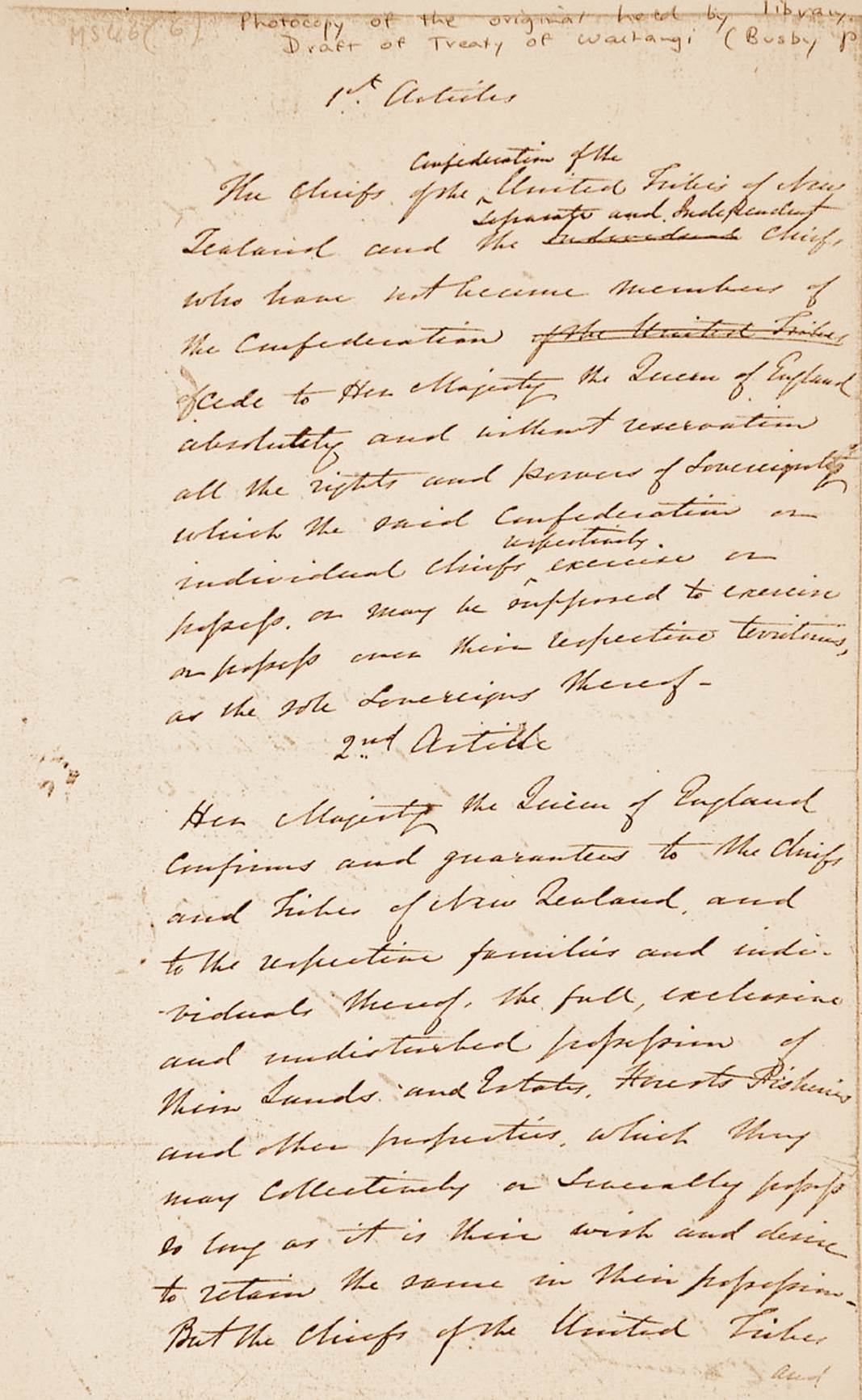
Busby, realising the urgency, immediately immersed himself in fleshing out the Articles for the treaty and put in a great deal of writing effort throughout Sunday 2nd of February 1840. He could see that Hobson had a reasonably adequate preamble, so didn’t attempt to rework that section. All that Busby wrote would ultimately have to be discussed with and agreed to by Hobson and a Final Draft written under Hobson’s direction.
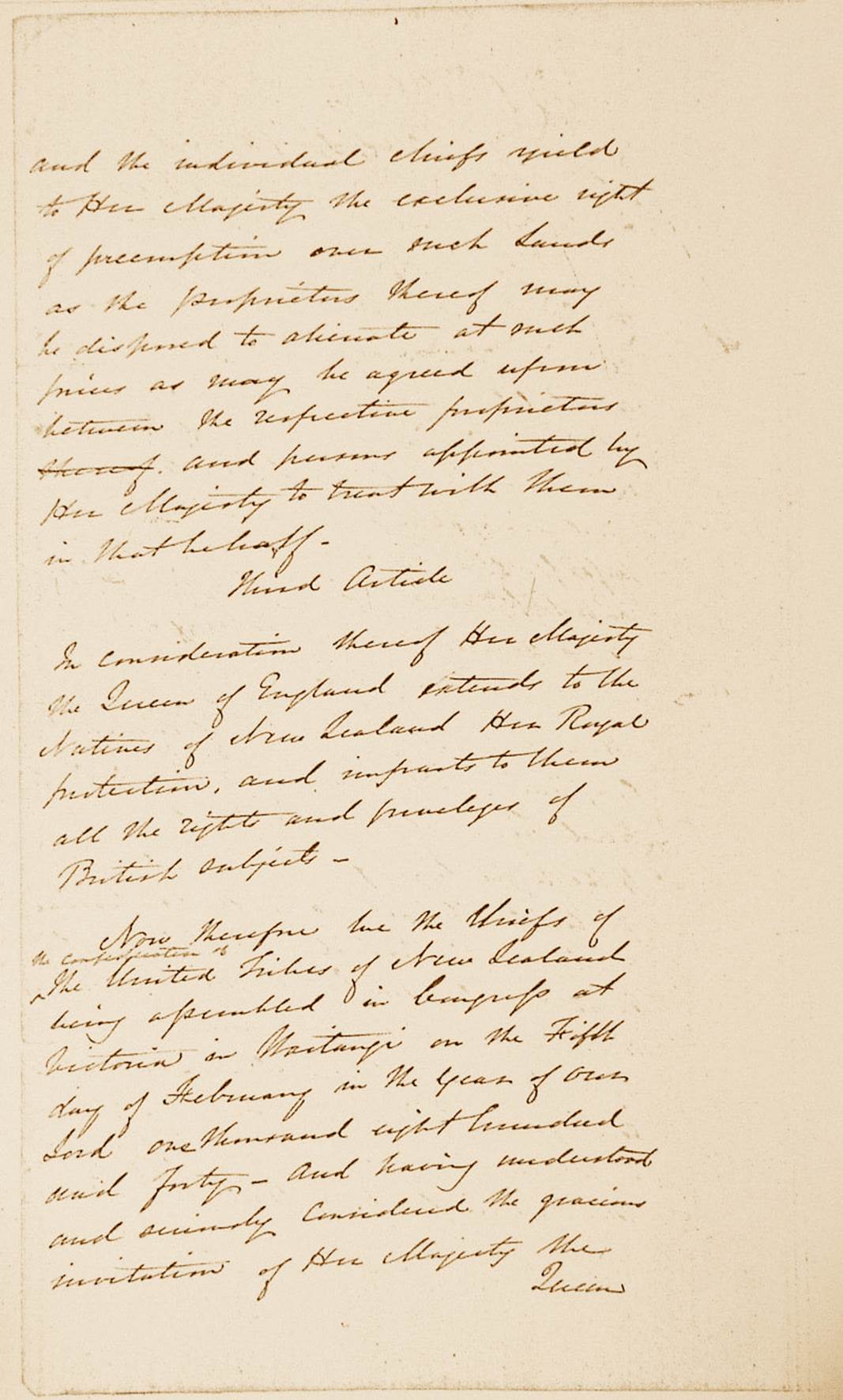
Busby continued to thrash out content for three Articles or proposals for the chiefs to consider only 3-days hence.
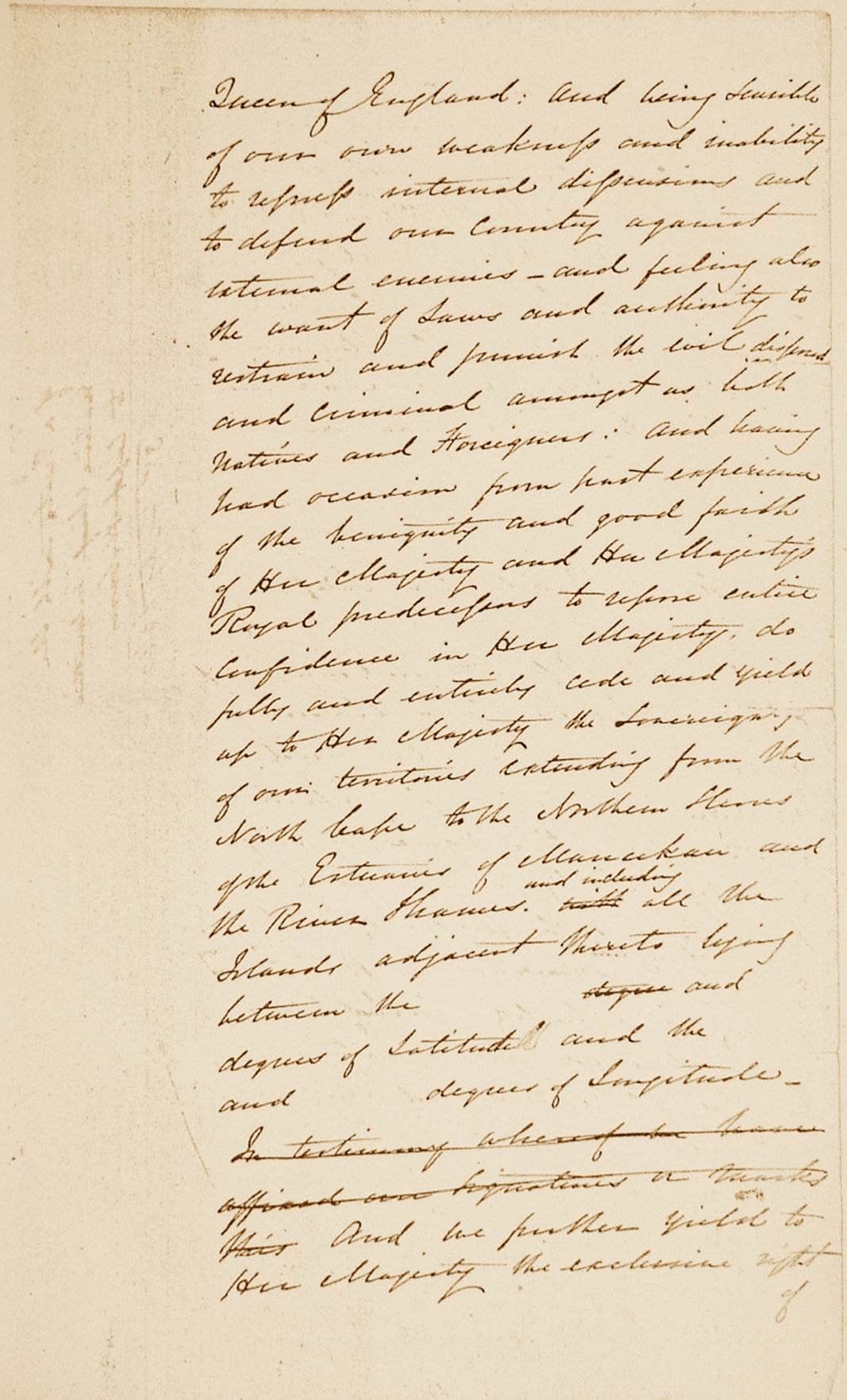
Busby, thinking Freeman’s references to latitude and longitude coordinates had some need for inclusion, added that text into his rough notes. However, in the Final Draft of the 4th of February, Hobson chose not to include any such reference.
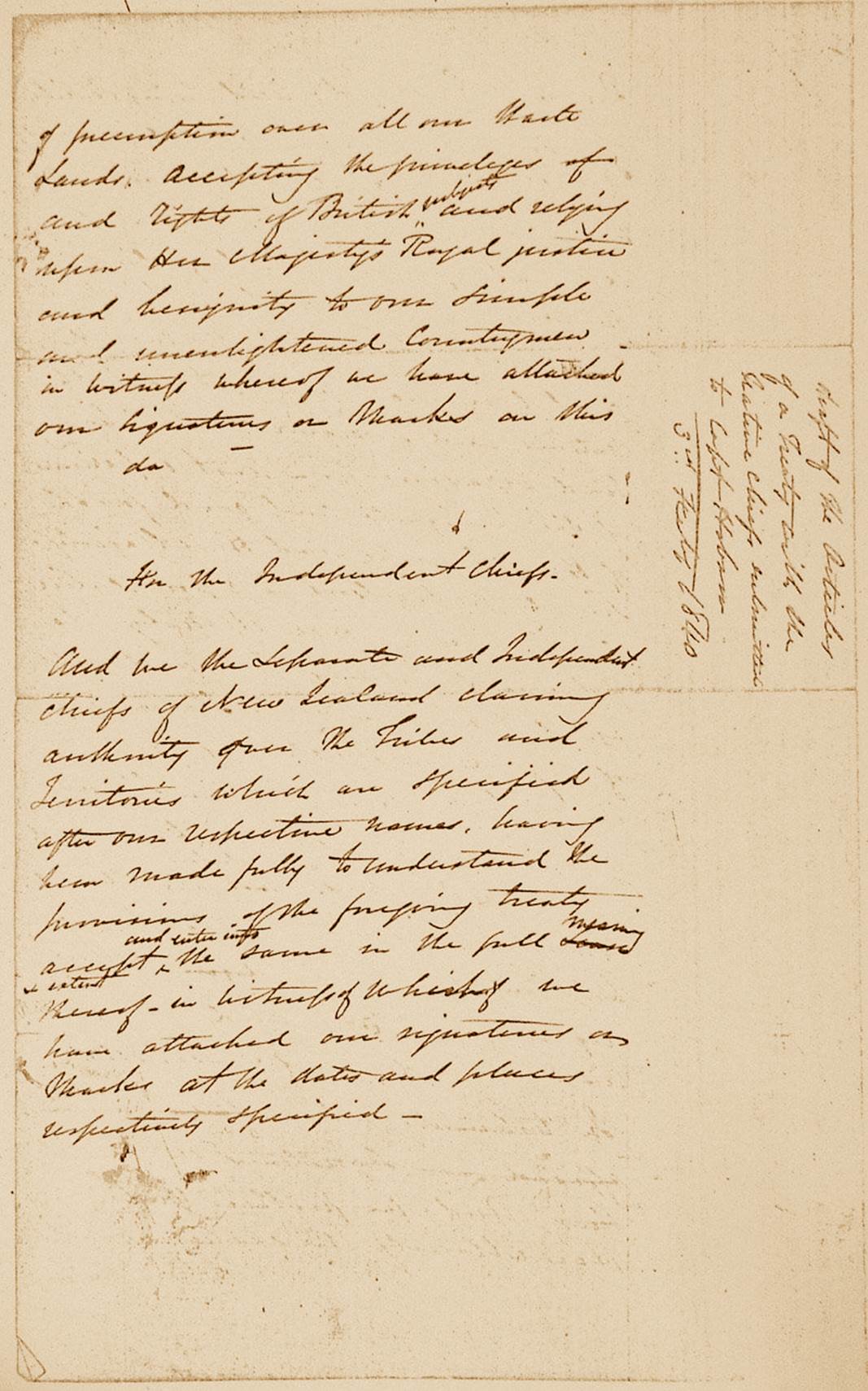
Between Sunday the 2nd and Monday the 3rd of February, Busby completed his rough draft and would now write a cleaner copy to show Hobson later in the day, so that the Final Draft could be written and approved for translation into the Maori language.
It seems that reports coming to Busby on Sunday 2nd from Hobson’s staff concerning Hobson’s migraine headache condition, a direct consequence of arguments with stroppy, obstructive captain Nias, impelled Busby to get Hobson as far away from Nias as possible. He therefore arranged to meet Hobson for the final drafting session, not aboard HMS Herald, but ashore at Busby’s two room cottage at Kororareka in the late afternoon of Monday the 3rd of February 1840.
With Busby now at the helm of the treaty incentive, it was essential that he employ all available resources to take pressure off Hobson, such that Hobson could stand before the chiefs and present himself in full vigour as Queen Victoria’s duly appointed representative. Busby therefore marshalled his forces, including Reverend Henry Williams to oversee the translation and James Reddy Clendon to provide the comfortable, 8-room mansion venue for composing the Final English draft. During Monday 3rd of February Busby worked hard in writing up a “clean copy” of his treaty proposal for Hobson to scrutinise that evening.
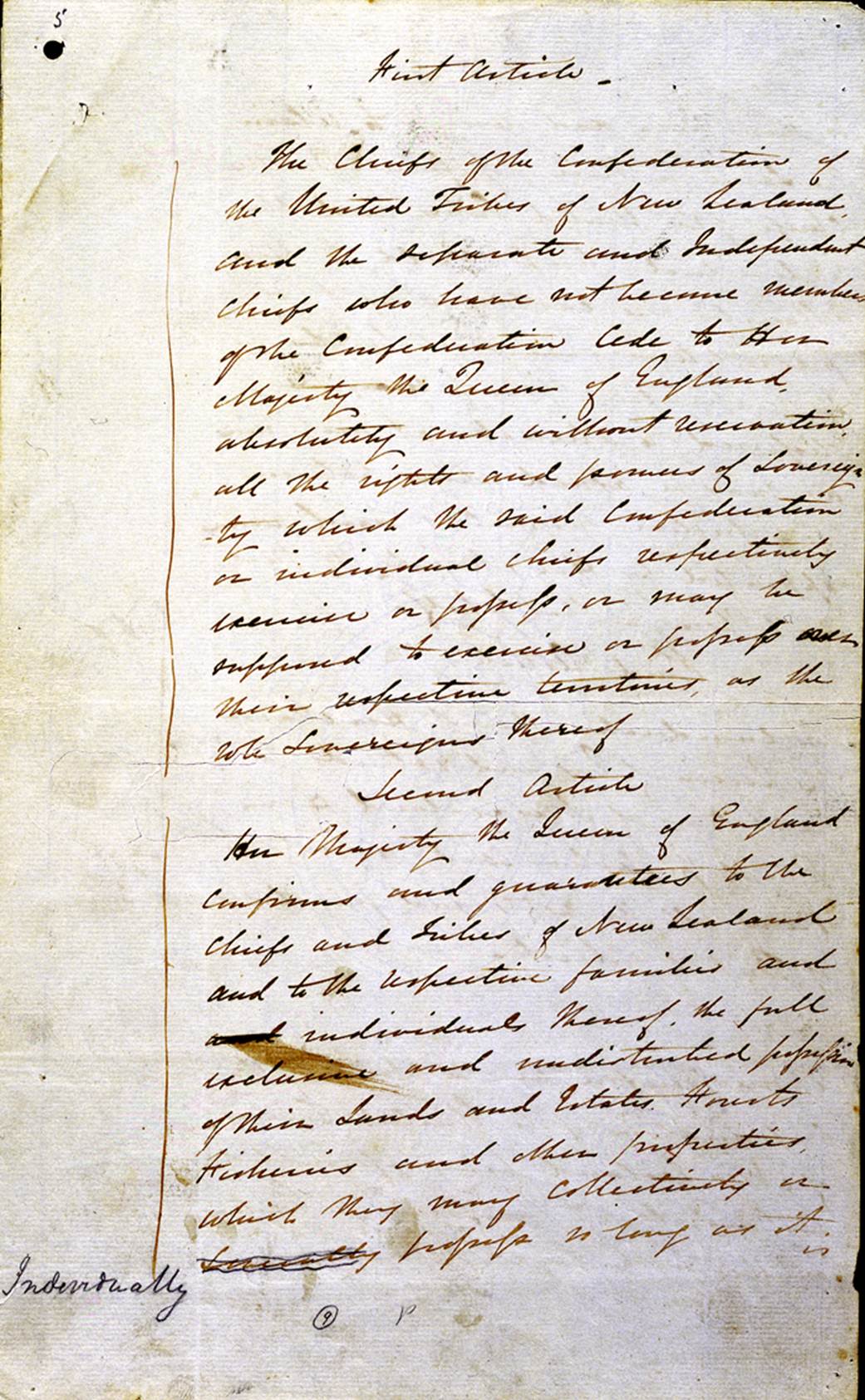
Page 1 of Busby’s “clean copy”, with the crossed-out text or spelling mistakes mostly eliminated, making it easier to decide on how the Final Draft should be worded.
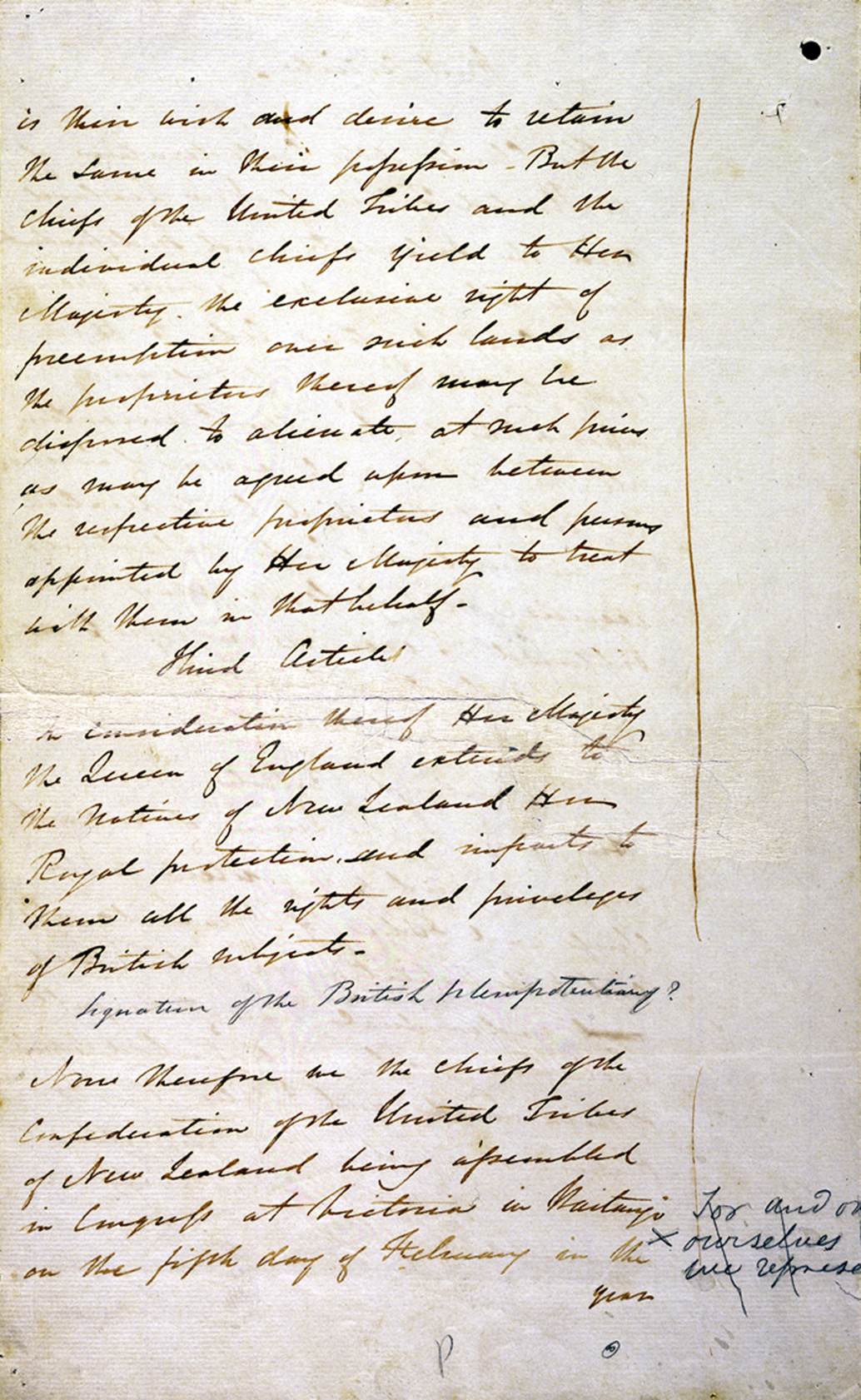
Page 2 of Busby’s clean copy for Hobson’s consideration.
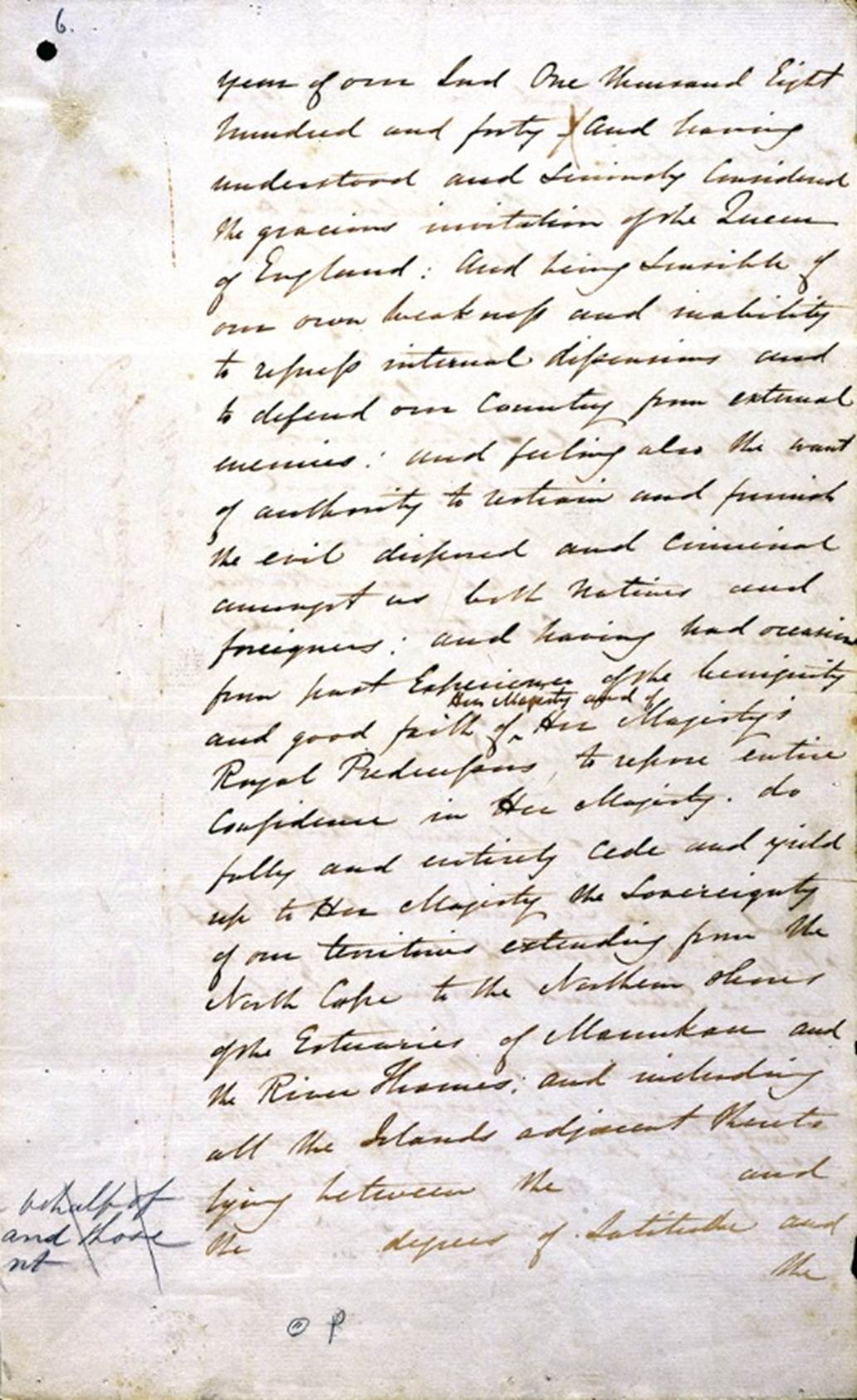
Page 3 of Busby’s “clean copy”.
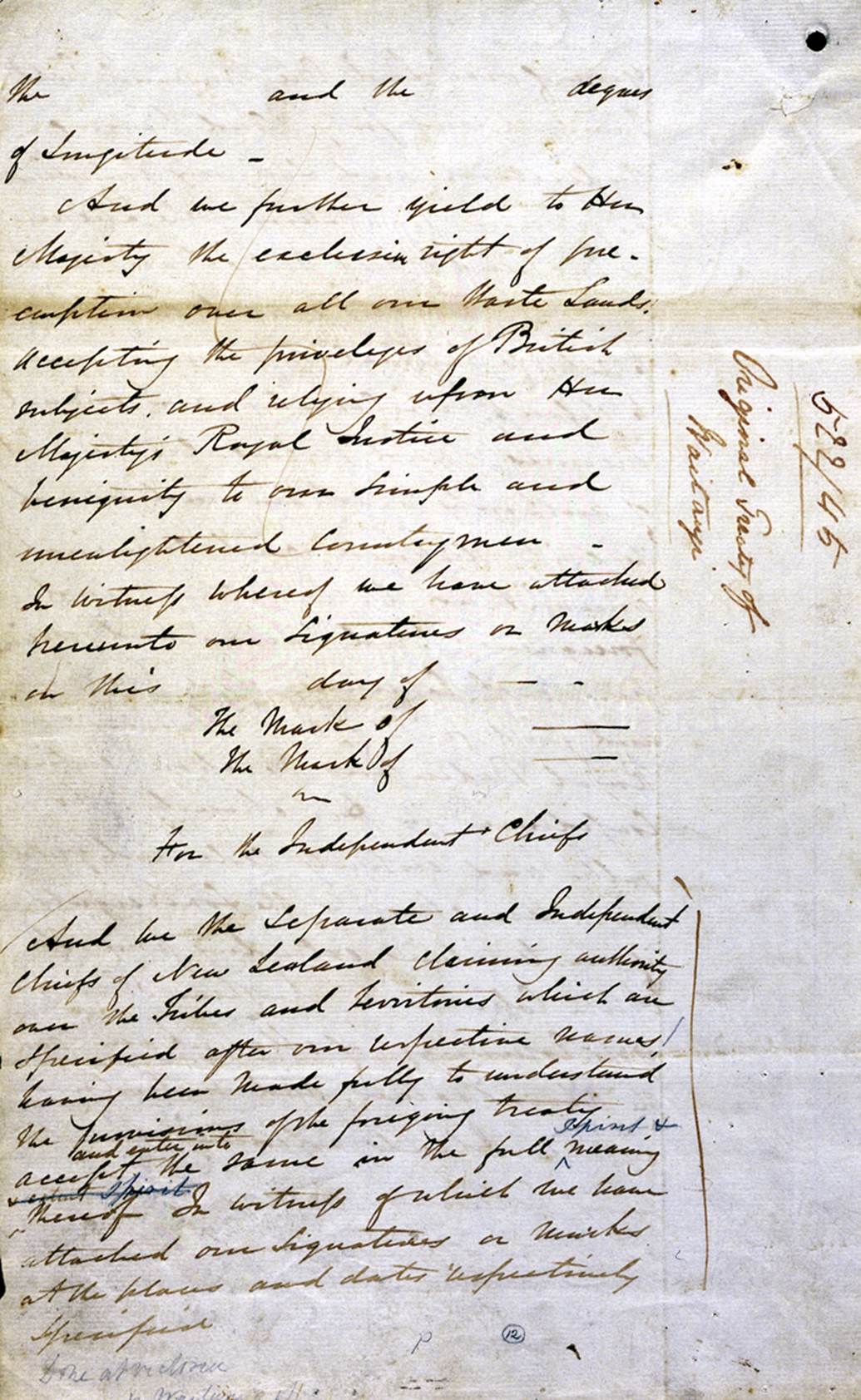
Page 4 of Busby’s “clean copy”.
ALL OF THE FORGOING ROUGH DRAFT TREATY PAGES WERE WRITTEN BETWEEN THE 29TH OF JANUARY TO FEBRUARY 3RD AND WERE OBSOLETE WHEN THE FINAL DRAFT WAS WRITTEN ON THE 4TH.
By 1975 at least, a campaign was unleashed by longstanding Maori Member of Parliament within the Labour Party, Matiu Rata, as well as the Maori Council, that these very rough notes, or at least composite bits of them here & there, somehow contained the exact English Final Draft text that was used to create Te Tiriti o Waitangi.
In and of itself, this hodgepodge jumble of crossed-out mistakes, additions, rambles and sometimes pretentious language that was virtually untranslatable into the Maori tongue (words like solicitude) was totally inadequate to hand over to translators to make any sense of.
WHAT DOES A TRANSLATOR NEED?
Hobson, Busby and any other advisors, constructing a treaty text, had an absolute obligation to provide a full and complete, clearly set-out document composed of words, sentences, paragraphs and concepts that the translators could easily understand. Obviously, there is nothing in the foregoing hodgepodge of confusion that could, by any stretch of the imagination, qualify as a finished English text to pass to a translator.
When historian, Ruth Ross, did her in-depth analysis in 1972, there was no English language draft text, known to her, that was capable of producing Te Tiriti o Waitangi.
As stated: ‘Ms. Ross noted that the English text used by Henry Williams as the starting-point for the creation of the Maori text “Unfortunately ... does not appear to have survived”, and Dr. Orange could only agree that no trace of “the final English draft” could be found’ (See: The Treaty of Waitangi, 1987 pp. 36-37).
(See also: Ruth M. Ross, Te Tiriti o Waitangi: Texts and Translations, New Zealand Journal of History 6#2, Oct. 1972, pp. 129-157, particularly pp. 132-136).
There is now, however, one document, discovered in 1989, that qualifies as the Final English Draft and here’s what it looks like:
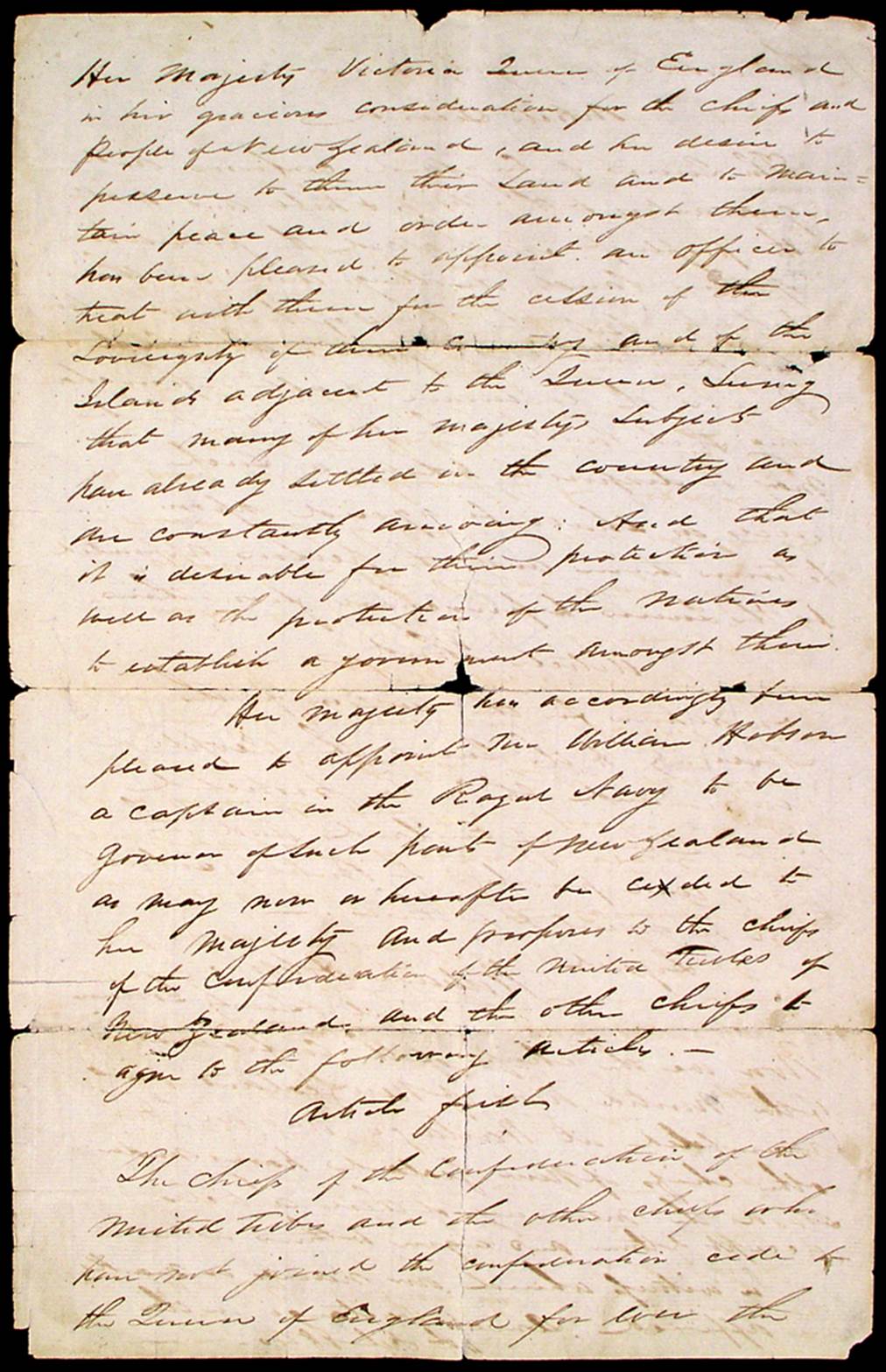
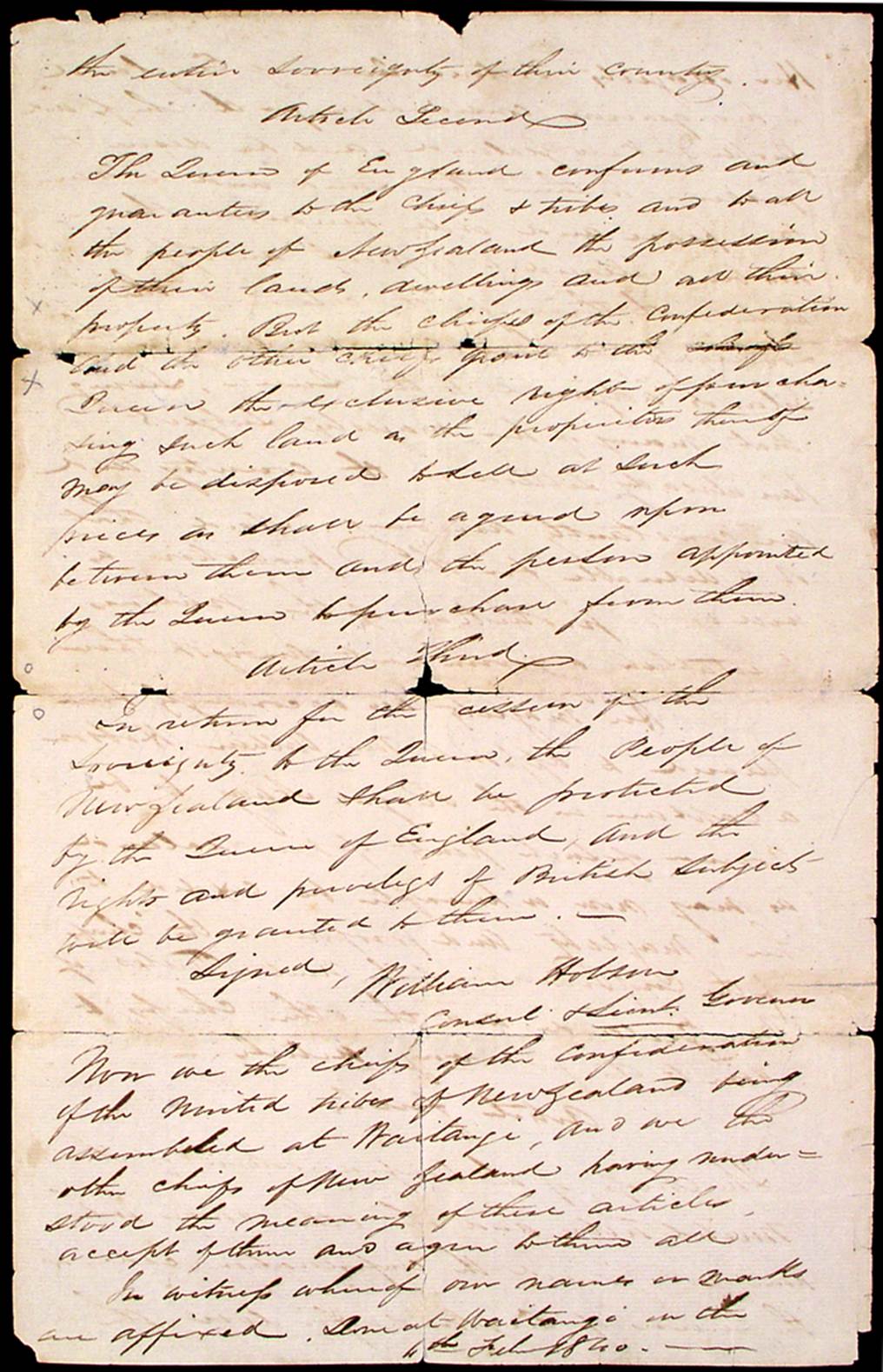
This is the only known document, correctly dated the 4th of February 1840, that could qualify as the English Final Draft or mother document from which Te Tiriti o Waitangi was translated. Such a document must have a traceable pedigree back to Hobson, and this one has just such a pedigree … Littlewood family … back to 1840s – 50s solicitor Henry Littlewood … back to American Consul, James Reddy Clendon … back to Lieutenant-Governor William Hobson.
The Littlewood Treaty, which was Busby’s final draft of the 4th of February 1840 |
The Maori text translated by Reverend Henry Williams & Edward M. Williams 4-5/2/1840 |
Translation from the Original Maori by, Mr. T.E. Young, Native Department (1869) |
A translator will work line-by-line and sentence-by-sentence to render a translation that exactly duplicates the wording requirements of the original language script in need of translation.
Parts of speech within a translated sentence will often need to be placed in a different sequence, in order for the sentence to sound correct to the native speaker . All words or concepts mentioned in the original script will be translated, with no omissions, but no surplus words or sentences will be included if they did not appear in the original.
Line-by-line, the document found by the Littlewood family in 1989 perfectly duplicates the Maori text in meaning and word weight per sentence. It also duplicates the meaning of the 1869 back-translation commissioned by the NZ Government and supplied by the Native Department. The government needed an official back-translation due to interpretational problems arising out of the 1840s loss of the Final English Draft.
DIRTY TRICK NUMBER 4 … TWISTING THE TREATY MEANING BY INTRODUCING SOMETHING CALLED, “THE ENGLISH TREATY AS SIGNED” INTO OUR LEGISLATION IN 1975.
Historian Ruth Ross had made it crystal-clear that she could find no surviving document that provided the English text from which Te Tiriti o Waitangi was translated. That document was lost!
MP Matiu Rata, however, had a pet project in mind that would require a particular English language version of the treaty to be brought into our legislation to sit alongside Te Tiriti o Waitangi and be co-equal to it in authority when drafting laws or understandings based upon the treaty. The version he wanted was dubbed by him, “The English treaty as signed’, although it bore little resemblance to the wording and sentence-by-sentence content of Te Tiriti o Waitangi.
It was merely one of James Stuart Freeman’s 7 Formal Royal Style memorial documents, earmarked solely for overseas despatch to dignitaries in foreign governments and one of the “composite” wordings discounted by historian Ruth Ross.
Alarm bells should have gone off as to why a Maori leader, fixated as he was on Maori interests, should be pushing so hard to elevate this particular version to the high status of Te Tiriti o Waitangi’s singular authority. Common logic would dictate that he would want Te Tiriti to remain pre-eminent as the only true wording.
Something else was in the wind.
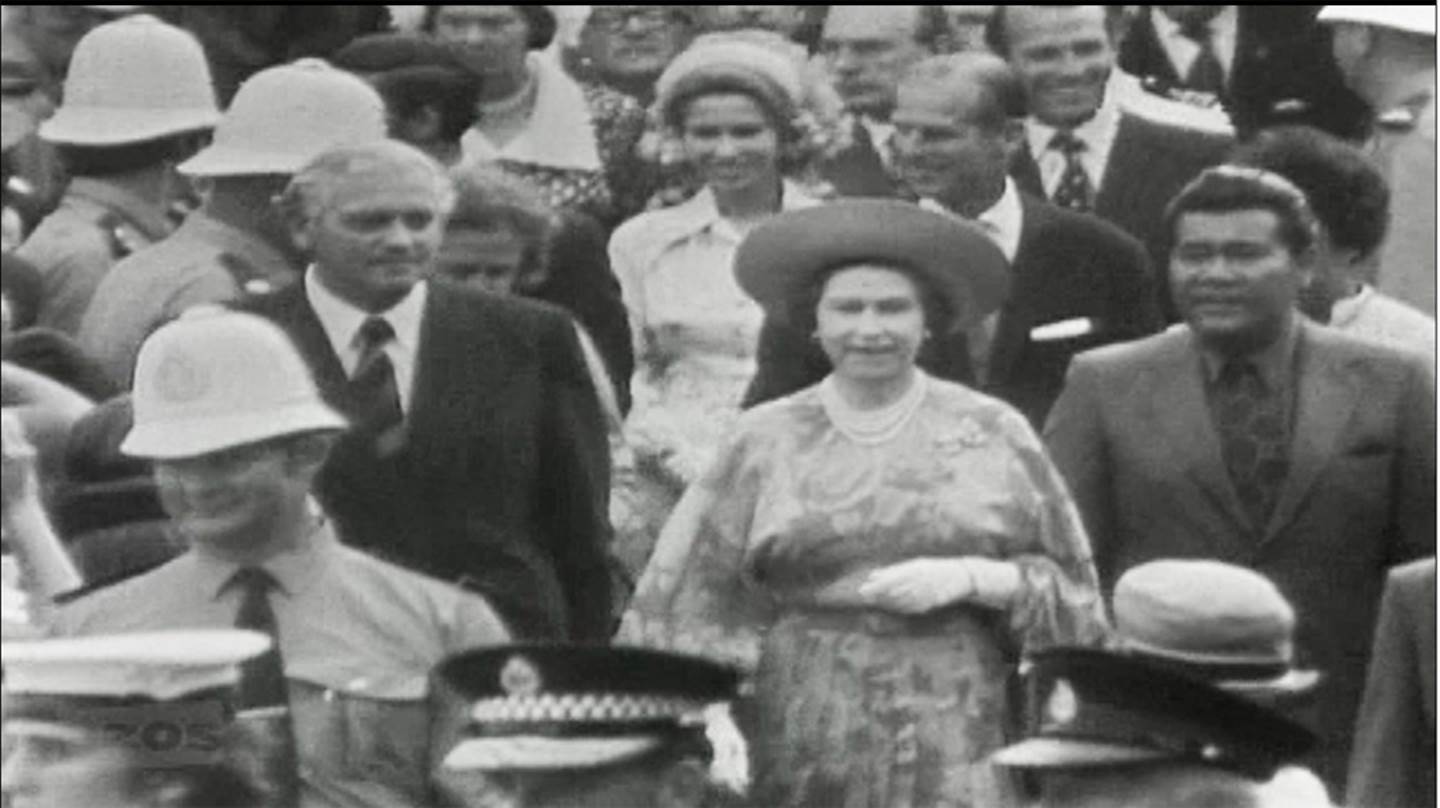
Member of Parliament and Minister of Maori Affairs, Matiu Rata is seen here with the Queen and newly elected Prime Minister of New Zealand, Norman Kirk, for the Waitangi Day celebrations, February 6th, 1972.
So why, leading up to 1975, did he so desperately want only one particular English version of the Treaty brought in to sit alongside the only internationally accepted Tiriti text, spanning the previous 135-years?
The answer is simple: So that he and his supporters could wreak havoc with the treaty wording, destroy its meaning and strip away its protections, thus leaving New Zealand and its rich assets open to plunder!
One can easily surmise that Matiu Rata and the Maori Council were assisted by switched-on internationalists or corporate factions in this 1970s sinister, resource-grabbing incentive.
So, what else was going on politically that inspired Matiu Rata to pursue his tribalist self-interests?
A PONSONBY BOY’S PERSPECTIVE …THE POLYNESIAN PANTHER PARTY GATE-CRASHERS OCCUPY PONSONBY AS THEIR GANG HEADQUARTERS.
I was raised in Ponsonby, Auckland, New Zealand from 1950 onwards, with the family owning our home at 75 St Mary’s Bay Rd until 1984. I attended Ponsonby Primary School on Curran St, considered to be the most cosmopolitan school in New Zealand and the foremost study-model of demographics due to its very diverse student population.
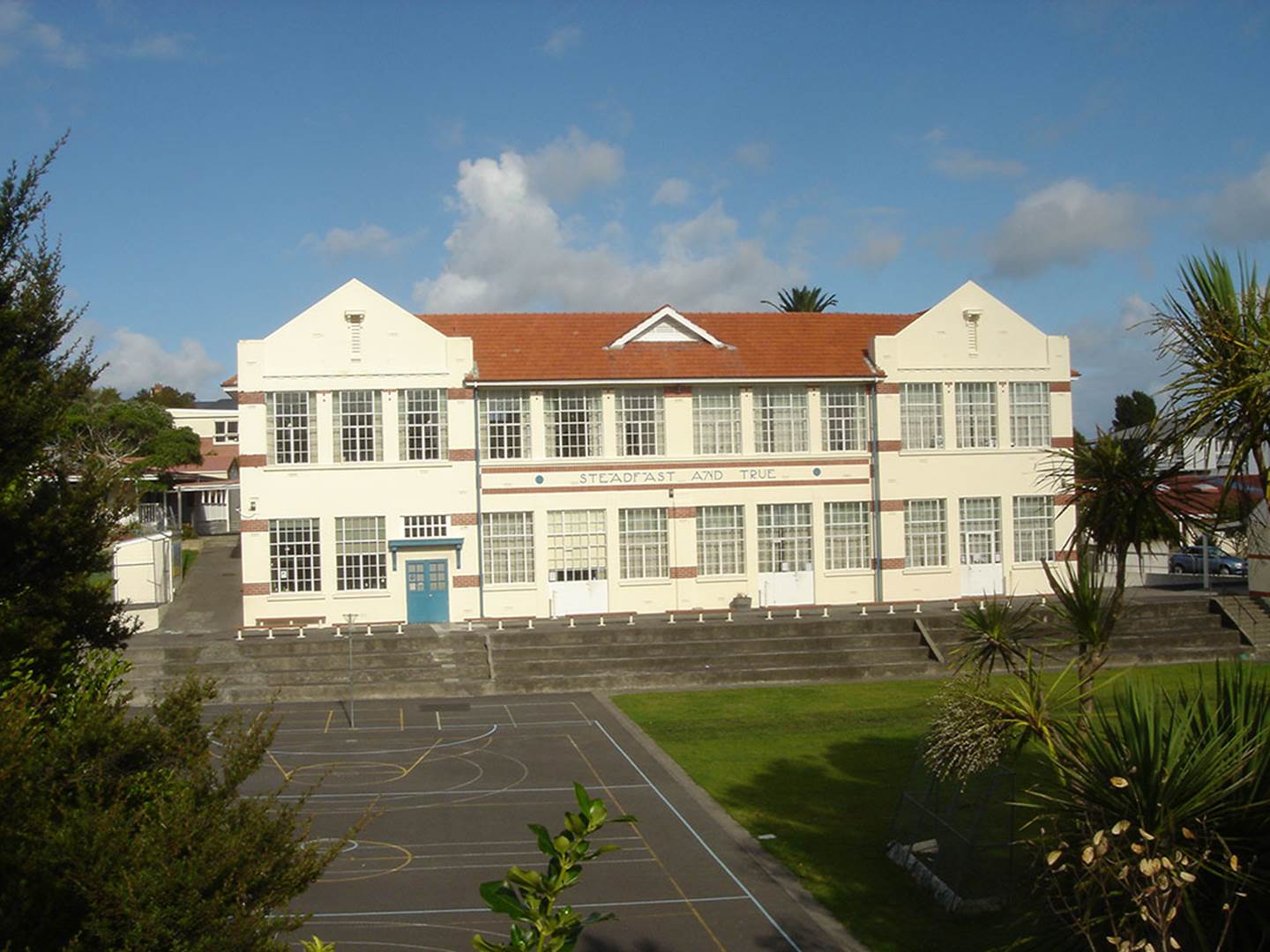
Ponsonby Primary School, Curran Street in the 1950s had a student population of many Polynesian ethnicities including, Maori, Cook Islanders, Niue Islanders, Tongans, Samoans, Fijians, Tokelau Islanders … then there were the Chinese & Indian kids, as well as the English (British), Dutch, Yugoslavian, Greek, Hungarian (1956 war refugees), Lebanese and at least a couple of us who were American born, but with New Zealand mothers (repatriated WWII brides).
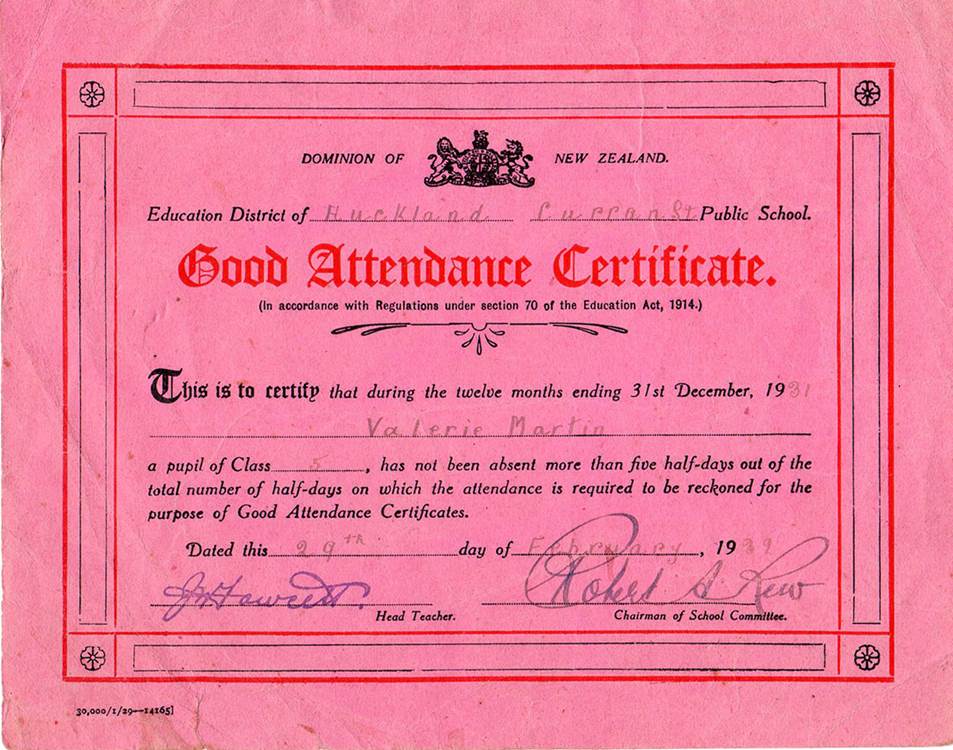
My mother’s good attendance record from Ponsonby School for the 1931 school year. My uncles also attended Ponsonby Primary School.
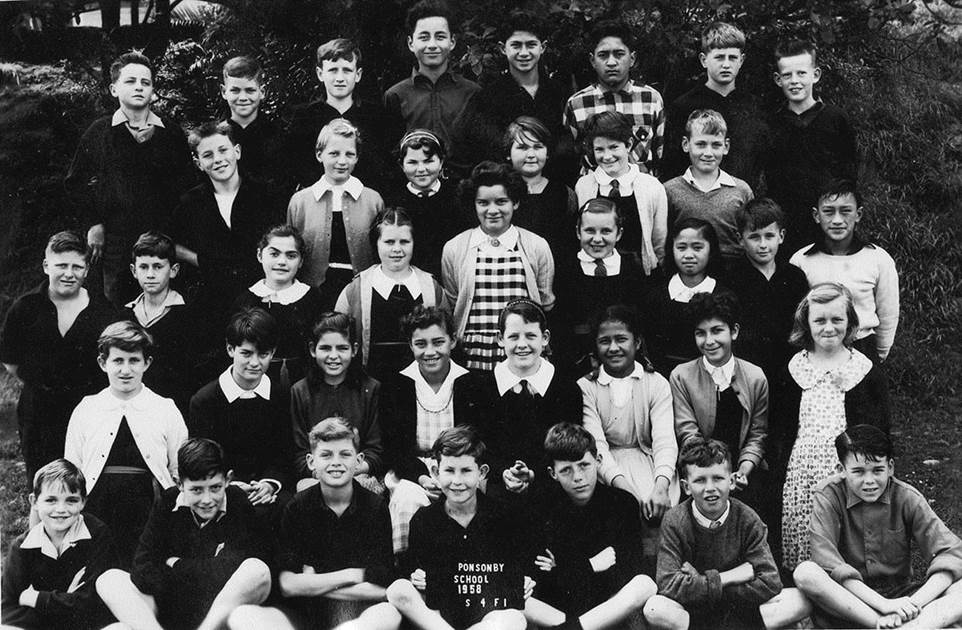
Class of 56. I’m the little squirt down in the left-hand corner.
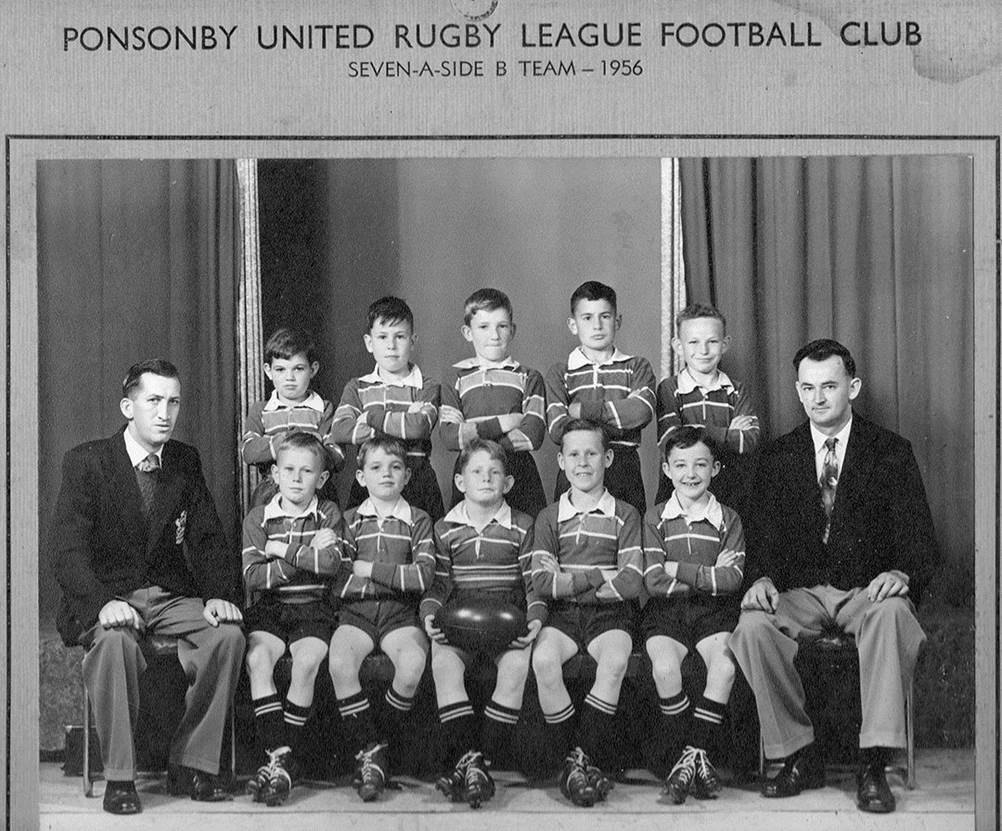
My brother Robin (top left) and I (2nd player in from the bottom left) played Rugby league for Ponsonby, as well as Rugby for Ponsonby School later. We often played Rugby against the Samoan boys at Beresford Street Primary School in adjacent Freeman’s Bay … all good fun.
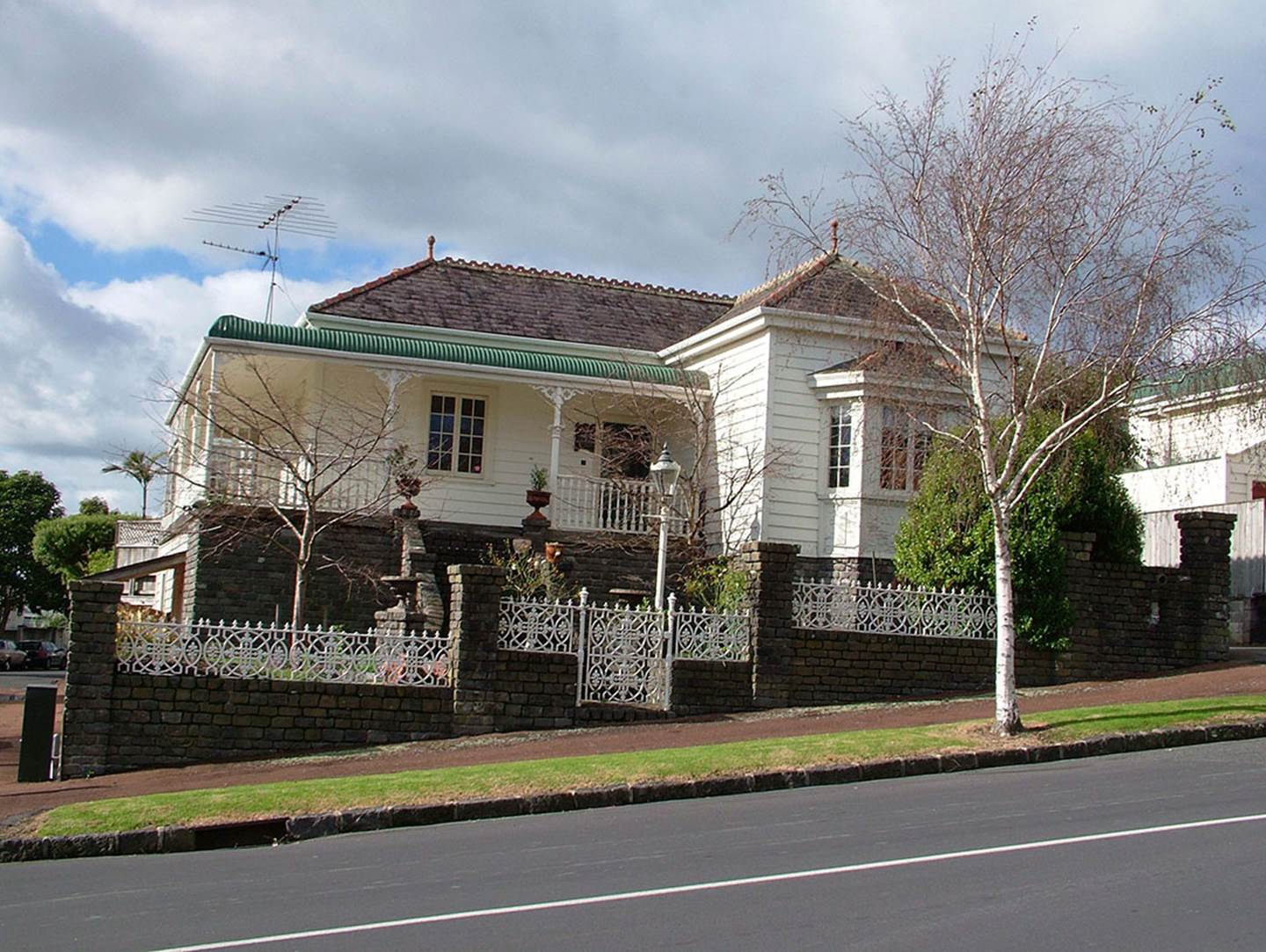
Our house at 75 St Mary’s Bay Rd, Ponsonby, in 2003.
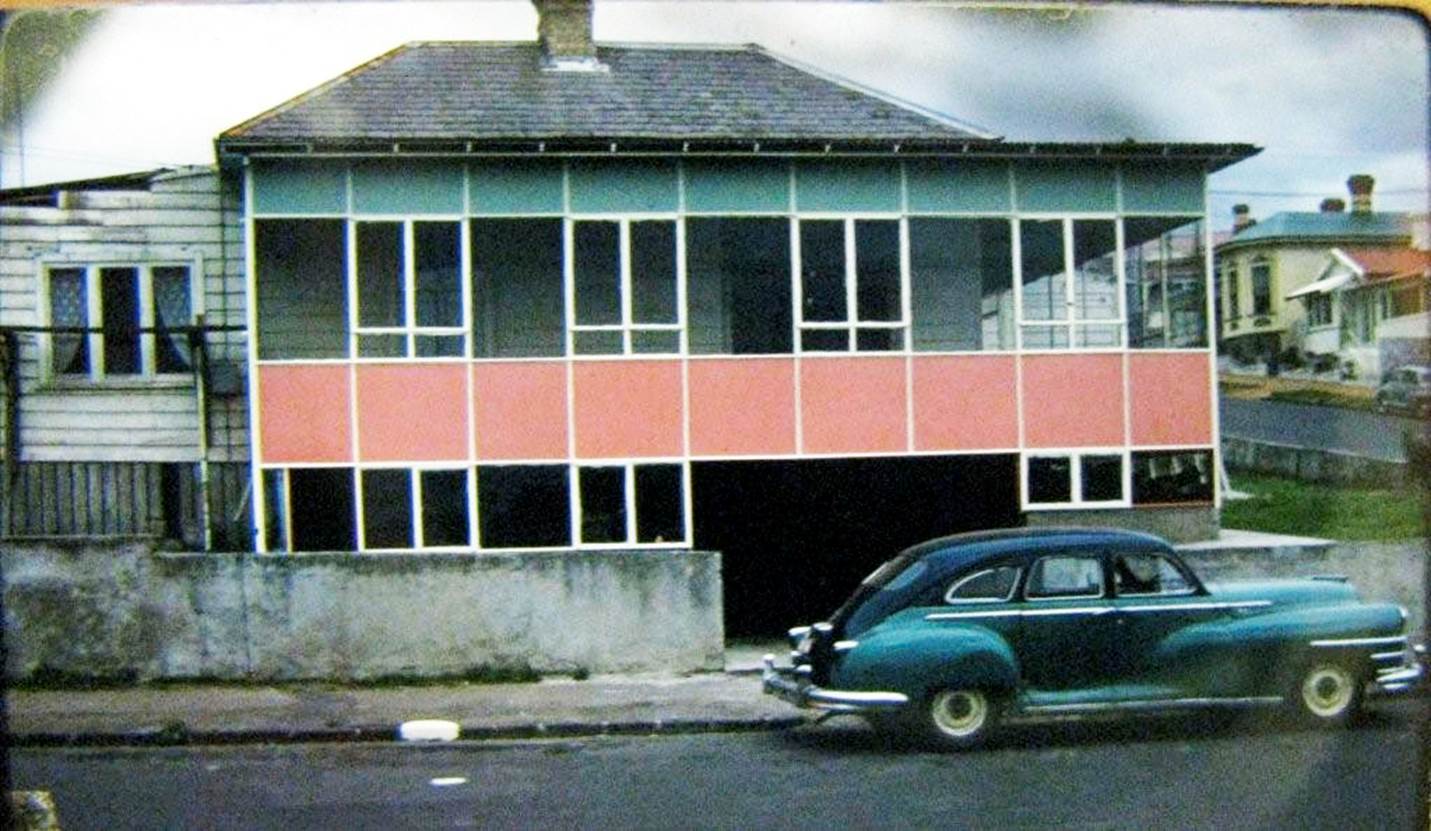
This is what it looked like when we lived there in the 50s … also showing the family car parked outside. In the summer months it was our taxi to beaches all around Auckland, loaded down with Nana, aunty Win, mum & dad, 4 kids and a dog.
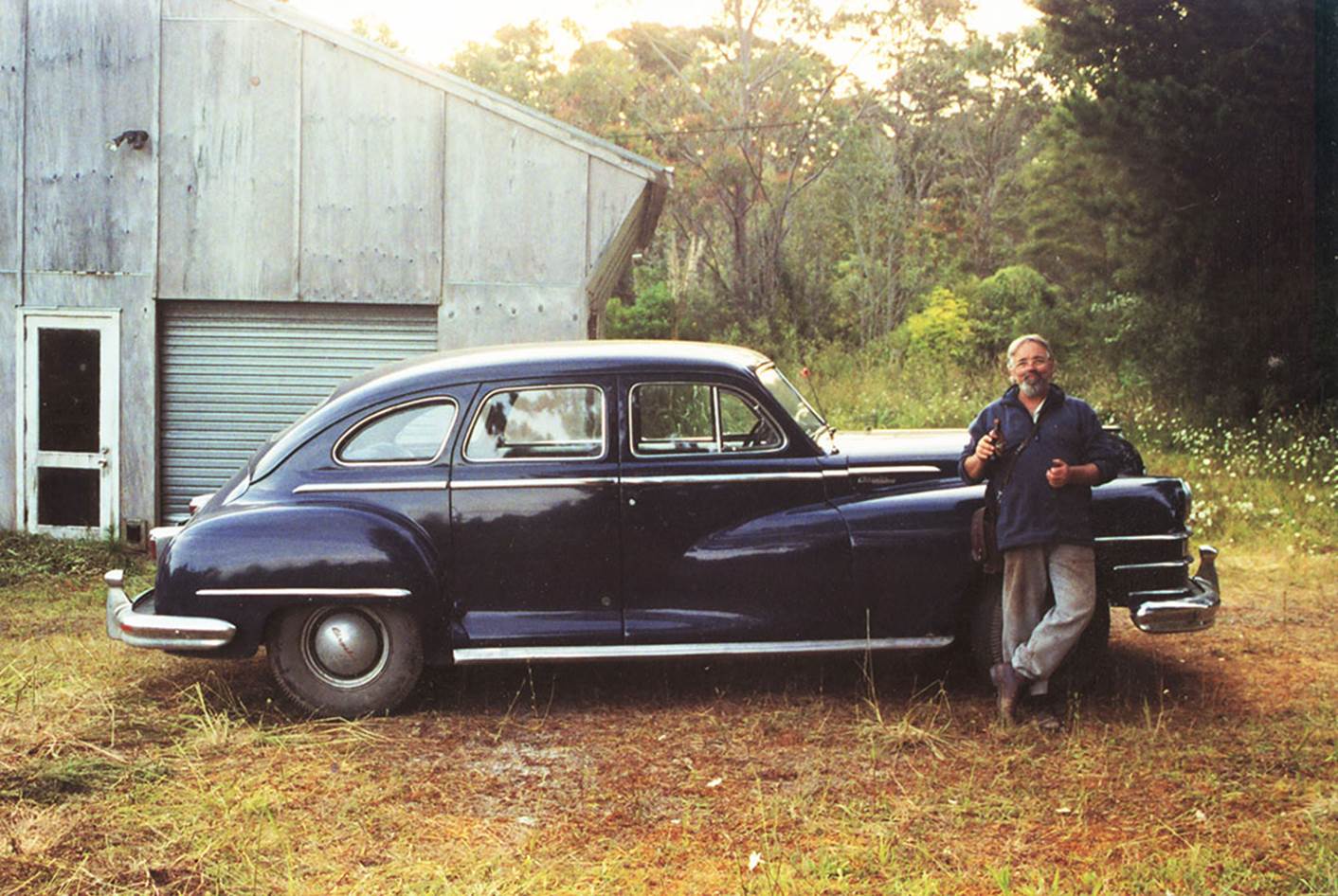
Still in love with old Chryslers and collect them.
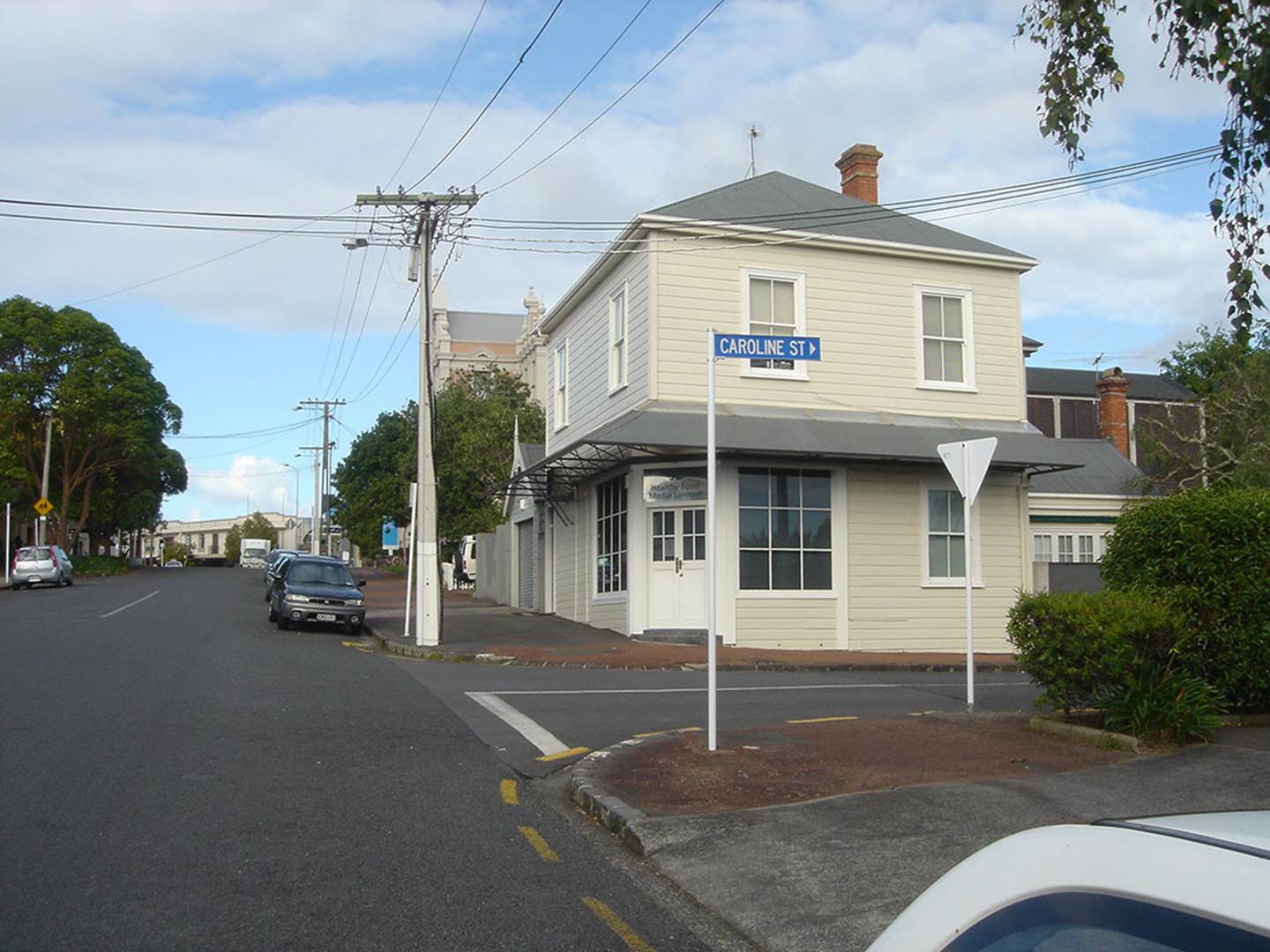
This was the vegetable shop of the Indian Bhana family on St Mary’s Bay Rd, Ponsonby. I went to school with the Bhana kids. In the far background is the Gluepot Pub at the “Three Lamps” and the Chan family had a fruit and vegetable shop very nearby it on Ponsonby Rd. Vivian Chan was my jive partner at Ponsonby School. Her brother sang at the school concerts … ‘I was born on a morning when the sun didn’t shine … I picked up my shovel and I walked to the mine … ya load 16-ton, whad-a-ya get, another day older and yer deeper in debt …’, etc.
The only known Indian member of the Polynesian Panther Party was Nigel Bhana.

This was once Mac’s Dairy on St Mary’s Bay Rd, where you could get a very nice chocolate milkshake.
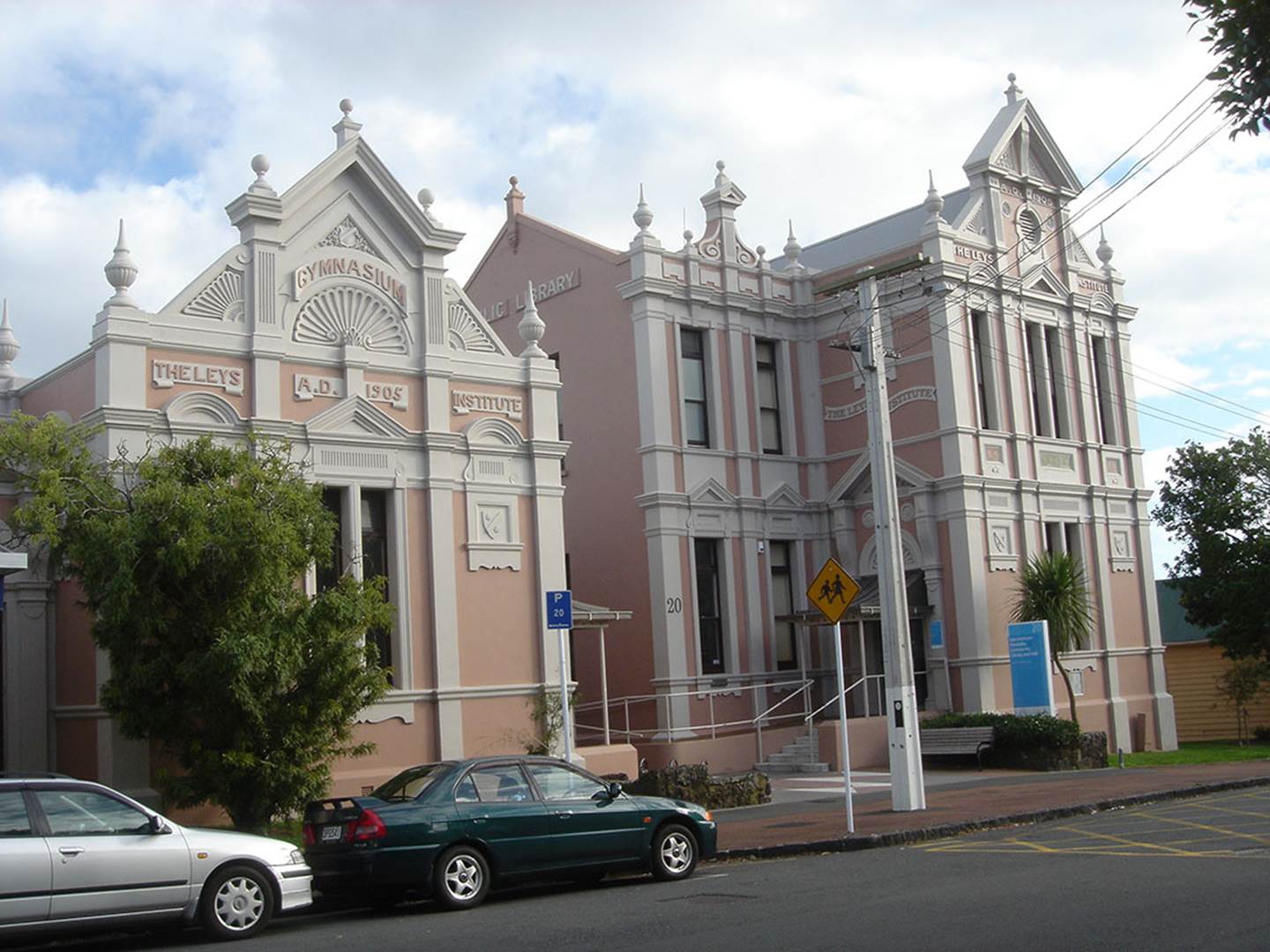
Ley’s Institute Library on St Mary’s Bay Rd, with a facility attached where, over the years, it catered for sports like gymnastics or boxing. My uncles participated there in their youth before WWII and were excellent gymnasts.
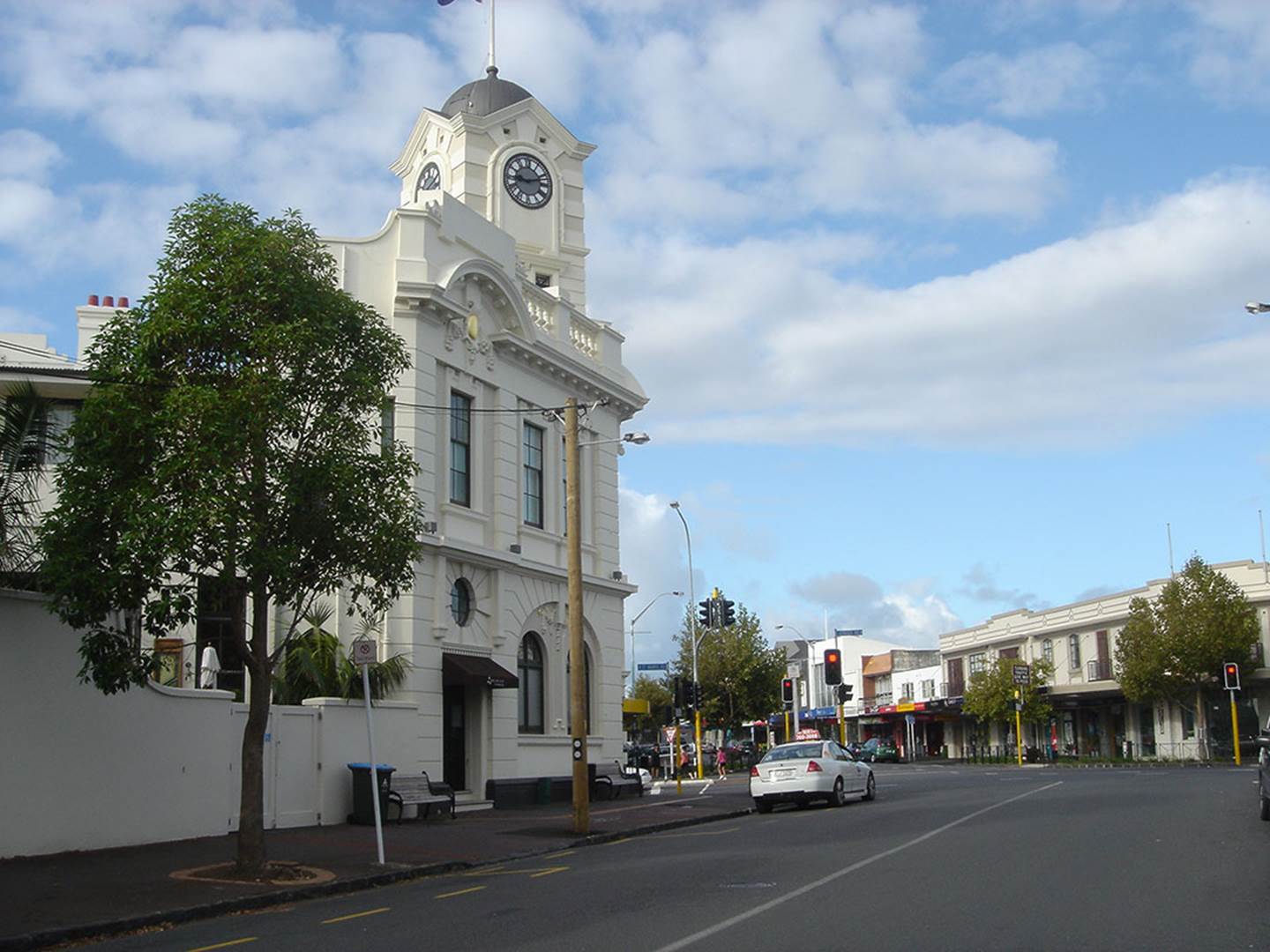
The Ponsonby Post Office and clock tower. In the background is the Gluepot Tavern, which my uncles kept afloat by their unwavering loyalty, patronage and generous contributions in the many decades following WWII.
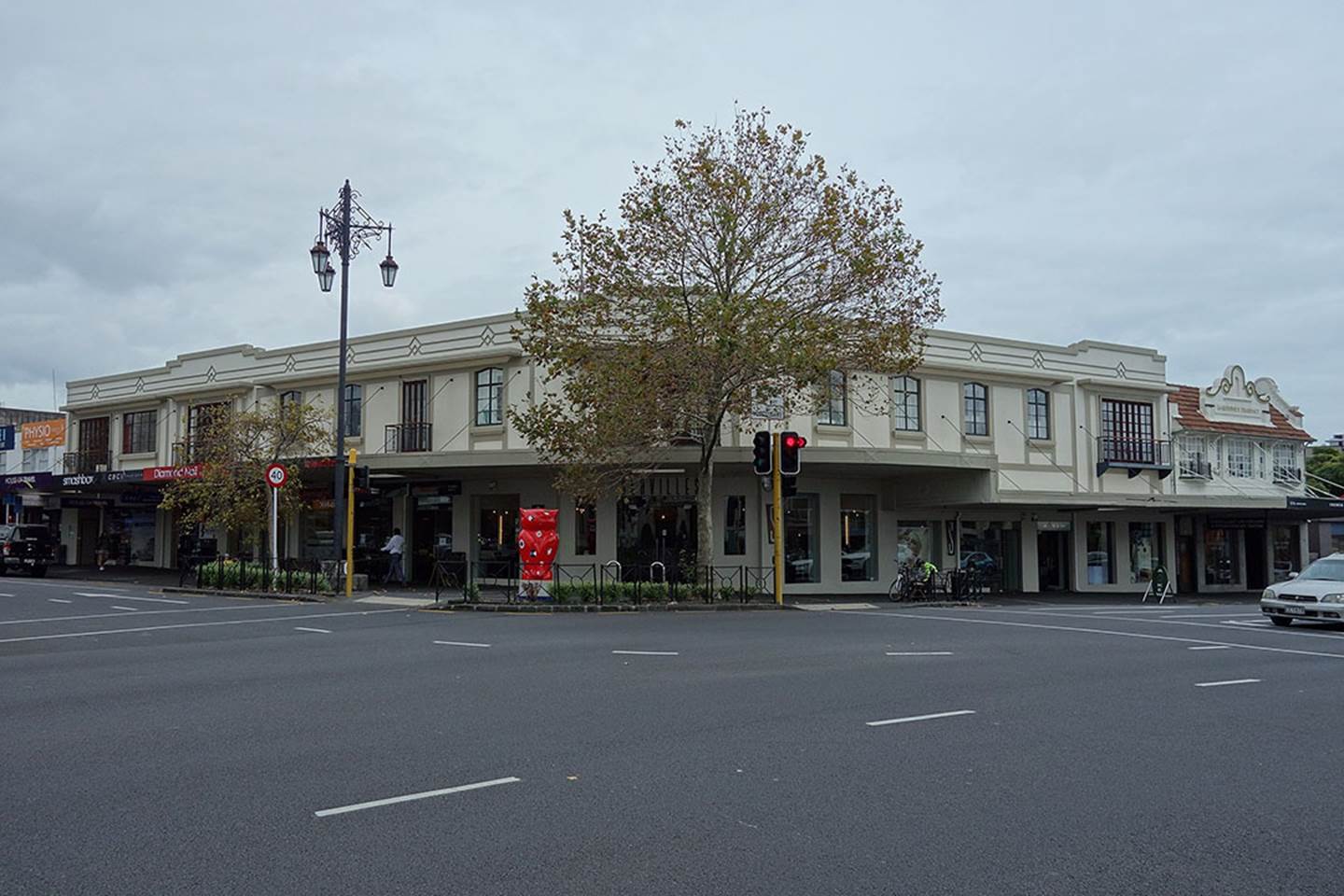
The Gluepot Tavern, the favourite watering hole of the (dr)unkles.
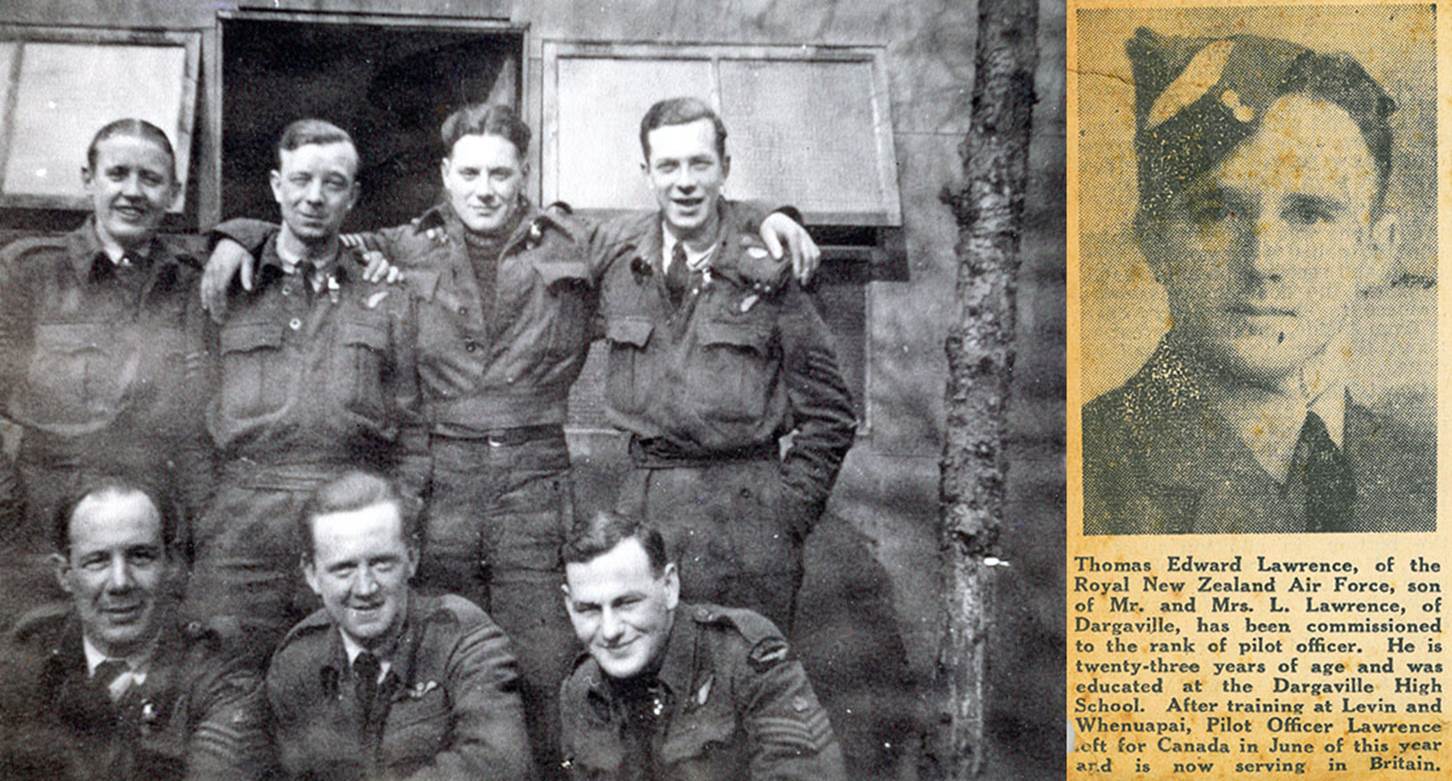
My mother’s brother Ron Martin, (centre, bottom row), was a Lancaster bomber pilot in the RAF during WWII. Her cousin, Tom (right) was a Spitfire fighter pilot stationed in England. Many men returning to civilian life after traumatic, wartime experiences seemed to need their watering holes, like the Gluepot Tavern, and Ron was no exception. My grandfather, who’d been wounded at Gallipoli in WWI downed a few pints there as well. My father was in the US Navy but was a non-drinker.
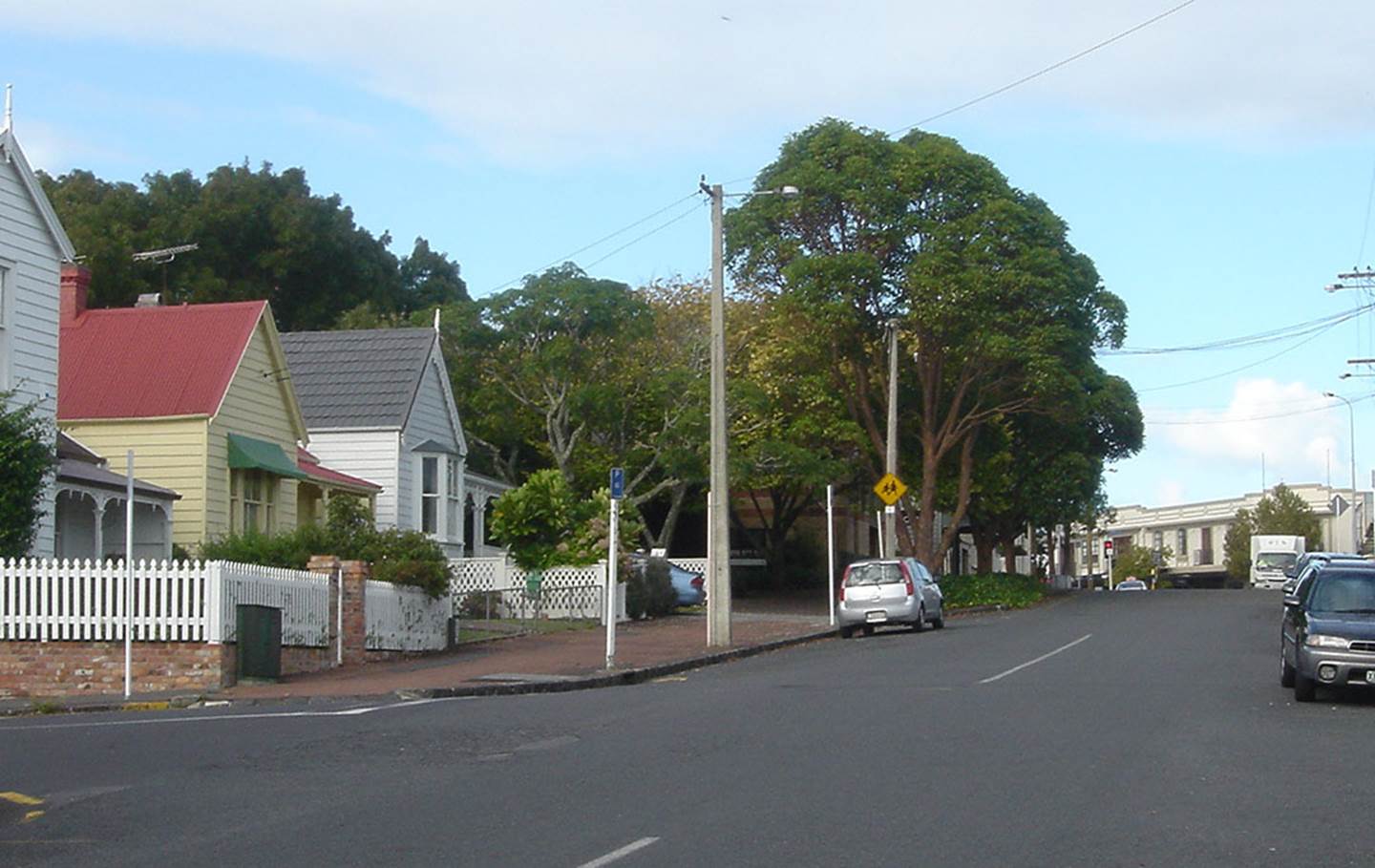
In this 2003 picture is a small tree enshrouded park, across St Mary’s Bay Rd, Ponsonby, from Ley’s Institute. It was here in early 1974 that I first encountered and confronted the Polynesian Panther Party spokespeople selling their wares. I had just returned from 8-years in the United States and Europe and was all-too-well aware of the often violent, destructive activism overseas, having experienced or witnessed it first-hand myself … in Watts, Los Angeles, Newark, New Jersey, Minneapolis, Minnesota etc., etc.
At the Polynesian Panther Party tent, I got fobbed-off by a Samoan girl wearing a negress-type, crimson head scarf and huge sunglasses. When she couldn’t answer any of my questions, she called upon a Maori girl, who told me she’d just returned from China and the experience there ‘was like going back to the Marae’.
THE PPP, GANG AFFILIATED, INTERLOPERS.
If there was chronic racism afoot in Ponsonby, running amok and unchecked when I was a child, then it escaped my attention, as well as those of my multi-cultural entourage of friends. We were blissfully unaware of any such thing lurking in the shadows. The fact of the matter was that we couldn’t identify with the racism we heard about going on in the USA or elsewhere, just as we couldn’t understand the subtleties of British humour related to the “class system”. In Ponsonby we were all getting on just fine and this fact is borne out in the comments of long-term Polynesian residents as well:
‘We all thought that the rest of New Zealand was like this little patch of Ponsonby – Grey Lynn where people got on, diversity was celebrated, pakeha people were part of our family and, like I said, we had our Indians, our Chinese, our Yugoslavians, Catholics’.
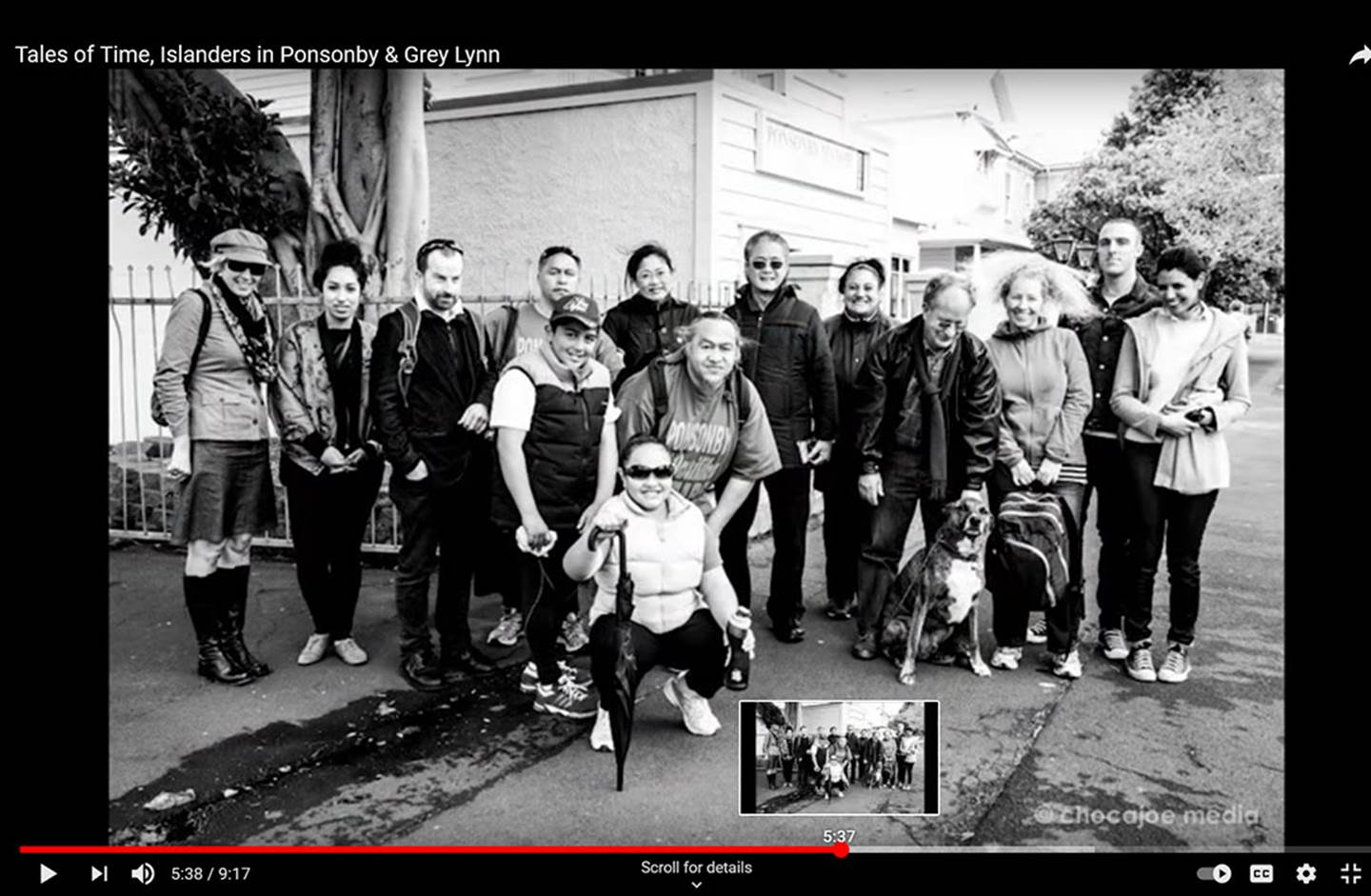
See: Tales of Time, Islanders in Ponsonby & Grey Lynn https://www.youtube.com/watch?v=az48CabzX30
The 1960s saw a fervent uprising in the United States by the negro civil rights movement, coupled with widespread protest, across America, due to an escalation of the Vietnam War. During this tumultuous period a number of black activist spokespeople like Angela Davis, Rap Brown, Huey Newton, etc., etc., rose to prominence worldwide and achieved cult status … and no more so than amongst gang elements of the Polynesian community of Auckland, New Zealand where they were revered almost as gods.
“The Polynesian Panthers adapted the American iconography, images of clenched fists in the leather gloves, the lines of civilian-soldiers in empowering uniforms of black polo-neck sweaters, impenetrable shades and black berets.” (See: PPP website).
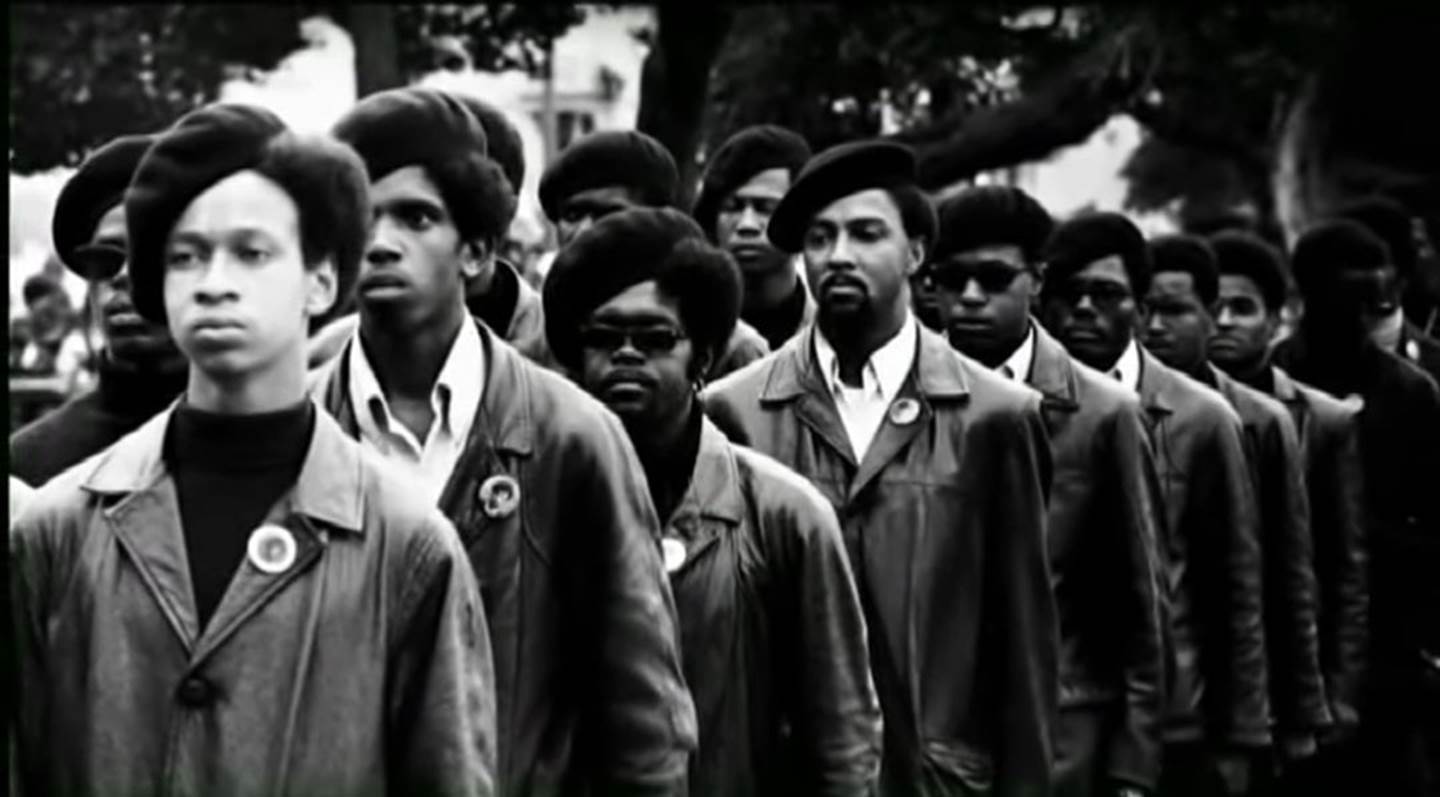
The Polynesian’s adored black-American attire, afro hairstyles, the brightly coloured head scarves or overly large sunglasses of the negress women and adopted all things black-American as an outwardly gushy fashion statement. They earnestly wanted to identify in solidarity with the black-American struggle but had nothing in common with the American experience themselves. Something in their demeanour didn’t ring true and they came across more like “groupies” or immature rebels without a cause who needed to grow up.
It was on the 16th of June 1971, that New Zealand born, teenage Polynesians formed the Polynesian Panther Party, explicitly influenced by the American Black Panther Party and more-especially Huey Newton’s policy of black unity. But something was lacking with these trendy, fashion-conscious, South Pacific island, brown-bro-in-arms wannabes and that was the fact that they’d never been “SLAVES” like the ancestors of their newly adopted, black American brothers and sisters.
The Polynesians had nothing in common with the black history of America. In fact, when Captain William Hobson was sent to New Zealand in 1839-40 to secure a treaty with Maori chiefs, an estimated 10% of Maori in New Zealand were slaves under subjection to other tribes.
In 1839 Hobson, sailing to New Zealand, carried with him a 4000-word brief on how he was to conduct his affairs with Maori should he procure a treaty and form a colony under his governorship. That brief had been written, ostensibly, by the British anti-slave movement and Hobson himself had formerly been a British captain in the Caribbean, charged with stopping the trafficking of slaves, raiding slave ships and liberating their cargoes. The first major hurdle of his newly formed, fledgling government was in trying to free the slaves of New Zealand.
The PPP began to concoct a fantasy history about being an enslaved people under the yoke of British Imperialism, but their migration from the Pacific Islands had been a mere trickle from the 1920s onwards and only became significant during the 1950s-60s. They had come to New Zealand seeking work and economic advantage. They never experienced any “slavery” under the yoke of the British Colonial government, either in New Zealand or their Pacific Island homelands.
These days, the cause célèbre argument put forward to justify the formation of the Polynesian Panther Party centres around alleged oppression of the Polynesian community at the hands of the New Zealand Government. Justification, or the Polynesian Panther Party’s claimed raison d'être, focuses on the “Dawn Raids” undertaken by the police to identify illegal foreign workers who had stayed-on in New Zealand long after the expiry of their work permits. Most of these overstayers were from Pacific Island countries and the individuals concerned knew they were in breach of immigration laws.
However, the now-infamous “Dawn Raids” didn’t get underway in earnest until March 13th , 1974, almost 3-years after the formation of the Polynesian Panther Party, when the known number of overstayers had grown to about 500. By March 18th 34 Tongan detainees had been arrested that month and an amnesty or stay against deportation, was called-for by the Norman Kirk Labour Government. By the end of that year, 107 Tongans, 24 Samoans and 2 Americans were deported. In the final analysis, two thirds of the deportees were Pacific Islanders and one third other foreign nationals.
As unfortunate and traumatic as these raids and detentions were for the overstayer individuals affected by them, I also had to really jump through hoops in early 1974 to get acceptance, by Immigration NZ, to come home and stay after 8-years away overseas. Processing my paperwork took months. By April 2nd, 1974 sweeping restrictions curtailed immigration from the UK as well, under new rules designed to overhaul New Zealand immigration policy. Everyone was affected, whether members of the Commonwealth or not.
The arguments conveniently used nowadays to laud and applaud the formation of the Polynesian Panthers, as social-justice-warrior heroes, intervening to curtail police harassment of Polynesians, fall flat on their face, as no general NZ Government targeting of the Polynesian overstayers existed till 1974. For the intervening 3-years, the strutting PPP members were looked upon, by the Ponsonby community at large, as little more than teenage rabble-rousers, whose causes or slogans had no real relevance to New Zealand. A lot of opposition came at them from the elders within the Polynesian community, as well as their own parents.
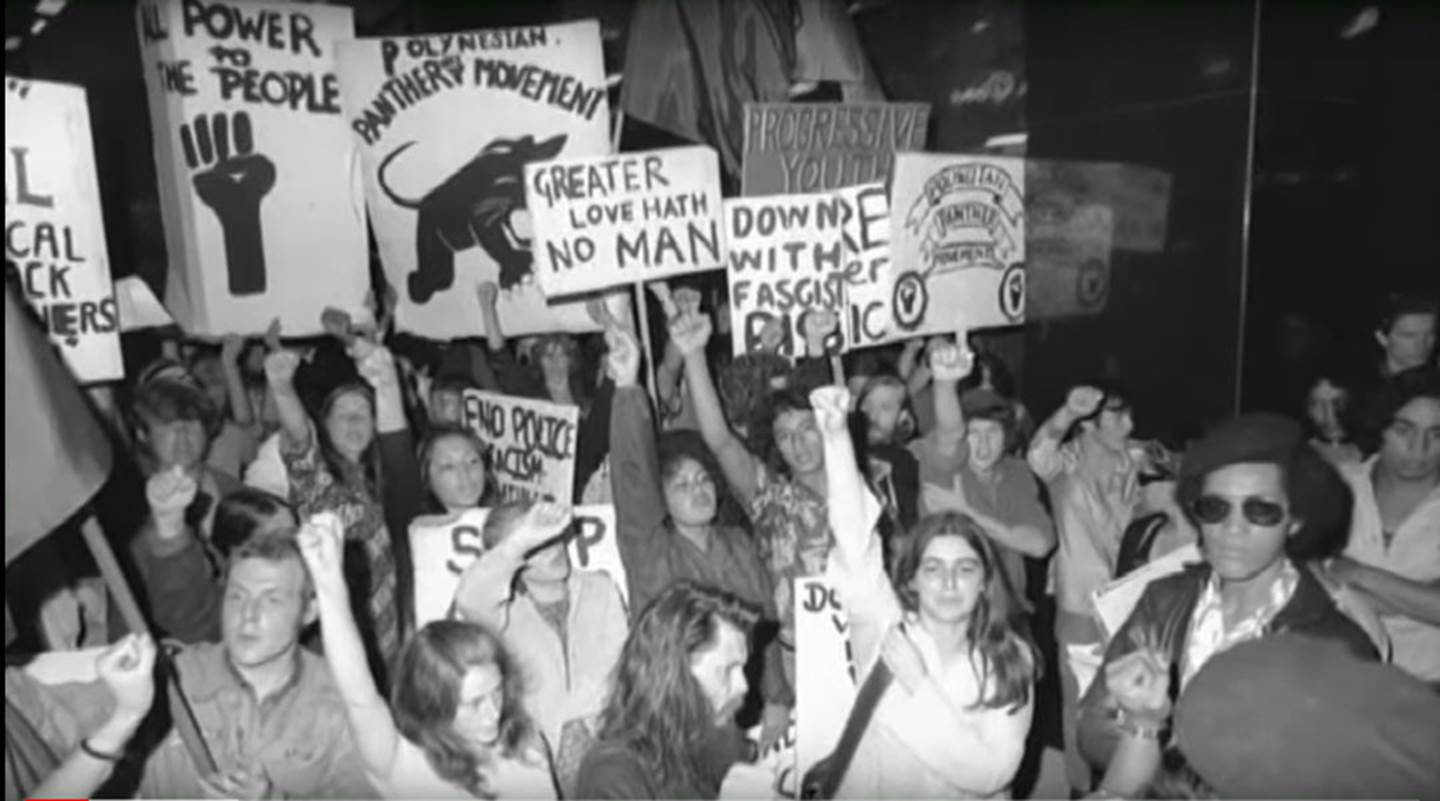
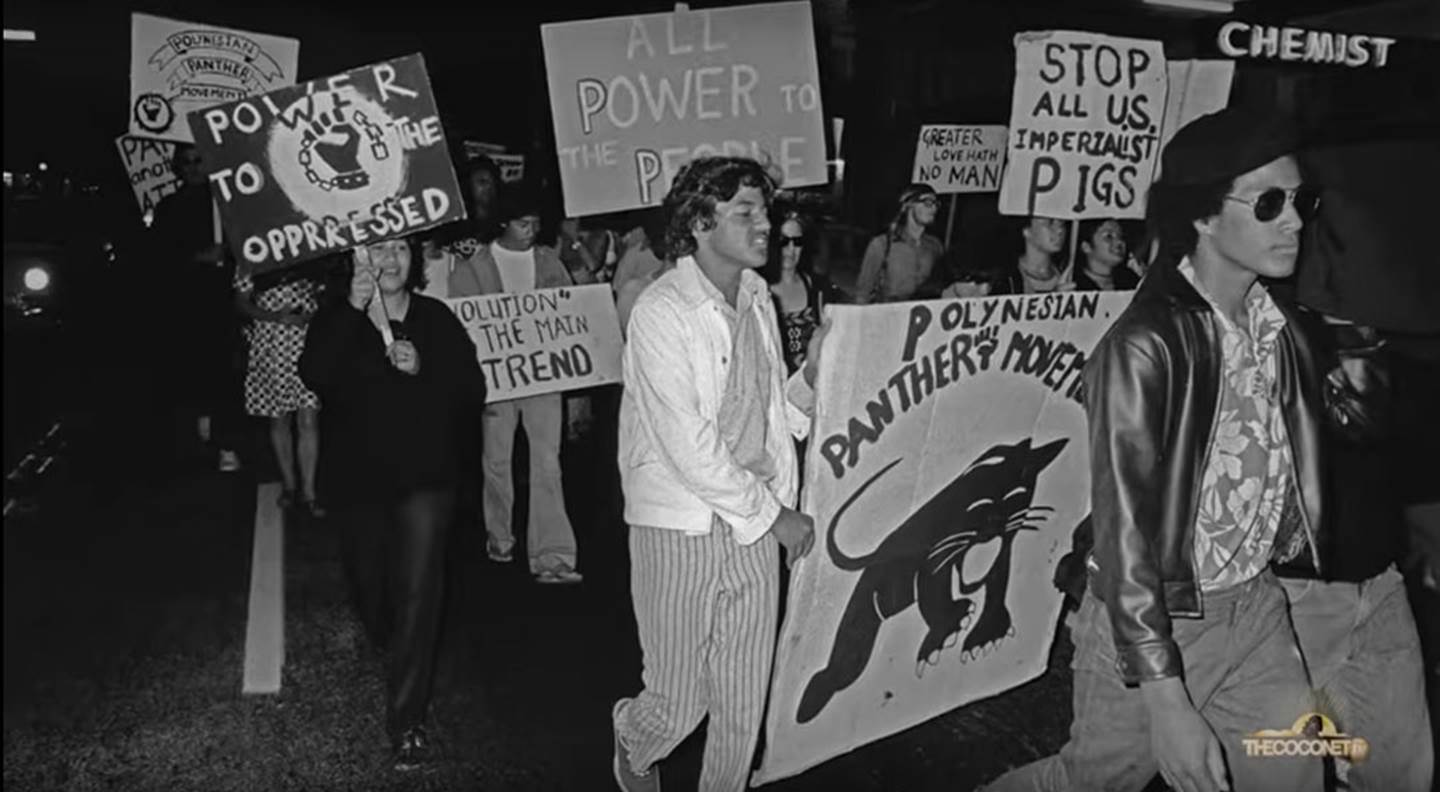
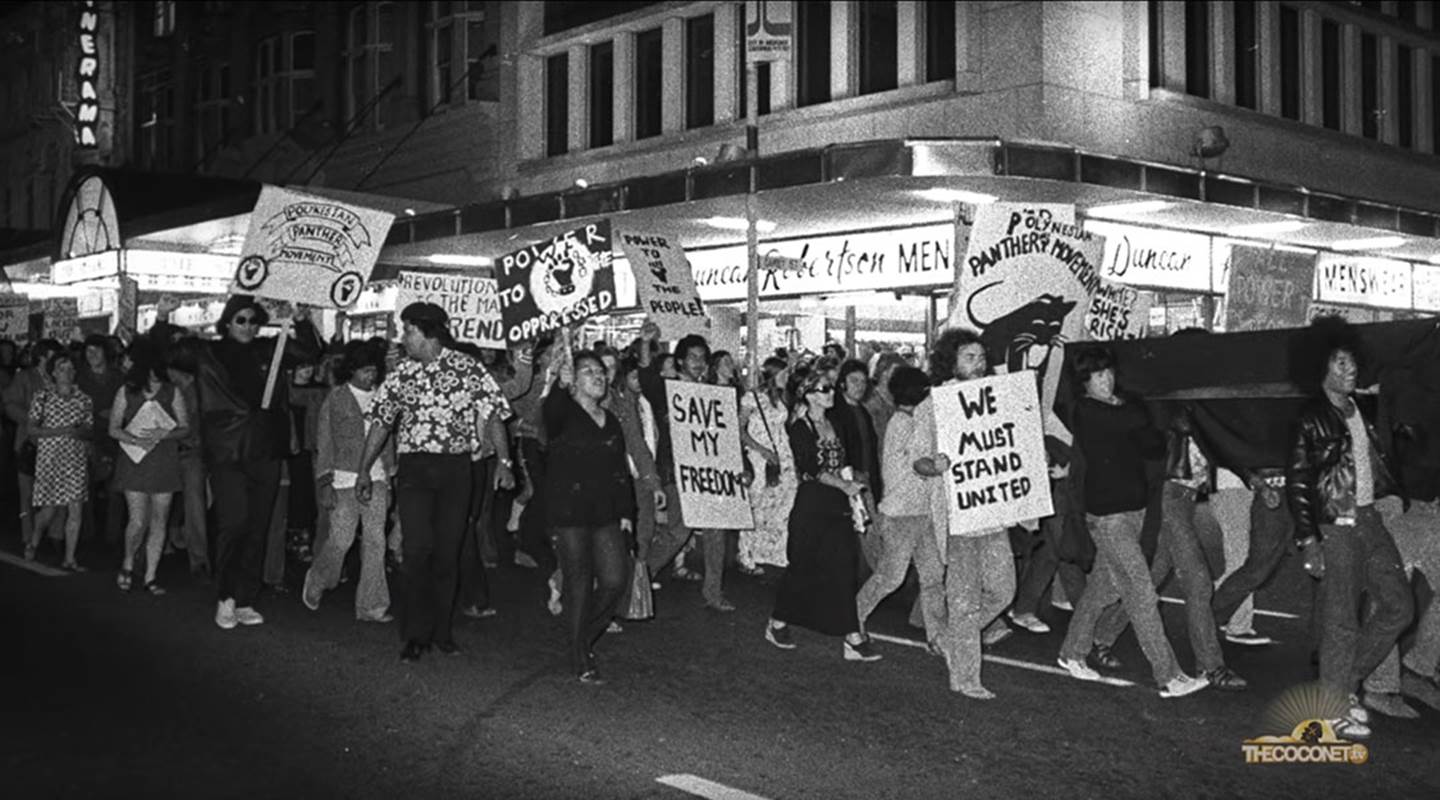
Everyone seems to be having a good time … smiles all ‘round. Naaahh … hard to take this lot of partygoers/revellers seriously.
Their anti-social or criminal activity around the Ponsonby, Grey Lynn or Newton suburbs between 1971 to 1974 were what increasingly drew police focus onto them and initiated the infamous Dawn Raids of 1974.
Who was funding the PPP and paying their office rent and wages through this period between 1971 & 1974 … ill-gotten gains from the gangs …the Communist unions?
Maori initially showed little interest in the goings-on of the of the “Pacific islanders” [whose parents had immigrated to NZ mainly from Samoa] and were slow to warm towards Polynesian Panther Party radical rhetoric, even calling them very derogatory names.
However, in time, a trickle of Maori opportunists aligned themselves with the PPP, whose core membership was made up mostly of teenage Polynesian members of the Nigs Pacifika gang, later joined by biker gangs like, King Cobras, Black Power, Mongrel Mob, etc.
In commenting concerning founding member, Miriama Rauhihi Ness, wife of Tigilau Ness:
"We were so privileged to have her in the Panthers because she was able to cut a lot of the ice, especially in those days because there was a lot of friction between Māori coming from little Aotearoa and us coming down from the islands. So, she was able to cut across that and she became out first paid worker in the Panthers”.
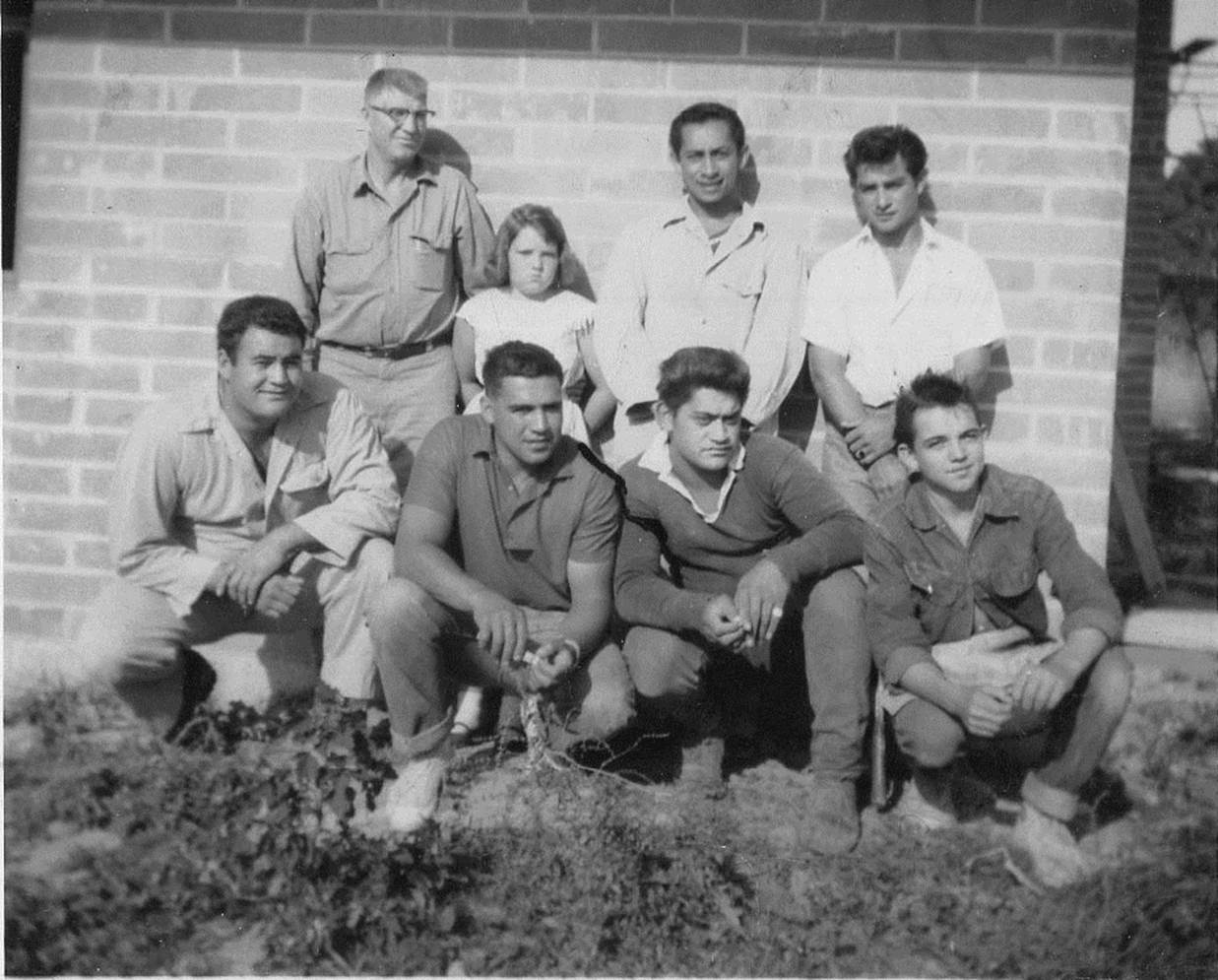
As a young carpenter in the mid-60s I had worked in outlying Maori communities and observed that Maori were quite stand-offish or detached in terms of their association with the several Pacific Island ethnicities. I was also surprised to find that there was a generally recognised hierarchy or pecking-order amongst the Pacific Island groups themselves, with something akin to a class system. As I recall the Tongans held the high ground, probably due to the Tu'i Tonga dynasty that had conquered a wide section of the Pacific between 1200-1500 AD.
I was also told that the Niuean’s ranked the lowest in the NZ Polynesian immigrant pecking order, for what reason I know not, as I did renovation work in Ponsonby for Niuean families and found them to be lovely people … including the Ness mother & daughter of O’Neil St, Ponsonby, who I think were the mother & sister of Tigilau Ness, founding member of the PPP.
I found it hard to take the Polynesian Panther Party version of disruptive idiocy seriously, with their heavy gang affiliations and excessive, cult-like adoration of black American fashion fads. They reminded me of many so-called “hippies” I’d encountered in the States, who simply went down to the local “hippy” shop, bought some blue-glass wire-frame spectacles, a bunch of psychedelic clothing, beads and a sleeveless serape poncho, then learnt to say “heavy” and/or “groovy” in a spaced-out, slurred drawl. Whereas, there were genuine “hippy” individuals, breaking away from the establishment and seeking to be self-sufficient in isolated communes, most dress-up wanabees sauntering around town were frauds, swept along by a passing fad.
Over the years, I watched the latest black-American, in-vogue fads come and go, all enthusiastically adopted by the Polynesians …rap music, break-dancing, turn-the cap, baggy pants and hoodies, tagging-graffiti, shoulder carried boom-boxes (ghetto-blasters) and if black gangs in Newark, New Jersey, USA were assaulting people on the streets and stealing their leather jackets, then the groupie NZ based locals dutifully got into that as well, etc., etc
THE VERY SURPRISING, ROLL ON EFFECT OF POLYNESIAN PANTHER PARTY VOCAL ACTIVISM
Surprisingly, the Polynesian Panther ruckus, stirring-strutting-stomping, had a profound revolutionary effect in transforming placid little, together-New Zealand into a divided country.
The very powerful worker’s unions of New Zealand were heavily Marxist, mostly leaning towards Soviet Russian Communism. A smaller faction idolised Chinese Communism under Mao Tse Tung and trotted out gems of wisdom from Mao’s Little Red Book.
The unions, ever willing to further their communist agenda, seized upon the opportunity to fuel the fire of the Polynesian Panther uprising and funded activists to be sent to Russia, China or Cuba for indoctrination in destabilising tactics or even Libya for weapons training. This fifth column contingent were to return to New Zealand and cause helter-skelter to our placid, bi-cultural society, with its mostly enduring friendship between Maori and European since early colonial times.
At the height of the divisive noise of 1974, the Returned Services Association of New Zealand took out a full page ad in the Auckland Star Newspaper, pleading with the PPP and aligned Maori dissidents, spouting accusations of racism, ‘Please don’t do this to us … we have been comrades in arms through two world wars, we are recognised throughout the world as being a country without racism … Racism is something that is caused by people talking about it …’
Maori WWII veterans appeared on TV pleading with the rabble-rousers to stop trying to divide us, but it all fell on deaf ears.
Among the leading, mouthy dissidents was Syd Jackson, ‘a core member of Ngā Tamatoa (the “young warriors”), the pre-eminent Māori pressure group of the time. He undertook comparative studies on race and racism in the United States and New Zealand as part of his Masters in Political Science degree, and was in part inspired in his activism by the books of Eldridge Cleaver and Stokely Carmichael. For some activists, then, Black Power was seen to be forcing a confrontation of New Zealand society with the reality of white supremacy. As one participant recounted, in an important youth conference, “Black Power is to stop white power ...’ (See: https://robbieshilliam.files.wordpress.com/2012/11/black-power-aotearoa.pdf ).
Another mouthy ranter in the dismal line-up of the time was Donna Awatere, who seemed to adore mass murderer, Che Guevara. She wore the Guevara/ Black Panther beret and the slogans that spewed forth from her mouth sounded like they were coming from The Peoples Voice communist newspaper … which calls to mind Bob Dylan’s lyrics, ‘I was so much older then, I’m younger than that now’ … or, a parent’s exasperated retort to their ignorant, over-opinionated brat, ‘why don’t you leave home while you still know everything’. Awatere went to Cuba in 1979.
Shakespeare probably summed-up individual actors within this sorry pantomime best as, ‘It is a tale told by an idiot, full of sound and fury, signifying nothing’.
As the clamour of this purpose-manufactured, but historically inaccurate, dissonance rose to a crescendo through the 1970s, the fallout began increasing to infiltrate New Zealand’s institutions of higher learning and government departments, heavily influencing the direction of both.
Beyond 1974 or so, the earlier, reliable history books, written since the dawn of the colonial era, were assailed in Marxist-speak as ethnocentric or Eurocentric in an effort to throw their contents into disrepute. It was a form of book-burning and most of our old titles or former foundation studies about colonial history or pre-colonial human habitation and interactions (derived from Maori oral traditions and archaeological evidence) began to disappear from the library shelves, only to be replaced by more suitably sterilised pseudo-history that promoted the views or long-term goals of the Marxist political organs.
This was a time when dissident factions within New Zealand conveniently forgot that we were all New Zealanders in this together and their Marxist or tribalist agendas began to fragment our society into greedy self-interest groups, to the exclusion of all other groups.
Central to this incentive was Minister of Maori Affairs, Matiu Rata, as well as the Maori Council, who saw a growing opportunity to push their own tribalist or separatist agendas.
As a young carpenter in the mid-1960s, I vividly recall having a conversation with a Maori work colleague whose tribe was located in the Manukau-Waikato districts of the North Island’s West Coast. He told me that ‘his tribe had more rights under the treaty than any of the other treaty-signatory tribes throughout all of New Zealand. Unlike all the other tribes, their treaty included “Forestry & fisheries”, whereas none of the other treaty agreements mentioned this’
I never really thought about what he’d said or its significance till years later, after I’d gained a fuller grasp or understanding related to the treaty signing assemblies that had occurred around New Zealand in 1840.
MATIU RATA BECOMES MINISTER OF MAORI AFFAIRS IN 1972.
By 1974, Minister of Maori Affairs, Matu Rata had managed to have his Treaty of Waitangi Bill accepted for reading by Parliament and it received royal assent into law in 1975. As stated, Rata was fixated on having an English-language version of the treaty introduced to sit alongside the Maori-language treaty (Te Tiriti o Waitangi) and be co-equal to it … a seemingly very strange request from a Maori leader as, up till that time, Te Tiriti text constituted the solitary wording under New Zealand and international law.
Rata and his cohorts forced acceptance of wording from a defunct and illegitimate Formal Royal Style document in English, concocted after the treaty presentation in 1840 solely for overseas despatch to foreign governments as a pretentious, memorial document … heralding the treaty between Britain and New Zealand to the international community.
As stated, what Rata was morally obliged to use, if he truly and genuinely intended to show what the Maori text said in English, was the 1869 back-translation, formally commissioned by the New Zealand government and officially issued by the Native Department, which absolutely mirrored, line-by-line, the content, meaning and intent of Te Tiriti o Waitangi.
The very cunning Matiu Rata, however, had a particular tribalist agenda in mind in elevating this illegitimate English wording to a status co-equal, under NZ legislation, to Te Tiriti o Waitangi Maori text.
Composite "Royal Style" version assembled from early notes by James S Freeman, about 5-6/2/1840. Her Majesty Victoria Queen of the United Kingdom of Great Britain and Ireland regarding with Her Royal Favour the Native Chiefs and Tribes of New Zealand and anxious to protect their just Rights and Property and to secure to them the enjoyment of Peace and Good Order has deemed it necessary in consequence of the great number of Her Majesty's Subjects who have already settled in New Zealand and the rapid extension of Emigration both from Europe and Australia which is still in progress to constitute and appoint a functionary properly authorized to treat with the Aborigines of New Zealand for the recognition of Her Majesty's Sovereign authority over the whole or any part of those islands. Her Majesty therefore being desirous to establish a settled form of Civil Government with a view to avert the evil consequences which must result from the absence of the necessary Laws and Institutions alike to the native population and to Her subjects has been graciously pleased to empower and to authorize "me William Hobson a Captain" in Her Majesty's Royal Navy Consul and Lieutenant Governor of such parts of New Zealand as may be or hereafter shall be ceded to Her Majesty to invite the confederated and independent Chiefs of New Zealand to concur in the following Articles and Conditions. ARTICLE THE FIRST The Chiefs of the Confederation of the United Tribes of New Zealand and the separate and independent Chiefs who have not become members of the Confederation cede to Her Majesty the Queen of England absolutely and without reservation all the rights and powers of Sovereignty which the said Confederation or Individual Chiefs respectively exercise or possess, or may be supposed to exercise or to possess, over their respective Territories as the sole Sovereigns thereof. ARTICLE THE SECOND Her Majesty the Queen of England confirms and guarantees to the Chiefs and Tribes of New Zealand and to the respective families and individuals thereof the full exclusive and undisturbed possession of their Lands and Estates Forests Fisheries and other properties which they may collectively or individually possess so long as it is their wish and desire to retain the same in their possession; but the Chiefs of the United Tribes and the individual Chiefs yield to Her Majesty the exclusive right of Preemption over such lands as the proprietors thereof may be disposed to alienate at such prices as may be agreed upon between the respective Proprietors and persons appointed by Her Majesty to treat with them in that behalf. ARTICLE THE THIRD In consideration thereof Her Majesty the Queen of England extends to the Natives of New Zealand Her royal protection and imparts to them all the Rights and Privileges of British Subjects. [Signed] W Hobson Lieutenant Governor Now therefore We the Chiefs of the Confederation of the United Tribes of New Zealand being assembled in Congress at Victoria in Waitangi and We the Separate and Independent Chiefs of New Zealand claiming authority over the Tribes and Territories which are specified after our respective names, having been made fully to understand the Provisions of the foregoing Treaty, accept and enter into the same in the full spirit and meaning thereof in witness of which we have attached our signatures or marks at the places and the dates respectively specified Done at Waitangi this Sixth day of February in the year of Our Lord one thousand eight hundred and forty. |
The original Maori text translated by Reverend Henry Williams and Edward Williams 4/2/1840. |
Translation from the Original Maori by, Mr. T.E. Young, Native Department (1869). |
In Matiu Rata’s hard push to introduce an English language version into our legislation, to sit alongside Te Tiriti o Waitangi and be co-equal to it, he wanted the text (left column, highlighted in red). He absolutely needed that text to supplant and replace the red-highlighted text of Te Tiriti o Waitangi (middle column), as well as the text found in the official back-translation, commissioned by the NZ Government, in 1869 (right column).
All of the early draft, English text in the left-handed column was rendered obsolete and discarded, by February 4th when the Final English Draft was written. However, Matiu Rata, if he was to pull off his deceptive ruse, absolutely needed that solitary text, as it made no clear mention of the English or settler rights, whereas Te Tiriti o Waitangi and every back-translation derived therefrom clearly mentions “and all the people of New Zealand – ki nga tangata katoa o Nu Tirani.”
The totally ridiculous and impossible claim, foisted upon New Zealanders and now taught in our schools, is that the English text, seen in the left-hand column, was the Final English Draft, used by Reverend Henry Williams and his son, Edward Marsh Williams (considered to be a scholar “par excellence” in the Ngapuhi dialect) to translate into Te Tiriti o Waitangi Maori text on 4/2/1840.
As any seasoned translator would conclude, that’s absolutely impossible!
The main (present day) problems related to treaty interpretation are borne out of the wording of this bastardised, Article II, officially recognised, 3rd of February, rough draft English version that we use, which states that the rights guaranteed under the treaty are only for:
“…the Chiefs and Tribes of New Zealand and to the respective families and individuals thereof”.
But that’s not what the Maori version says:
“ki nga Rangatira ki nga hapu-ki nga tangata katoa o Nu Tirani…” [which means] … “…to the Chiefs, the Hapus [tribes or families] and all the people of New Zealand…” (Translation from the Original Maori by, Mr. T. E. Young, Native Department…1869).
Which is what the Littlewood Treaty says:
“…to the chiefs and the tribes and to all the people of New Zealand…”
Which is what James Reddy Clendon’s 20th of February 1840 despatch No. 6 to the U.S. Secretary of State says:
“…to the chiefs and the tribes and to all the people of New Zealand…”
Which is what Commodore Charles Wilkes’ wrote into the U.S.S. Vincennes’ letter book and, subsequently, sent in his April 5th, 1840 despatch No. 64 to the U.S. Secretary of State:
“…to the chiefs and the tribes and to all the people of New Zealand…”
Which is what Gordon Brown’s back-translation, found amongst the Clendon House Papers, says:
“…to all the tribes, chiefs and all men in New Zealand…”
Which is what a very early back-translation by an unknown author (found in the Clendon House Papers) says:
“…to the chiefs, to the tribes, to all the people of New Zealand…”
Which is what J. Noble Coleman wrote in, A Memoir of the Rev. Richard Davis, 1865 pp. 455-56:
“to the chiefs, the tribes, and all the people of New Zealand…”
Which is what Prof. Hugh Kawhura’s modern translation says:
“…the chiefs, the subtribes and all the people of New Zealand…”
Treaty historian, Dr. Claudia Orange, echo’s a known fact, long-since acknowledged by experts that:
‘The original draft in English, on which Henry Williams based this Maori translation, has not been found. His original translation, presented to the Waitangi meeting of 5 February, has also disappeared’.
As stated, the text of the newly elevated into the limelight, Formal Royal Style document was based upon rough-draft English notes that were obsolete by the 3rd of February 1840 and had been discarded before the tightly worded and concise, Final English draft was written the next day then translated to become Te Tiriti o Waitangi (New Zealand’s equivalent to the US Declaration of Independence … leading on to The Constitution of the United States).
With the layout of sentences, paragraphs or the wording in the Formal Royal Style composite being so different, especially in Article II, a marvellous opportunity, obviously premeditated, for exploitation of the differences, could occur.
By severely muddying the waters, based upon pointing out the vast differences between the two texts, Rata and his cohorts forced acceptance that this English text was what the English believed was the meaning of the treaty. The door was then left wide-open for major reinterpretation of the treaty.
Rata ultimately managed to completely replace the actual wording of the treaty (literally) and push the only true treaty (Te Tiriti o Waitangi) into the shadows, where its inconvenient, unwanted wording never had to be consulted ever-again.
Look carefully at all the extra words or topsy-turvy concepts (coloured blue), along with some of the more blatant place names or words that did not get included in the Maori text.
Look carefully at the order in which concepts or sentences appear; Consider where Hobson puts his name, etc., etc. It is absolutely impossible that adept translators, who had lived in New Zealand permanently for 17-years by that time, speaking Maori fluently every day or engaged in writing and translating English documents into the Maori language constantly, could make such a "botch-up" of a translation. It stretches credibility beyond the extreme for our so-called scholars to, seriously, advocate something so patently ridiculous.
Yes indeed, historian Ruth Ross, in 1972, was totally correct in stating:
‘A comparison of all five English versions (Formal Royal Style memorial documents for overseas despatch to foreign governments) with the Maori text makes it clear that the Maori text was not a translation of any one of these English versions, nor was any of the English versions a translation of the Maori text’ (See: Te Tiriti o Waitangi: Texts and Translations, New Zealand Journal of History, Oct. 1972).
Despite reams of documented proof to the contrary, showing sovereignty was most definitely ceded (and gratefully so on the part of beleaguered tribes afflicted with endless inter-tribal warfare), the radical, indigeneity-rights arguments persist to this day. Every attempt is made by the Maori supremacists to turn a benign and friendly treaty document of unification, which stood unchallenged for 135-years, into a document of apartheid or separatism. (See: http://www.celticnz.org/TreatyBook/Precis.htm)
That our treaty historians, academics and political leaders did not intervene to arrest such patently obvious fraud is a travesty, and reflects their very poor grasp on scholarship, the power to reason or the ability to apply the most basic logic. We trusted them to protect us, but the lack-lustre, moral cowards stood back and let the deception unfold without interference.
By the 1980s, international corporations or organisations like the UN had been able to deepen and exploit the disunity amongst New Zealanders, thereby finding in-roads to impose globalist agendas or gobble-up State-Owned Enterprises, formerly owned by the New Zealand public. The protections to New Zealand and its sovereignty inherent in the Treaty of Waitangi, now in tatters, were nullified and a corporate shark’s-feeding frenzy ensued. Massive foreign interference descended upon New Zealand’s rights to self-determination.
THE ERA OF THE GRIEVANCE-INDUSTRY USHERED IN.
The Marxist inspired and pushed, pseudo-history campaign of the Polynesian Panther Party, purpose-manufactured to represent themselves as victims of British Imperialism, was embraced by a growing number of Maori activists. The Maori people, at least, had about 135-years of close interaction, as British subjects, since the 1840 signing of the bi-cultural Treaty of Waitangi and formation of a British colony under Queen Victoria. Matiu Rata and the Maori Council obviously saw the potentialities of a lucrative future if they could revisit the many land or resource “claims” already settled with the Maori tribes by the NZ Government since the 19th and early 20th centuries.
The old saying goes: “The squeaky wheel gets the oil” and a great deal of public, media and government attention had become focused on the Polynesian Panther Party’s very vocal rants, posturing and activism. Despite the absurdities of the PPP claim that their fate had paralleled that of black-America under slavery, they were basking gloriously in the limelight of attention.
Matiu Rata and the Maori Council needed to do the same, so threw their lot in with the PPP celebrities and rode along on their coattails.
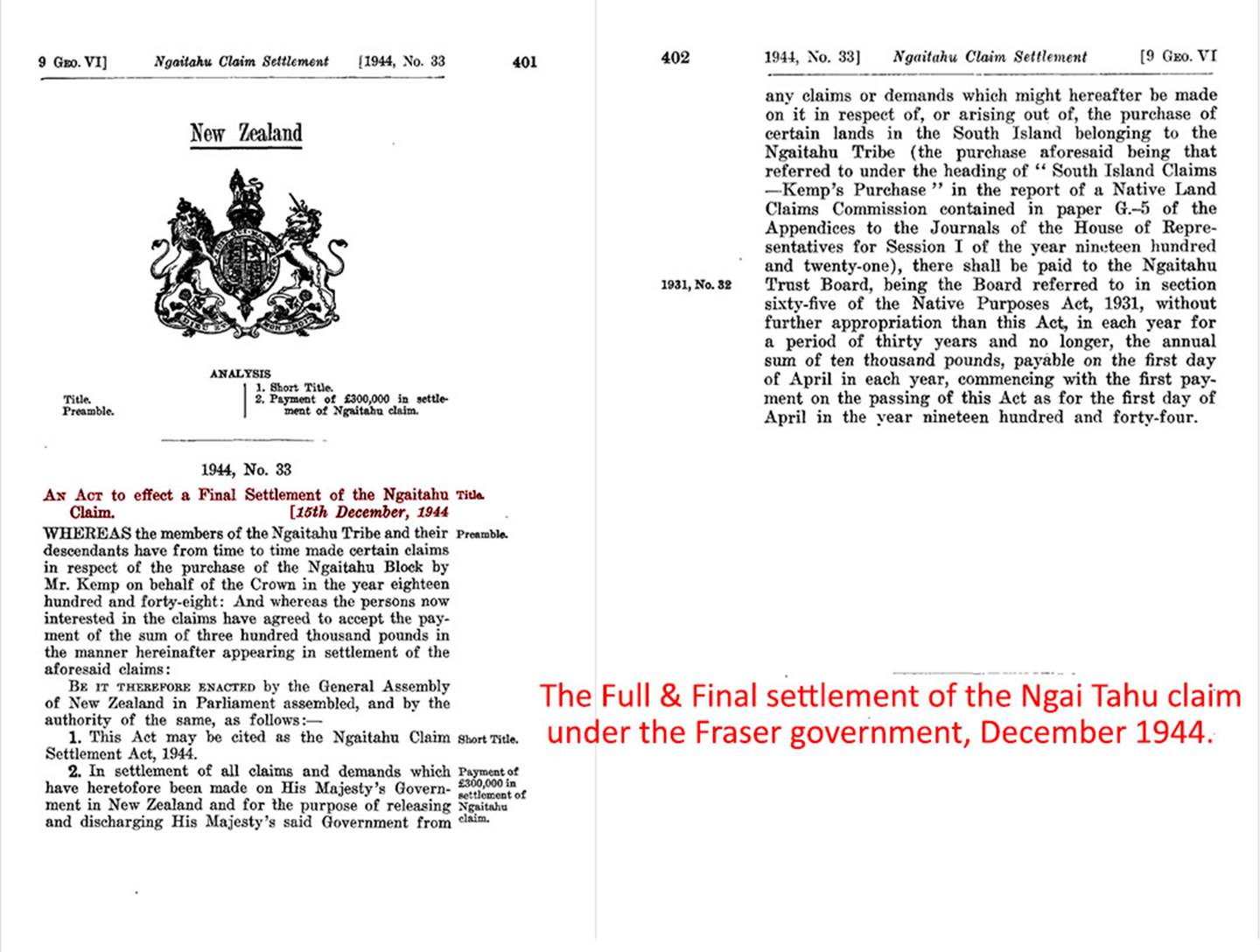
In 1974, with Matiu Rata at the helm as Minister of Maori Affairs, the final payment was made to Ngai Tahu, after 30-years of progress payments. However, Matiu Rata, with the stroke of a pen, designated that the payments would be “in perpetuity” … in other words, would continue to be made annually forevermore at a rate of $20,000 per annum.
This ultimately led to all or most paid-off claims since 1840 being revisited and paid again and again or 19th century “willing seller – willing buyer” lands being awarded back to Maori after having been sold by them to the government multiple times during the 19th century.
Historian, Michael Belgrave has noted that, in assessing the impact of colonial policies on Māori and in proposing practical redress for grievances, the Waitangi Tribunal ‘has become just one more in a succession of commissions of inquiry that have considered these events since soon after the colony was established’. He remarked:
‘It would come as a surprise to most New Zealanders to learn that, for almost every case examined before the Waitangi Tribunal since 1985, there have been previous court proceedings, or commissions of inquiry (including royal commissions), recommendations, negotiations and even an extensive record of settlement or partial settlement.’ See: Historical Frictions: Māori Claims and Reinvented Histories, by Michael Belgrave, Auckland, 2005, p.3.
Since the 19th century, whole provinces, like Taranaki or parts thereof, have been sold to the government, claimed back, then resold to the government multiple times. Here’s a testimonial from a Taranaki chief of the 19th century:
BY 1860 TARANAKI PROVINCE HAD BEEN FULLY PURCHASED ABOUT FIVE TIMES.
There is considerable evidence that land sold by Maori to European settlers or government purchasing agents, in pre-colonial or early & later colonial times, was sold more than once. The History of Taranaki, published in 1878 by B. Wells, provided extracts from a letter by warrior chief Ihaia Kirikumara, in conjunction with his friend Tamati Tiraura, to the settlers in New Plymouth. In this the chiefs mention 3 of the purchases:
"Friends, formerly we, the Maoris, lived alone in New Zealand; we did wrong one to another, we ate one another, we exterminated one another. Some had deserted the land, some were enslaved, the remnant that were spared went to seek other lands".
"Now this was the arrangement of this Ngatiawa land. Mokau was the boundary on the north, Ngamotu on the south; beyond was Taranaki and Ngatiruanui. All was quiet deserted; the land, the sea, the streams, the lakes, the forests, the rocks, were deserted; the food, the property, the work was deserted; the dead and sick were deserted; the landmarks were deserted".
"Then came the Pakeha hither by sea from other dwellings, they came to this land and the Maori allowed them - they came by chance to this place - they came to a place whose inhabitants had left it. There were few men here - the men were a remnant, a handful returned from slavery".
"And the Pakeha asked, where are the men of this place? And they answered, they have been driven away by war, we few have come back from another land. And the Pakeha said, are you willing to sell us this land. And they replied, we are willing to sell it that it may not be barren; presently our enemies will come, and our places will be taken from us again".
"So, payment was made; it was not said, let the place be taken, although the men were few; the Pakeha did not say, let it be taken, but the land was quietly paid for".
"Now the Pakeha thoroughly occupied the purchases made with their money; and the Maoris living in the land of bondage, and those who had fled, heard that the land had been occupied and they said, Ah! Ah! the land has revived, let us return to the land. So, they returned. Their return was in a friendly manner. Their thought of the Pakeha was, let us dwell together , let us work together".
"The Maoris began to dispute with the Pakeha. When the Governor saw this, he removed the Pakeha to one spot to dwell. Afterwards the Pakeha made a second payment for the land, and afterwards a third; and then I said, Ah! Ah! Very great indeed is the goodness of the Pakeha, he has not said that the payment ceases at the first time".
"My friends the Pakeha, wholly through you this land and the men of this land have become independent; do not say that I have seen this your goodness today for the first time. I knew it formally, at the coming here of Governor Grey, I was urgent that the land might be surrendered and paid for by him; that we might live here together, we the Maori and the Pakeha. And my urgency did not end there but through the days of Governor Grey.................".
This letter was written by the warrior chief Ihaia Kirikumara and his friend Tamati Tiraura at Waitara on 15 July 1860 and records that the land in that area was paid for three times over.
For additional study, please read: "The Realms of King Tawhiao", by Dick Craig.
Photo originals of the deed of sale and payment receipts for Waikato Chief Te Wherowhero's sale of Taranaki can be acquired from Land Information New Zealand (LINZ).
Te Wherowhero, who under Maori law was the rightful owner, sold Taranaki to Governor William Hobson on the 31st of January 1842. This payment was in addition to earlier payment made to Chief Wiremu Kingi at Waikanae by William Wakefield or additional repayments to purchase the same territories, several times over, in the years to follow. Wakefield made two substantial purchases from Wiremu Kingi (Te Whiti) and other chiefs, including Te Rauparaha, on the 25th of October and the 8th of November 1839 (see Copy of The Deed of Purchase, New Zealand Company 7 & 8). One of these was for the entirety of Taranaki.
In the final tally, Taranaki was fully purchased from Maori up to five times. The problems leading to war in Taranaki were due to the deceit of chief Wiremu Kingi, who returned to the district in 1848 and caused major disunity.
INDIGENOUS RIGHTS LEGISLATION
Rata also pushed hard for recognition of DUNDRIP (Draft United Nation’s Rights of Indigenous People), which would elevate Maori into a preeminent status over all other people in New Zealand and render others second class citizens.
Having successfully replaced the wording of the Treaty of Waitangi with an altogether different text titled “The English Treaty as Signed”, Rata and his cohorts set about reinventing the treaty’s meaning. Some of the most abysmal scholarship imaginable followed, comparable to “the insane taking over the asylum”.
Not content to simply let his new, illegitimate English text stand on its own two feet, Rata had to deceptively pluck words or compound-word snippets from the Maori language treaty and transfer them as distorted meanings into his new, self-serving interpretation. Let’s look at some of these conspicuously insane manipulations:
Because Article II of his newly elevated, Formal Royal Style version says : “Her Majesty the Queen of England confirms and guarantees to the Chiefs and Tribes of New Zealand and to the respective families and individuals thereof…” the Maori activists and their lawyers argued that the treaty wording only included people of Maori descent and that the British Crown or settlers were not actually included.
- Having erroneously concluded that the British Crown or settlers didn’t feature in the treaty, the reinterpreters of the treaty’s meaning could justifiably pluck the compound word tino-rangitiratanga from the Maori language text and redefine it to mean Maori chiefly authority or the inalienable authority of the Maori chiefs.
The actual wording of this section of the Maori language Article II goes: KO te Kuini o Ingarani kA wakarite kA wakaae ki nga Rangatira ki nga hapu—ki nga tangata katoa o Nu Tirani te tino rangatiratanga o ratou wenua o ratou kainga me o ratou taonga katoa … which means:
The Queen of England confirms and guarantees to the chiefs and the tribes and to all the people of New Zealand, the possession of their lands, dwellings and all their property.
In other words, owners of lands, dwellings or property (goods/objects) do not have to be forfeit their possessions to the Queen or Her government, but will retain full ownership of them.
- Tino rangitiratanga, in this context, only means “full ownership” or “continued possession” and refers to chiefs and tribes and everybody else (the non-Maori settlers).
- Rata and his associates then plucked out the word kawanatanga from the Maori language text and bastardised or nullified its far-reaching meaning, which was intended, by translator Reverend Henry Williams, to encompass and convey the cession of “sovereignty”.
Throughout the treaty text the term “sovereignty” in English is rendered as “kawanatanga” in the Maori text each time. Article I states: Ko nga Rangatira o te wakaminenga me nga Rangatira katoa hoki ki hai i uru ki taua wakaminenga ka tuku rawa atu ki te Kuini o Ingarani ake tonu atu-te Kawanatanga katoa o ratou wenua.
The word kawanatanga is a Maori word derived from an English word (Ka-wa-na) and is the closest Maori pronunciation could get to rendering the word “governor” or in this case, “governorship”.
Rata and his associates then argued that “kawanatanga” didn’t mean or adequately encompass “sovereignty” and therefore actual “sovereignty” was never ceded but, to this day remains steadfastly in Maori possession. They then concocted a scenario that all the Maori chiefs ever agreed to was to let the British Crown govern affairs under a partnership arrangement with the ruling chiefs of New Zealand … WOW! … What a revelation to us all after thinking for 135-years that a British colony had been formed under cession of sovereignty by the chiefs of 1840 to Queen Victoria.
So, let’s explore this nonsensical logic by Rata and his mob of self-serving linguistically-challenged greedies:
Some in the ranks of this lot suggested that Reverend Henry Williams should have asked the chiefs to cede their “Mana-tanga”. The term Mana relates to how an individual is imbued with respect borne out of pride, accomplishments, leadership-ability, rank, strength, mental-prowess, courage, descent, etc.
Perhaps an individual, Samuel Carpenter, summed it up best when writing a letter to the editor:
‘To use ‘mana’ to translate ‘sovereignty’ would make no sense in any case. Williams’ intimacy with Maori social practice, if not the deeper aspects of language, meant that he knew mana was the essence of a chief’s dignity - both as a descendent of great ancestors or in terms of courageous deeds. This is not something that could be ceded to the Queen of England and it is not something that the British Queen or officials or missionaries expected to be ceded. Claudia Orange agrees that mana was not the right word, as ‘rangitiratanga and kawanatanga each has its own mana’. A chief’s mana was the exercise of his rangitiratanga, his chieftainship. This the chiefs were retaining, and the missionaries wanted them to retain, under the Treaty. But the chiefs also appreciated the mana of the British Queen. They gave to her and her government the right and authority to establish instruments of law and regulation on New Zealand shores’ (see Investigate Magazine, letter from Samuel Carpenter, Onehunga).
And with regards to the assertion that the word “kawanatanga” somehow fell well-short of the mark, another correspondent, writing a letter to the editor stated:
‘Secondly, his support for the assertion that Maori Christians would have understood a kawana (governor) to be inferior to a rangitira (chief) because, in the Maori New Testament, kawana Pilate was subject to rangitira Caesar. Has he not read the rest of the book, and learned how Pilate the kawana wielded absolute authority over the elders, chief priests and leaders (in Maori, kaumatua, tohunga nui and rangitira) of the Jews, even unto death? Any Maori Christian would well have understood the concept of kawanatanga, governorship: that is, that Hobson, under Queen Victoria, would hold full authority over Maori chiefs’ (see Investigate Magazine, Nov. 2004, letter from Roger Evans, Kerikeri).
4 Also mentioned in the Formal Royal Style English wording is Forests & Fisheries. The Maori activists have milked these resource references to the max, having laid claim to large tracts of New Zealand’s laboriously hand planted forests, as well as the seabed & foreshore. They are constantly assailing mussell farmers or others involved in aquaculture, wrestling these built-up resources into their possession under indigenous-rights legislation or treaty rights..
5. They’ve also plucked the word taonga out of the Maori treaty text to further exploit their resource-grab. In the 1820 Kendall & Lee Maori Alphabet and Grammar, chief Hongi Hika defined taonga as “goods acquired by the spear”.... in other words, physical goods. However, the ever-greedy activists now define taonga as spiritual treasures, including the very lucrative and valuable “radio waves” and “radio frequency spectrum”, much of which has been awarded to them under their Treaty of Waitangi claims.
6. As for the treaty being conceived in 1840 as a Partnership between Queen Victoria and the Maori chiefs, that is patently ridiculous. However, that wheelbarrow is now being pushed relentlessly as Maori activists promote, their new, radical, UN backed plan to take over the entire country by 2040. One commentator writes:
The Government’s plan to undermine Crown authority through Maori co-governance, shows their ambition has not changed.
Under the guise of implementing the United Nations Declaration of the Rights of Indigenous Peoples, the Government’s He Puapua report maps out a pathway for replacing democracy with tribal rule by 2040.
Like a runaway train, the pace of change of this separatist takeover of our culture and institutions, is escalating to new heights. Everything from crushing local government democracy, to changing the country’s name to ‘Aotearoa’, to introducing a separate Maori health authority - with the power of veto over all health decisions - is set out in He Puapua.
Nanaia Mahuta’s Three Waters reforms are also part of the plan. By commandeering ratepayer-funded assets and infrastructure, then establishing co-governance to give tribal interests control of freshwater, the Minister will ensure that every time a Kiwi tap is turned on, a royalty will flow to the tribal elite - in perpetuity.
Separatism is also being entrenched in the business sector. In spite of laws to prevent discrimination on the basis of race, New Zealand businesses who provide goods or services to Crown entities are now being asked whether they are 50 percent owned by Maori - or are Maori authorities – to determine whether they qualify for the new quota, which requires 5 percent of Government contracts to be given to Maori.
From parents on School Boards of Trustees being pressured into attending indoctrination courses on the Treaty of Waitangi, to State servants being advised that those of European descent will no longer be considered for promotions, under Jacinda Ardern’s administration New Zealand’s future is increasingly one of racial division, with Maori elevated to a ruling class, while everyone else is relegated to second class status.
The claim that the Treaty of Waitangi guaranteed a “partnership” between Maori and the Crown underpins the Maori sovereignty agenda and He Puapua. But since it is constitutionally impossible for a Sovereign to be a partner with her Subjects, the whole concept is ridiculous - a dangerous fabrication.
Professor Elizabeth Rata from Auckland University, who has long warned that bicultural policies are subverting democracy and leading to the formation of a powerful and wealthy elite within Maoridom, has provided two articles.
Her first, Ethno-Nationalism or Democratic-Nationalism - which way ahead for New Zealand? - see HERE – argues that New Zealand is now at a crossroads where our future is either to remain as a democracy where everyone is treated as equals, or to become a tribal nation, where we are defined by ancestry and race.
In her second article The Road to He Puapua - Is there really a Treaty partnership? she refutes the existence of a Treaty partnership and outlines the strategy being used by the Maori elite to gain control of the country - reminding us that the number of extremists behind this power grab is relatively small:
“The exclusive biculturalists driving the separatist agenda are actually a rather small group of individuals, numbering only in the hundreds. They are ethnically diverse and include iwi-Maori leaders, intellectuals, lobbyists, academics, activists, lawyers, officials, media figures, and politicians. Tight self-referential networks, strong personal relationships, and a willingness to play the long game have led to their remarkable success. These are all features common to those who lead revolutionary change.
“The consequences of these moves are set out in He Puapua. It assumes that the Treaty of Waitangi is a ‘partnership’ between the tribes and the ‘Crown’, one that entitles the tribes to economic and political rights in perpetuity to the exclusion of all others. This assumption is held to be true, sacred and non-negotiable. The success of Treaty strategists to date, combined with the silence of those who would be democracy’s defenders, makes their success a real possibility.”
And that’s where we come in. We must take a stand to defend our democracy and defeat this plan to split our nation in two.
As Professor Rata says, we should not be afraid to speak out. Our democracy and way of life is under attack, and we must not be cowed by those ambitious for the unbelievable wealth and power that co-governance would bring. Nor should we resile from demanding our right not be defined by race.
In fact, the whole racialisation of New Zealand is a disgrace, and we do not have to accept it. (See: The Turning Tide of Public Opinion, by Dr Muriel Newman, NZCPR Website). Emphasis added.
So, what are the people of New Zealand looking at here? … other than a bunch of conniving Maori tribalists and their lawyers et al, sitting around and concocting distorted-legalese arguments to destroy the otherwise simple meaning of the treaty … then taking over the country by stealth & deceit. That our so-called scholars or inept politicians stood back, or continue to stand back, and let this happen is unforgiveable.
In this dismal atmosphere of unprecedent change, a rather obvious campaign of amnesia was, by 1974, imposed in an effort to have New Zealanders forget their true history and, for political-expediency in the years ahead, to accept a more limited, sanitised, dumb-down, exploitable version. Our government-funded universities increasingly fell prey to the new, required interpretation of events and, over time, dutifully discarded the older, out-of-vogue books, replacing them with the nouveau, cultural-Marxist versions of socially engineered history that promoted Maori as the victims of British colonial imperialism. Beyond that time, any dissenting historian who adhered to the older, comprehensive and reliable works of yesteryear was labelled a “revisionist” or “racist” and faced academic-obscurity and career suicide if they didn’t abandon their heresy and embrace the new wisdom. Moral-coward leaders, academics or functionaries in government began to turn-aside, shirk their responsibility to the public and shamelessly compromise their integrity, thus leaving the populace open to fraud emanating from the very people they looked to for guidance and truth.
One benchmark, unchallengeable concept imposed, never-to-be questioned, was that Maori were the first and only inhabitants of New Zealand. To say otherwise was tantamount to the worst form of insult … which led Maori-supremacist Willy Jackson to state on TV words to the effect that: ‘The existence of Moriori (in the context of pre-Maori inhabitants) is a Pakeha (white man) myth designed to steal mana (pride, prestige) from the Maori’.
This campaign to deny the well-documented existence of pre-Maori inhabitants seems to have been borne out of Matiu Rata’s 1970-90s incentive to have Maori categorised as, exclusively, the “indigenous” people of New Zealand, with no precedents, in order to qualify for special recognition under, what used to be referred to as DUNDRIP (Draft United Nations Rights For Indigenous People).
We began to see the rise and implementation of the “experts-about-everything”, who could be trotted-out and consulted when public rejection-controversy arose. These lack-lustre, hand-picked, useful idiots were lauded and applauded as the final authority, but were, in fact, simply “trolls-at-the-gate”, whose purpose was to win over public opinion that such-or-such was true and the only rational/moral course to follow towards enlightenment or a dignified future. Thus, was ushered in the era of the “rent-a-prick” … individuals who could be relied upon to do the dirty work of discounting, with guile and deceit, unwanted truths. At best they would be equivalent to politically aligned ideologues or at worst something akin to commissars and propaganda ministers.
It was also the era of manufactured guilt, where European New Zealanders had to be burdened down with “broken heart-contrite spirit” guilt for sins that had never been committed by their ancestors, sins that required heavy financial compensation to be given to aggrieved Maori, in order to expiate.
We well remember the obligatory indoctrination sessions in many workplaces, where staff were, as a condition of employment, subjected to a rant by a Maori political officer, recounting his or her nouveau, recently concocted version of what the Treaty of Waitangi truly said and meant. Anyone answering back with contrary, documented facts was labelled racist and, having displayed an attitude of “cultural insensitivity”, could be considered unsuitable for that upcoming promotion or accreditation.
This seriously affected student nurses, who had to spend up to 25% of their training studying the revised meaning of the Treaty of Waitangi and its far-reaching implications in health services. A number of student nurses ended up having to go to Australia to finish their studies and get their diploma offshore as a consequence of their temerity in having challenged the narrative in answering back with documented facts.
Although Americans are now complaining about obligatory attendance at seminars decrying their alleged “White-Privilege” or promoting “Critical Race Theory” and acceptance of Self-Guilt, as conditions of further employment and promotion, New Zealanders were subjected to this bulls..t, starting over 40-years ago.
The combined gaggle of disenchanted activists, PPP members, Communists and Maori-supremacists, wrong about everything, pushed their selfish agendas under the flawed syllogism, Potuit, docuit, ergo fuit (It could be so, it ought to be so, therefore it is so).
But I digress:
Now, getting back to my workmate who told me that ‘his tribe had more rights under the treaty than any of the other treaty-signatory tribes throughout all of New Zealand. Unlike all the other tribes, their treaty included “Forestry & fisheries”, whereas none of the other treaty agreements mentioned this’
I never really thought about what he’d said or its significance till years later, after I’d gained a fuller grasp or understanding related to the treaty signing assemblies that had occurred around New Zealand in 1840.
Here’s what my work colleague from Waikato-Manukau had meant:
WHAT HAPPENED AT THE WAIKATO HEADS TREATY ASSEMBLY, APRIL 11TH 1840?
There’d been one irritating glitch in the treaty-assembly process, wherein Reverend Robert Maunsell of Port Waikato didn’t receive his government issued treaty sheet in time for his assembly before 1500 Maori of the Manukau-Waikato districts.
Poor Maunsell had to hurriedly innovate and come up with the only authorised, Maori language text that was permissible to present. Without exception, Maori, under a stringent rule laid out by Lieutenant Governor William Hobson, had to hear and consider that solitary, definitive text, as it contained the proposals that had to be agreed upon before the chiefs could decide whether or not they would cede their chiefly authority to Queen Victoria.
Here are references to what the chiefs had to hear:
Sir James Henare, the last surviving member of the Council of the Chiefs of Ngapuhi of the Treaty of Waitangi recounted, in 1987, oral history about the Waitangi proceeding’s and later hui discussion: ‘Captain Hobson arrived on the 5th at the Treaty grounds and read the clauses of the Treaty or the articles of the Treaty and suggested to the chiefs that they could have ample time, a week, to consider the Treaty and it was the Maori version that was given to them to consider’ (see Hobson...Governor of New Zealand 1840-1842, by Paul Moon, pp 104-105).
This was amplified again, when Williams wrote: ‘We gave them but one version, explaining clause by clause, showing the advantages to them of being taken under the fostering care of the British Government…’
‘The instruction of Captain Hobson was, “not to allow anyone to sign the treaty till he fully understood it;” to which instruction I did most strictly attend. I explained the treaty clause by clause at the signing of the same, and again to all the natives in this part of the island previously to the destruction of Kororareka, on March 11, 1845; I maintained the faith of the treaty and the integrity of the British Government, and that the word of Her Majesty was sacred, and could not be violated. That the natives to whom I explained the treaty understood the nature of the same, there can be no doubt; ...” (Volume II of “The Life of HENRY WILLIAMS, Archdeacon of Waimate,” by Hugh Carleton, published 1877 by Wilson & Horton, Auckland).
Let it be re-emphasised that every treaty copy issued by the government for presentation to the chiefs and earmarked to receive their signatures was written in, and was to be presented in, the Maori language. There were no exceptions to this rule.
At early assemblies where European settlers were present, Hobson read the final English draft for the benefit of the settlers. Alternatively, Maori were to receive and consider only the version expressed in their native tongue. This was in keeping with the instructions expressed in Lord Normanby’s Colonial Office, guideline brief, given to Hobson before he left England (over 4200-words in length):
‘All dealings with the natives for their lands must be conducted on the same principles of sincerity, justice and good faith as must govern your transactions with them for the recognition of Her Majesty’s sovereignty in the Islands. Nor is that all: they must not be permitted to enter into any contracts in which they might be ignorant and unintentional authors of injuries to themselves*. You will not, for example, purchase from them any territory the retention of which by them would be essential or highly conducive to their own comfort, safety, or subsistence. The acquisition of land by the Crown for the future settlement of British subjects must be confined to such districts as the natives can alienate without distress or serious inconvenience to themselves. To secure the observance of this - will be one of the first duties of their Official Protector’ (See: Lord Normanby’s 1839 Brief to William Hobson, The Treaty of Waitangi, by T.L. Buick, pp. 70-79).
Historian Claudia Orange (lauded and applauded by the grievance industry as the "Mother of the Treaty") writes in red-herring fashion concerning the English document that was used to receive signatures at Waikato Heads and Manukau:
'This copy was the only copy (as far as we know) sent out in English. Robert Maunsell, a CMS missionary stationed near the mouth of the Waikato river, received it in late March or early April, just as a large mission meeting of some 1,500 Maori was assembling. Maunsell believed that the thirty-two chiefs who first signed his copy comprised most of the leading men of the area. The names show that they were mainly from the lower Waikato region, while some came from Ngaruawahia and further upstream. In mid-April 1840, William Symonds carried this treaty copy back to Manukau harbour where seven more Waikato chiefs signed (at Awhitu?) on 26 April. Te Wherowhero and several others were present but would not sign.
Maunsell took care to record the tribe or hapu for most of the chiefs. Sometimes he noted their location, although this was seldom fixed; political and seasonal pressures meant that chiefs and their people moved about a good deal'.
Although deliberately evasive in trying to convince New Zealanders that the Hobson government, against his express orders, would send out a solitary treaty document in a foreign language that the chiefs had no ability to understand, Claudia Orange had to cover her proverbial arse, relative to the printed Maori sheet used by Maunsell:
'The names of the Waikato chiefs on this sheet [printed CMS Treaty] were witnessed by Robert Maunsell, but there is no indication of the date or place of signing. The chiefs were possibly visiting Maunsell's mission at the Waikato river mouth. Ngati Pou lived on the east and west banks of the river further upstream; Ngati Te Wehi were at Raglan. Some uncertainty surrounds this sheet as far as its date of printing (she meant to say “signing”). It seems highly likely, however, that it was dispatched with the English treaty copy sent to Maunsell to enable him better to explain the terms of the treaty'.
The truth of the matter is that Maunsell would not have been able to conduct a treaty assembly without that text in the Maori language.
It’s of upmost importance to the scam launched by Matiu Rata that he and his tribalist confederates convince the New Zealand public that only one treaty document, in the English language, was received and used by Maunsell on the 11th of February 1840. They have to ignore and distance themselves from the possibility that Maunsell had the Maori language copy in his possession on the day.
That’s why Claudia Orange has to remain vague and obtuse about the two documents being present together on the day.
let's see if we can reconstruct the sequence of events and find out what documents were received, used, signed and despatched by Reverend Maunsell, W.C. Symonds and Reverend John Whiteley.
On March 1st, 1840, Lieutenant Governor suffered a severe stroke while at the Waitemata Harbour and returned to the Bay of Islands aboard HMS Herald on the 6th, paralysed down his right side. The reins of government were taken over by Willoughby Shortland, who continued the treaty signing process throughout the country. Many "official" copies of the Treaty of Waitangi, all in Maori and earmarked for signing by the chiefs, were written up and despatched from the Bay of Islands. There is no record of how many documents were made, but 7 large handwritten copies and 1 printed copy became the repositories of about 540 chiefly signatures from around the country.
On the 13th of March, acting lieutenant-Governor Shortland sent a signed Maori language copy, bearing his signature, to Captain William Cornwallis Symonds, formerly an officer in the British Army and son of Sir William Symonds, Surveyor of the British Navy.
Captain WC Symonds was Deputy-Surveyor of New Zealand and a competent linguist in the Maori language, with a vocabulary of 3000 words. His assignment was to collect signatures at Awhiti, Manukau, assisted by Church Missionary Society catechist, Mr. James Hamlin, considered by many to be one the best Maori speakers to be found amongst the Europeans.
Captain Symonds was to conduct Treaty meetings with the chiefs, first at the southern shores of the Manukau Harbour, then, with the assistance of Reverend Robert Maunsell, at the Waikato Heads mission. From there Captain Symonds was to undertake a journey further south to the Wesleyan mission station of Reverend John Whiteley at Kawhia to collect signatures from chiefs, ranging down the coast toward Taranaki.
Unfortunately, ardent opponents to the Treaty, like Chief Rewa, influenced by the negativity of Catholic Bishop Pompallier, had already coloured the thinking of the chiefs at Manukau when Symonds arrived, and none signed after the first hurriedly called meeting conducted by James Hamlin and William Symonds.
Another meeting was held on the 20th of March where Paramount Chief Te Wherowhero was present, but the only signatures acquired came from 3 chiefs of the Ngati Whatua tribe. After two futile meetings, and only meagre success, William Symonds was obliged to abandon any further attempts at negotiation, for the moment, and make his way to Reverend Robert Maunsell at Waikato Heads.
Symonds left Manukau on April 3rd, hauling his boats across the portage, which divides the Manukau from the waters of the Waikato. He then proceeded down the Awaroa River to the Church Mission Station at Waikato Heads, unfortunately arriving there several days too late for Reverend Robert Maunsell's Treaty meeting (see The Treaty of Waitangi, by T.L. Buick, pp 188-189).
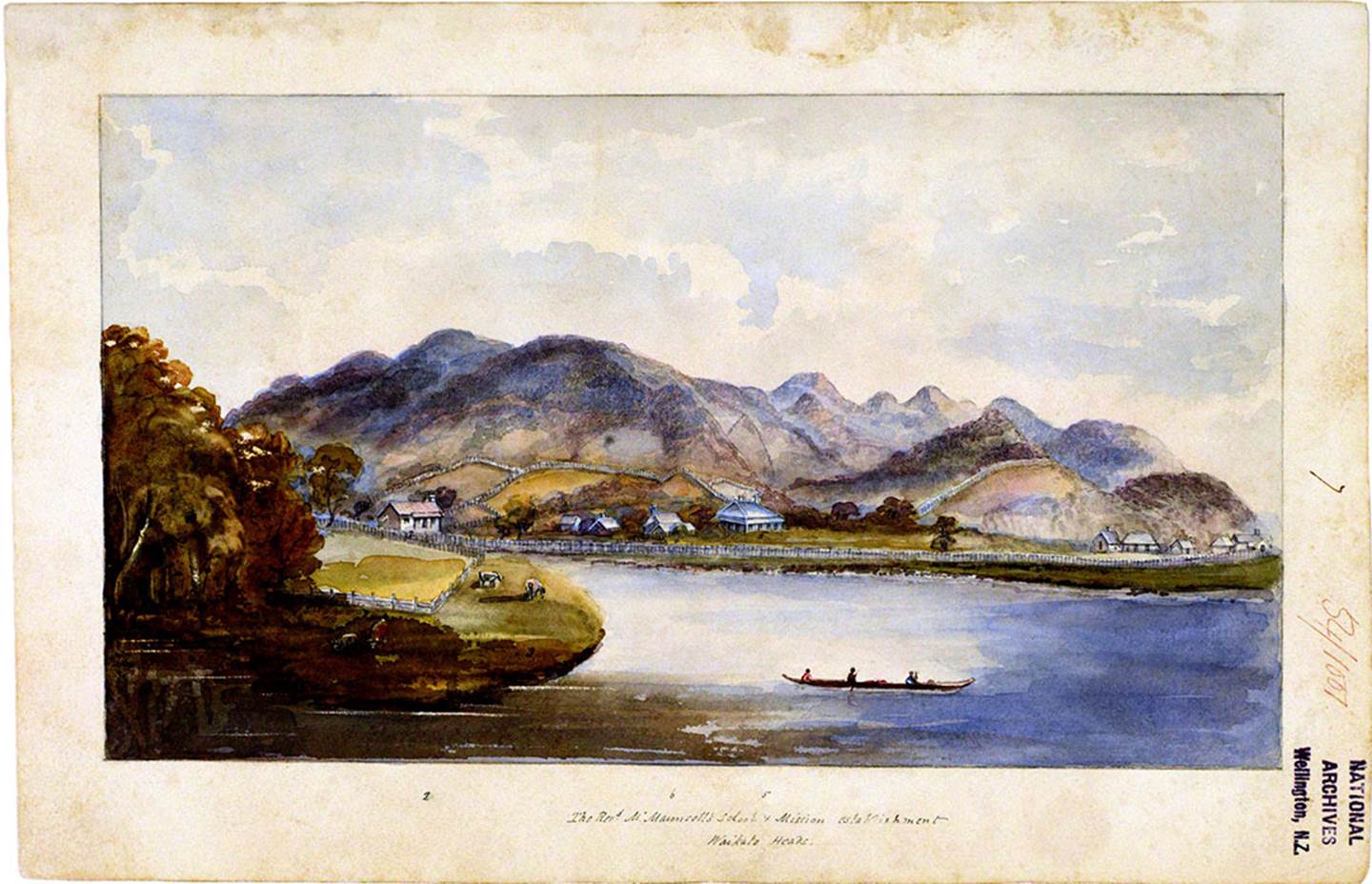
Reverend Robert Maunsell’s mission station at Waikato Heads.
Reverend Maunsell had been obliged to take advantage of an already scheduled "business meeting" (hui) of the natives in his district and address their assembly concerning the Treaty. This meeting was held on April 11th, 1840, before a huge Maori assembly (1500 people). Reverend Maunsell was very successful in his endeavours, but within the space of a few days it dawned on the signatories that they had not received "blankets" like other chiefs of the north, as tokens of friendship and thanks (koha). Some chiefs were insulted by this oversight and wanted to "tear the treaty up" as a result of this breach in protocol.
Reference to this "hui" is mentioned in Te Manihera...The Life and Times of the Pioneer Missionary Robert Maunsell, by Helen Garrett, 1991, pg. 90, wherein it says:
'Amongst the missionaries, four were appointed to collect signatures. One of the four was Maunsell, who was sent a copy of the Treaty* and was responsible for getting signatures of the Waikato chiefs. He took advantage of a business meeting of the natives in his district to produce the Treaty'.
*Footnote: It's important to remember that Maunsell was only ever sent "one" official Treaty document (in Maori) by the government, despatched with William C. Symonds on the 13th of March 1840.
Thankfully, before the situation got too far out of hand, Captain WC Symonds arrived at the mission. He'd brought Maunsell's "official" Treaty document but had arrived too late for it to be of any use. Symonds had a few blankets with him, and these were distributed, with a promise that more were arriving. The formerly "slighted and insulted" chiefs were appeased at the gesture and goodwill returned. Maunsell had been awaiting the arrival of Symonds, "with no small anxiety" (see The Treaty of Waitangi by TL Buick, pp 188-189).
Maunsell, in lieu of having received the "official" Treaty document, brought too late by Symonds, had innovated to take advantage of the "hui" business meeting on the 11th of April, at which chiefs from far and wide were assembled. For his presentation on the day he had a Church Mission Society printed Maori version of the Treaty of Waitangi, as well as a beautifully handwritten, but unauthorised, English Formal Royal Style copy.
This English copy was yet another of the strange English versions penned by James Stuart Freeman, using rejected articles from Busby's "rough notes" of the 3rd of February 1840 and one of two choices of preambles originating on about the 1st or 2nd of February 1840. We know for certain that it was not sent to him by the NZ Government for use in his meeting. The "official" Treaty document for presentation and signing was coming with the government's representative, William C. Symonds.
*Footnote: This was one of Freeman's several and variable Formal Royal Style version copies, which were only ever sent overseas and never intended for use at signing assemblies in New Zealand.
Freeman had sought-out Hobson's signature, on this English language document for despatch, at the height of Hobson's stroke induced paralysis and Hobson had attempted to comply, although he was very severely incapacitated. The left-handed signature Hobson executed was terrible and could have had no other effect than to immediately render the document worthless.
Hobson, realistically, would never have agreed to allow the document to be sent to his superiors overseas or any foreign government with such an abysmal, tortured signature on it. The only conceivable time that this incident could have occurred is between the 1st & 4th of March, aboard H.M.S Herald at Waitemata harbour.
The historical record tells us that Freeman sent the reject and worthless document, which he'd personally put a lot of work into creating, to Reverend Robert Maunsell at Waikato Heads mission station. Maunsell, in a letter to the Lay Secretary of 30th March 1840 made mention that "the Secretary" (Freeman) had sent the document to him. (See R Maunsell to Lay Secretary, 30 March 1840, in ATL-Micro-MS-Coll-04-33 (CMS Archives CN/M v. 12
pp 308-309).
HMS Herald had remained at the Waitemata Harbour until after the treaty meeting at Tamaki on March 4th, 1840. Freeman's Formal Royal Style document went overland to Maunsell and was later used to accommodate overflow signatures at his treaty assembly, held five weeks later.
DIRTY TRICK NUMBER 5 … “THE ENGLISH TREATY AS SIGNED”.
With no "official" document to work from, Maunsell had to innovate at short notice and use a printed Maori document, produced on the CMS Mission press on the 17th of February 1840. The defective English document on-hand was of no consequence, as the proceedings were fully conducted in the Maori language, using only the authorised text. Nevertheless, the beautiful big piece of paper, bearing the Formal Royal Style English text had a large clear space at the bottom, which could serve the purpose of accommodating additional signatures when there was no further room left on the Church Mission Society (Maori language) printed copy.
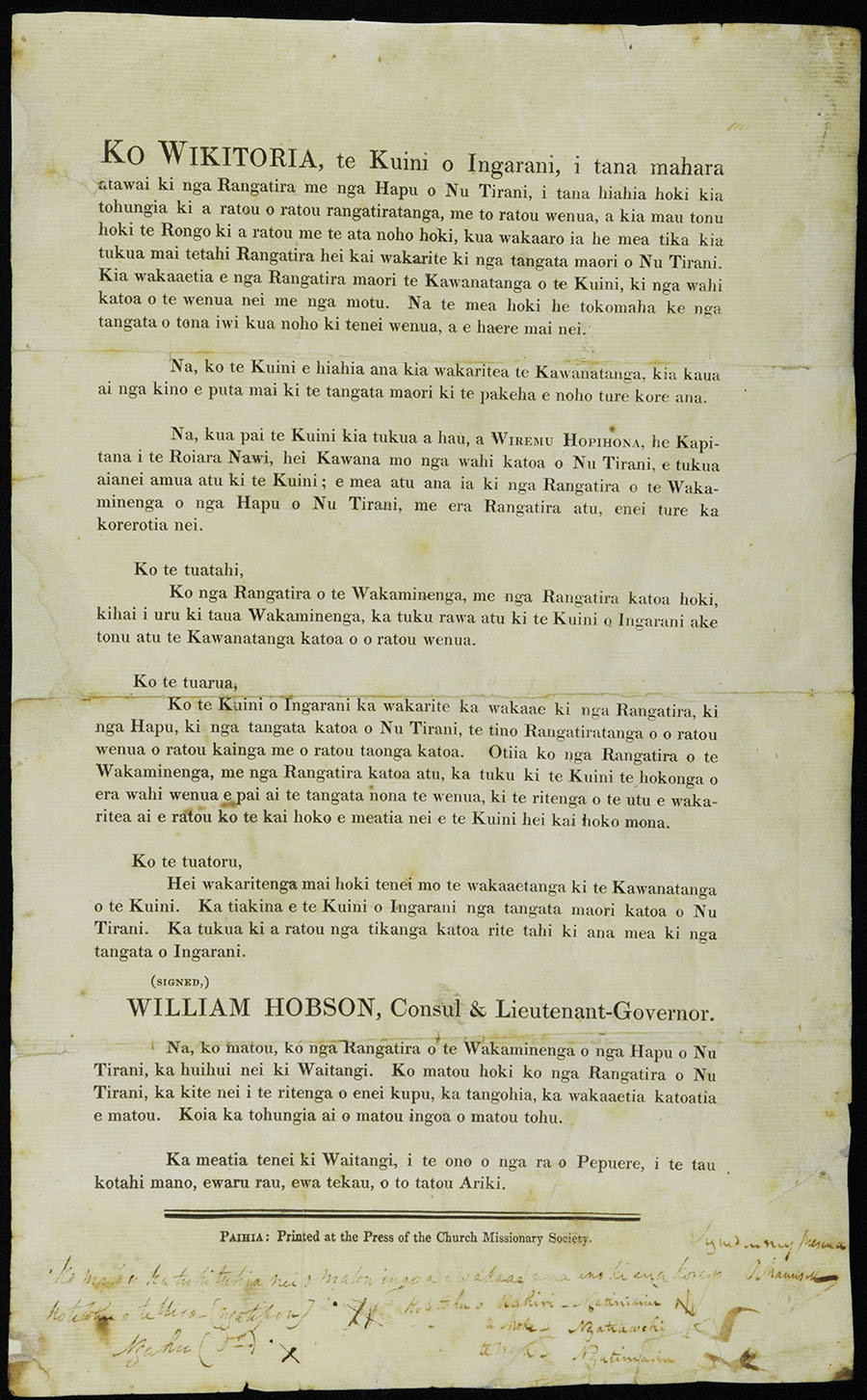
A photo of the actual sheet used by Reverend Robert Maunsell for his presentation of the Treaty of Waitangi proposal before the Maori chiefs of the Port Waikato district. In size the printed page was about equivalent to A4 and offered only a small section of clear space at the bottom to receive the signatures of chiefs. The limited space available could only accommodate 5 chiefly signatures, whereas another 32 chiefs also wished to sign. Maunsell also witnessed the sheet on the right-hand side, writing: Signed in my presence R Maunsell.
The above document contained the only official text that the Maori chiefs were permitted to hear and consider. Had this text not been present, no treaty assembly could have been convened.
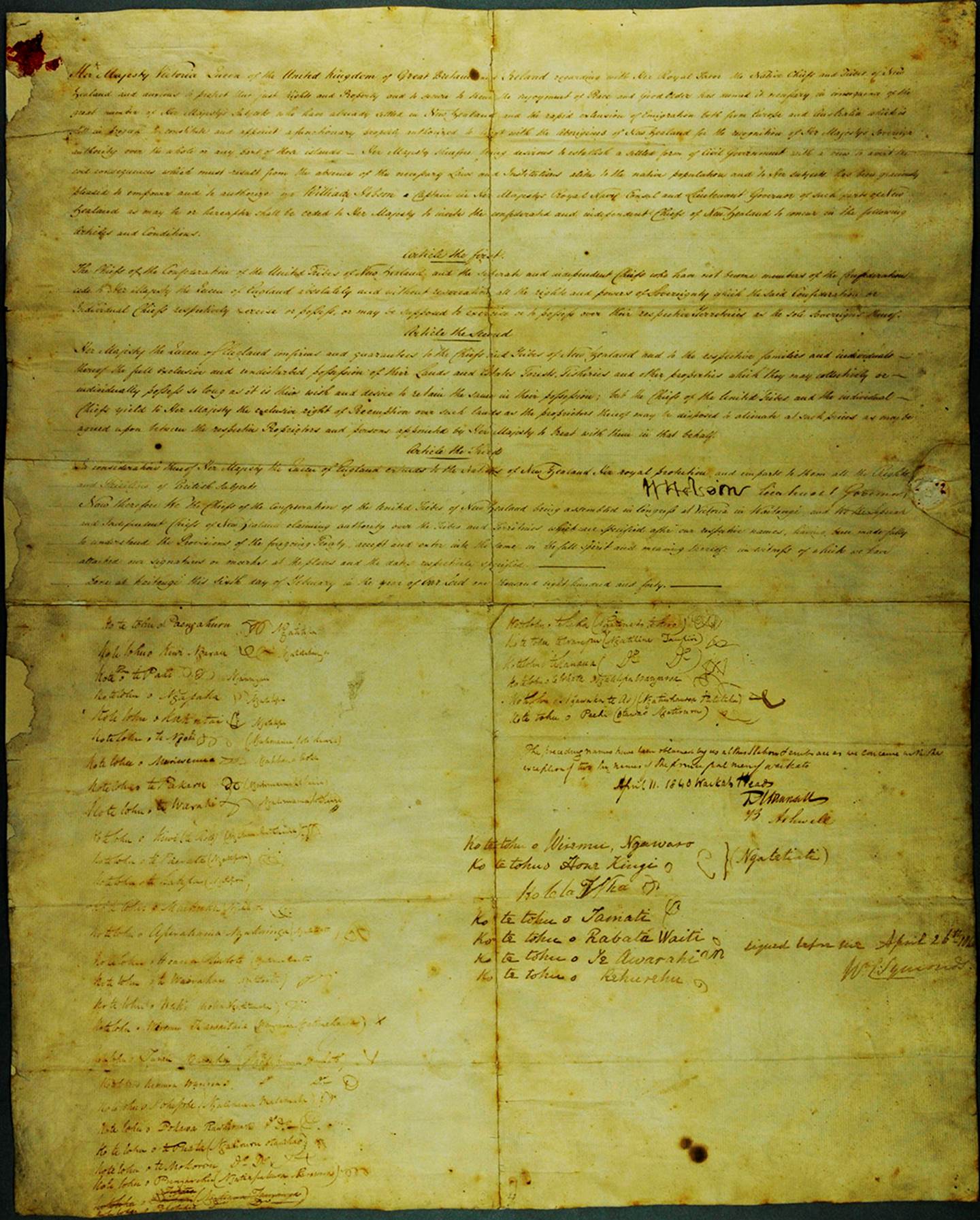
This is the English language sheet that was sent, along with the Printed Maori sheet by Hobson’s “secretary”, James Stuart Freeman, from Tamaki, The Thames (Auckland) on the 4th of March 1840 to Reverend Maunsell at the Port Waikato mission station. Note Hobson’s horribly tortured signature, executed at the height of his stroke induced paralysis, which rendered this Formal Royal Style sheet useless for overseas despatch as a memorial document.
Freeman went ashore from HMS Herald to attend the treaty assembly at Tamaki and would have used the services of an overland courier to deliver the two sheets of paper to Maunsell.
The English sheet, beautifully penned by Freeman, was one of, ultimately, 7 differently worded Formal Royal Style memorial documents that were earmarked only for overseas despatch. This one, having been ruined by Hobson’s terribly tortured signature, attempted with the left hand at the height of his stroke induced paralysis, could only be discarded. The proud captain and Lieutenant-Governor, Hobson, would not have allowed this to be sent overseas, as the tortured signature showed just how incapacitated he was.
For many months after this, the reins of power were handed over to Willoughby Shortland who was the acting Lieutenant-Governor until Hobson recuperated.
Minister of Maori Affairs and his supporters in1975 dubbed this document under the misleading misnomer, The English Treaty as Signed in a deceitful ruse to have its wording elevated to become co-equal to that of Te Tiriti o Waitangi.
If Rata was to destroy the true meaning and intent of the treaty, he really needed this shonky document, composed of wording from obsolete, scrapped draft notes and not The Final Draft. As stated, the text he needed most was contained within Article II of this English sheet and he ultimately used that to nullify or repudiate the true meaning contained within the Maori language rendition of Article II in Te Tiriti o Waitangi.
The official document, brought by WC Symonds, which had arrived too late for Reverend Maunsell's meeting, was forwarded on, by Maunsell, to Reverend John Whiteley, further to the south at Kawhia. To see this official document that Maunsell was, technically, supposed to use, we need only view Reverend Whiteley's document, the last name upon which was added on September 3rd, 1840.
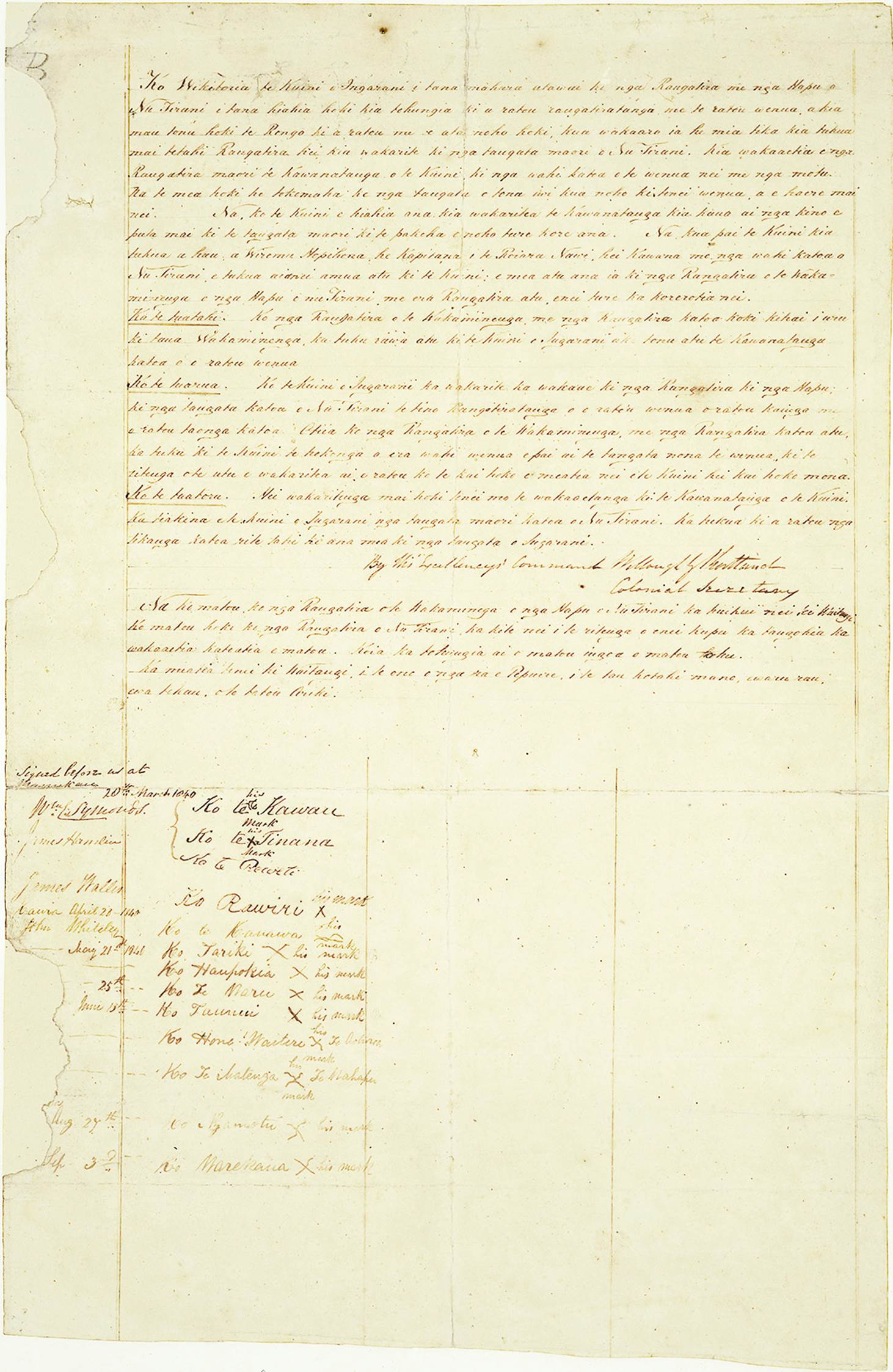
The so-called Kawhia Treaty sheet, which was issued by the NZ Government for use at Manukau, Port Waikato and Kawhia. It arrived too late for use by Maunsell at Port Waikato.
Maunsell later wrote to Hobson: 'and I have already forwarded on to Messrs Wallis and Whiteley the document left with me by Captain Symonds in order that they may obtain as many more names as they deem expedient' (see Robert Maunsell LL.D. A New Zealand Pioneer, His life and Times, by Henry E.R.L Wily, 1938, pp 68-69).
Captain WC Symonds started heading South in an attempt to add more signatures to Maunsell's "make-do" Treaty documents (composed of a CMS Mission printed Maori Treaty sheet and the other defective English sheet with sufficient space available to accommodate signatures). He had missed attending Maunsell's very successful meeting at Waikato Heads, for which he'd brought the official document.
That document had been left with Maunsell for direct despatch, by messenger, to Reverend Whiteley at the Kawhia Mission Station. Symonds, it would seem, was going to take a circuitous route to acquire more signatures in the district, then meet up with Reverend Whiteley later and take all signatures acquired, on all 3 documents, back to Government House in Russell.
For his own signature gathering incentive, before meeting up with Reverend Whiteley at Kawhia, Symonds would now, for the first time, use Maunsell's "make-do" documents, bearing the signatures that Maunsell and Ashwell had acquired at Waikato Heads on April 11th, 1840.
Shortly after leaving Reverend Maunsell, however, Symonds took time to look closely at the signatures that Maunsell had acquired, undoubtedly in an effort to plan his itinerary and movements. Upon examination he could see from the 5 signatures on the Maori copy and the 32 signatures overflowing onto the English sheet, that all the primary chiefs, except a few from Kawhia area, had already signed the Treaty. These few missing signatures could be acquired, without his participation, by Reverend John Whiteley and his assistant, James Wallis.
Symonds decided, therefore, to venture no further south, but to attempt, once more, to get the elusive signatures from the obstinate chiefs at Manukau (some of which had been promised), and especially that of the Paramount Chief Te Wherowhero. He, consequently, sent a letter on to Reverend Whiteley, informing him that he was not now coming, and asking him to proceed in the signature gathering incentive without him.
Maunsell had already despatched the "official" Treaty document southward to Reverend Whiteley by messenger, expecting that all documents and letters would come together when Symonds finally reached the mission station there at Kawhia.
Unbeknown to Maunsell, when he wrote his report to Hobson, Symonds would later decide to return for a third try at getting signatures at Manukau and not go south to Kawhia as expected.
Three earlier acquired Ngati Whatua signatures, from the second meeting at Manukau, were on the official document, now in the possession of Reverend John Whiteley in Kawhia. Symonds, without access to that document, would, as stated, use Maunsell's "unofficial make-do documents", bearing the many signatures that Reverend Robert Maunsell and his assistant, Benjamin Yate Ashwell had acquired at Waikato Heads on the 11th of April.
This impressive list would, most assuredly, have some influence on the reluctant chiefs at Manukau. Maunsell, had sent off a letter with Symonds, addressed to Hobson, which said:
'You will, I trust, receive with this [letter despatched with Symonds] the document lately forwarded to me to have the signatures of the principal men in Waikato attached to it. I am happy to inform you that the signatures obtained [on the alternative, "make-do" documents] comprise those of the leading men, except perhaps two. Those we hope soon to obtain, and I have already forwarded on to Messrs Wallis and Whiteley the document left with me by Captain Symonds [the one Maunsell was supposed to use...the official "Government-issued" document] in order that they may obtain as many more names as they deem expedient.
On May 12th, 1840, Captain WC Symonds reports: 'On examination of the signatures obtained by Mr. Maunsell, I found that with the exception of very few, all the leading men of the country as far as Mokau had acknowledged the sovereignty of Her Majesty. The few belonged to the neighbourhood of Aotea and Kawhia, wherefore I determined proceeding myself no further, being well assured of the disposition on the part of the Wesleyan Mission to support the Government in every exertion in its power, and I sent a letter to the Rev. John Whiteley claiming his assistance in procuring the remaining names. I returned to Manukau on April 18, where I obtained the adherence of seven other chiefs to the Treaty. Te Whero-whero and several others have objected, though they manifest no ill-will to the Government (see Robert Maunsell LL.D. A New Zealand Pioneer, His life and Times, by Henry E.R.L Wily, 1938, pp 68-69).
So, it becomes very clear what had happened with the various documents:
(a) Reverend Maunsell had not been able to use his "official" document, sent to him from Government House in the Bay of Islands and signed by acting Lieutenant Governor, Willoughby Shortland, as it had arrived 3 days too late. He had used, instead, "materials on hand" to conduct his meeting on the 11th before 1500 Maori, conveniently gathered in for their hui business meeting. His document for the hui meeting was an authorised Maori text, printed by the Church Mission Society. Two hundred of these authorised Maori Treaty text documents had been produced by Paihia Mission printer, William Colenso on February 17th.
(b) At the April 11th meeting another "unauthorised for presentation to Maori chiefs" piece of paper had been used in no other capacity but to receive the overflow of signatures that would not fit onto the "authorised Maori text document". Reverend Maunsell wrote a letter to Hobson, describing what had transpired locally and gave it to Captain William Symonds, who, supposedly, was heading southward, by a circuitous route, to eventually join up with Reverend John Whiteley at Kawhia Mission.
(c) Captain Symonds later changed his mind enroute, after looking over Maunsell's list of signatures and deciding that his efforts should be focused on Manukau, where he'd had only moderate success, despite two meetings with the chiefs there.
(d) Symonds, unbeknown to Maunsell, returned to Manukau, this time with a different document (Maunsell's signed, Maori printed text from the CMS Press and the mistaken English treaty document used only to accommodate the overflow of signatures). On his third attempt at Manukau, on the 26th of April, Symonds managed to get an additional seven signatures, bringing his tally in the Manukau area to ten signatures. His primary objective, in going to Manukau Heads, was in hope of obtaining the signature of Paramount Chief, Te Wherowhero, which he failed, once again, to do.
Captain Symonds then took all of the signatures, affixed to the two pieces of paper used by Maunsell and Ashwell, as well as himself, to Hobson. The "official" document, which was the only one envisioned by acting Lieutenant Governor, Willoughby Shortland, to be signed in Manukau, Waikato Heads and Kawhia came back, from Reverend John Whiteley to the Bay of Islands, by other means after September 1840.
These two documents (The Maori text for oral presentation and the other to accommodate the overflow signatures) were used again by WC Symonds on the 26th of April at Manukau Heads, after the "Government issued" document had been forwarded southward on to Reverend John Whiteley.
Again, Symond's presentation had to be fully conducted in the Maori language, according to the Maori wording of the Treaty of Waitangi CMS printed text. The lower signatures seen in the Formal Royal Style English document were recorded by WC Symonds beside his notation, which said, 'Signed before me April 26th 1840'.
This was, as stated, the third attempt by WC Symonds to acquire signatures at Manukau, the other two attempts, using the only authorised document (in Maori) sent by Willoughby Shortland, which, by this time, was in Kawhia and being used by Reverend John Whiteley.
We know full well from the May 12th report of William Cornwallis Symonds that he was talking about the printed Maori document being used for the presentations at Waikato Heads and his 3rd attempt at Manukau, with the English copy being used to accommodate the overflow signatures obtained. Symonds writes:
'I have the honour to submit to you for the information of His Excellency, the Lieutenant Governor, a Report of my proceedings in the Manukau and Waikato districts in my late mission to obtain the adherence of the Principal Chiefs on the West Coast of this Island to the Waitangi Treaty and herewith - transmit to you a Copy of the Treaty signed by upwards of Forty of the more influential Chiefs of that part of the Country'.
Symonds is stating that the signed treaty he is submitting contains "over forty" signatures. The actual tally is: The English copy has 32 signatures obtained by Maunsell on the 11th of April 1840 (at Waikato Heads) and another 7 signatures obtained by Symonds at Manukau (third attempt there) on the 26th of April 1840 = 39. The printed Maori copy, read to the assemblies at both gatherings, contains the very first of the 5 chiefly signatures obtained at Waikato Heads on April 11th by Reverend Maunsell, bringing the final total to 44.
If we then include the 3 Ngati-whatua signatures that William C. Symonds acquired in Manukau on the 20th of March 1840 (his 2nd meeting there), which were written upon the "official", government issued document, pre-signed by Willoughby Shortland, then the full tally for the Manukau and Port Waikato districts is 47.
In their treaty book, released in November 2004, authors Dr. Paul Moon and Peter Biggs reinforced many of the conclusions arrived at in my website, related to the status of the three documents used between Manukau, Port Waikato and Kawhia in 1840. Moon & Biggs wrote:
'With Hobson ill, Willoughby Shortland, the Acting Governor, undertook to send the Treaty around the country. Copies of the Treaty were made by Freeman and dispatched from the Bay of Islands with Henry Williams on the Ariel and overland by Captain W. C. Symonds. By late April, Hobson had recovered, and instructed Bunbury to carry the Treaty south (Sheet 7).
Sheet 2. The Manukau-Kawhia copy
On 13th March Shortland sent this copy, under his own signature, with Symonds to obtain signatures in the Manukau harbour area and south on the west coast. Symonds was familiar with this area (see p 245). He and James Hamlin, a CMS missionary on the southern side of the Manukau, assembled local chiefs (probably at Awhiti) but failed to get their agreement. A second meeting was held on 20th March, and many Waikato chiefs were also present including the great chief Te Wherowhero. However only 3 Ngati-Whatua chiefs signed. Symonds then sent this Treaty copy to John Whitely, the Wesleyan missionary at Kawhia [*1], who, along with his assistant, James Wallis, slowly obtained further signatures: the last name added on September 3rd. Symonds then moved on to Waikato Heads (see Sheet 3).
Sheet 3 The Waikato Manukau copy
On 11th April, at his missionary station at the mouth of the Waikato River, Rev. Robert Maunsell held a meeting. Over 1500 Maori had arrived - but Symonds had not arrived with the official Maori Treaty, pre-signed by Hobson [*2]. Anxious to take advantage of the meeting, Maunsell forged ahead. He already had a copy of Colenso's printed Maori Treaty and one of Freeman's carelessly written English Treaties. After the usual presentation in Maori the chiefs started signing the Printed Treaty (Sheet 4) and the overflow of signatures were placed on the English Treaty (Sheet 3). Maunsell believed the 32 chiefs who signed [*3] were most of the leading chiefs of the area - mainly from the lower Waikato, with some from Ngaruawahia and further upriver. Three days later Symonds arrived with an official Maori Treaty - but was too late. Maunsell handed both these sheets to Symonds.
Symonds then travelled to Manukau Heads to hold a third Treaty meeting in the area (probably again at Awhiti) on 26th April. As instructed, he would have presented the Printed Maori Treaty but, because no space was left on this, he used Sheet 3 for a further seven signatures of Waikato chiefs. But again, chief Te Wherowhero and several others would not sign. When Symonds returned to the Bay of Islands Hobson accepted the signatures on both sheets (Sheets 3 and 4), considering those appearing on sheet 3 simply as overflow signatures from Sheet 4. He then signed off this Treaty (Sheet 3), his weak signature indicating the effects of his illness.' [*4] (See The Treaty and Its Times, by Paul Moon & Peter Biggs, "Collecting signatures on the 9 Treaty sheets").
Red emphasis added to show areas of general, important agreement on historical points, promoted by my website since early 2004.
Whereas I'm in full accord with most of what Moon & Biggs state, I differ in opinion on points I've listed as 1, 2, 3 & 4.
*1. WC Symonds did not send the official, government issued Maori Treaty copy onward to Rev. John Whiteley from Manukau but carried this copy to Maunsell at Port Waikato. Because it had arrived too late, Rev. Maunsell sent it on "by messenger" to Whiteley and states this in his letter to Hobson.
*2 Hobson had not pre-signed any official, government issued Treaty document for specific use at Manukau, Port Waikato and Kawhia. Acting Lieutenant Governor Willoughby Shortland had signed the official (Maori language) document for use at those 3 locations.
*3 On the 11th of April 1840, Maunsell secured 37 signatures. Of these, 5 were on the printed Maori treaty sheet and 32 more overflowed onto Freeman's defective English copy.
*4 By May 1840, when Maunsell's two "make-do" documents were returned to the Bay of Islands, Hobson's ability to write and sign documents was much improved. Freeman had sent the two sheets from Tamaki on the 4th of March 1840. They were possibly picked up few days later by Captain Gordon Brown, who was shipping a large batch of CMS printed material from William Colenso (CMS Mission printer) to Reverend Robert Maunsell.
Captain Brown, undoubtedly, took his boat over the portage at Tamaki in order to transport the mission's cargo all the way to Port Waikato, using the waterways. William Cornwallis Symonds did the same thing with his boat 3-weeks later, in order to sail down to Maunsell's mission.
*According to the Day and Waste Book of Reverend William Colenso, who was the Church Missionary Society's printer, he printed off 200 copies of the Maori version of the Treaty of Waitangi text. This undertaking commenced on the 17th of February 1840. Maori Treaty researcher, Jean Jackson, states: 'Colenso the printer also gave senior chiefs a copy in Maori of the treaty (see his daybook). He printed 200' (see also William Colenso, by A.G. Bagnall & G.C. Petersen, 1948 pg. 97).
'The following items were printed by Colenso in 1840, to the order of the Lieutenant-Governor: The Treaty of Waitangi in Maori (200), Circular summonsing Natives to Waitangi (100), Proclamation of the Queen's authority (100), Proclamation regarding land purchases (100), Impounding notices (100), Circular to Natives (100), Circular warning natives against buying army stores (500), three additional printings of the, "Proclamation asserting the Queen's Sovereignty over new Zealand" (300 @ 100 per batch). The final batch had slightly amended wording. Payment for this Government commissioned work was received on December 22nd, 1840 and amounted to £14. 12s. 7d'. (See: Williams, A Bibliography of Printed Maori, 1926).
Our so-called "Treaty" historians and experts have a responsibility to represent events correctly, but on this historical point (concerning Maunsell & Symonds) have been deliberately obtuse and evasive. The documented evidence of what truly happened at Waikato Heads and Manukau is in the National Archives and fully accessible to our "politically aligned" historians. Their gross "dereliction of duty" to the New Zealand public, silence related to pertinent detail and very inadequate or elusive explanation of events, has been designed to legitimise the false claims of the "Treaty Industry", which can only survive if our historians deliberately misconstrue and mis-explain the true events of history.
William Cornwallis Symonds, who tried on 3 occasions to get signatures from the Chiefs at Manukau, well understood the importance of unfaltering and strong oratory before the Maori assemblies. On two occasions he had the very adept assistant and much respected orator, James Hamlin to help him. Hamlin was considered to be the most gifted speaker of the Maori tongue to be found amongst the British.
In the first two meetings, Symonds presented the "official", government signed (by Willoughby Shortland) document in Maori. At the 3rd meeting he had only Maunsell's "make-do" documents, one of which was the "official" Maori text, which he presented with as much finesse as he was capable. Unfortunately, James Hamlin was absent on the day, having travelled to another mission. Symonds later lamented:
'I obtained the adherence of seven other chiefs to the Treaty. Te Wera-Wera and several others, however, objected.... This I attribute partly to the Bishop's [Pompallier's] influence, partly to the extreme pride of the Native chiefs, and in great measure to my being alone and unable to make that display and parade which exerts such influence on the minds of the savages' (see WC Symonds in a letter to the Colonial Secretary, 12 May 1840. Great Britain Parliamentary Papers 1841 (311) XVII pp. 101-2).
It's glaringly obvious that Symonds, on all 3 attempts, presented ONLY, the authorised Maori text wording of the Treaty.
Reverend Robert Maunsell, a lettered scholar and linguist, was personally engaged in translating the Old Testament of the Bible into the Maori language at the time he made his Treaty presentation to 1500 Maori at Waikato Heads.
Of Maunsell's meeting, TL Buick writes, 'The project had been received by the natives in the most friendly spirit, and signatures had been obtained with the utmost alacrity' (see The Treaty of Waitangi, by Buick, pg. 189). Some years later, in 1845, Rev. Maunsell wrote the following during a time of conflict:
'Whether that Treaty was a 'fiction' or not, this is no fiction, that the Government stands pledged to secure certain rights to the Aborigines, & that the Aborigines were fully informed of that promise. Whether that Treaty has been attended with injurious consequences or not I do not know. This I know, that if it had not been for those stipulations the Colony could not have been established without war with the Aborigines and other more serious evils than those which at present attend it. The people may not perhaps understand all the particulars of that treaty, but we, their teachers took particular care to explain to them, as far as was necessary to allay the suspicions & jealousy with which they contemplated the movements of Government' (see R. Maunsell to Secretaries, 23 April 1845, in ATL-Micro-MS-Coll-04-35 (CMS Archives CN/M v. 15 p. 311).
The chiefs, who always heard the Treaty presentation in their own tongue, understood perfectly that they were ceding Sovereignty to Queen Victoria and becoming British subjects. The only area within the wording of the Treaty, where the missionaries were concerned that the chiefs might not understand the full implications of what they had agreed to, related to "selling their land directly to the Queen's representative" and having no right to sell it directly to the settlers. This was of particular concern to Reverend William Colenso, who impressed the "problem", with considerable force, upon the mind of Lieutenant-Governor Hobson on the 6th of February 1840:
'The correctness of Colenso's fears that the natives did not understand the implications and effect of a provision of the Treaty conferring on the Crown the right of pre-emption are substantiated by the natives subsequent dissatisfaction with this clause, which later had to be waived by Hobson in favour of the New Zealand Company and also by Governor Fitzroy. The failure of the Crown to exercise its right of pre-emption [exclusive right of purchase], thereby preventing the natives from selling sufficient land to satisfy their desire for European products became a source of grievance and was a contributing factor to the outbreak of Heke's rebellion' (see William Colenso, by A.G. Bagnall & GC Petersen, 1948, pg. 97).
In the end it was only the totality of signatures acquired at both Waikato and Manukau Heads, based upon an oral delivery of the Maori text to the assemblies, to which Hobson later affixed his seal, legitimising the signatures. Hobson was acknowledging the wishes of those who had added their marks to the dual documents (acting as one document in Maori) at Waikato and Manukau and was giving those individuals formal recognition that their wishes were duly noted and would be implemented. He could never have envisioned that latter-day, conniving individuals, protected by a "turn a blind eye" or "look the other way" government and judiciary, would seek to misconstrue the events of the 11th and 26th of April 1840, so that New Zealand was wide open to plunder.
It must be reiterated, there is ONLY ONE Treaty of Waitangi-Tiriti o Waitangi wording, and it is in the Maori language. There was never an English Treaty of Waitangi and all English versions are either drafts preceding the Maori version or latter back-translations of the Maori version. Of these English versions, only one has any perceived authority and that is the last and final draft by Hobson-Busby...now known as the Littlewood Treaty (the mother document from which Te Tiriti o Waitangi was translated).
THE FORENSIC EVIDENCE PROVING THAT MAUNSELL’S ‘MAKE-DO’ TREATY WAS COMPOSED OF TWO PIECES OF PAPER, WAX-GLUED, PASTE-GLUED OR STICK-PINNED TOGETHER.
Go to the following links and push the START button. The Formal Royal Style sheet’s, top left-hand corner will appear. Slowly, it will recede at 10% opacity at a time, while the Printed Maori sheet will emerge at 10% opacity at a time. The display will then reverse itself, and it is easily seen that the same “stick pin” holes occur on each perfectly scaled sheet, showing they were once conjoined as one “make-do” treaty… the Maori language sheet used by Maunsell as the text for consideration by the chiefs and the large English language sheet only serving the function of a repository for overflow signatures that would not fit on the Printed Maori language sheet.
Duplicate pin-holes, where the documents were stick-pinned together: http://treatyofwaitangi.net.nz/Pin/MaunsellTreaty.html
Duplicate fibre damage due to forced separation: http://treatyofwaitangi.net.nz/Damaged/MaunsellTreaty.html
To view all of the Treaty of Waitangi Sheets, go to: http://archives.govt.nz/exhibitions/treaty
DIRTY TRICK NUMBER 6 … THE CERTIFIED TREATY.
This particular deception was a real magician’s trick and anybody who was a little inattentive or let their concentration lapse for a mere instant would miss the “red-herring” stunt being pulled by the perpetrators of this treaty-related fraud.
It all has to do with a Despatch Enclosure, being sent overseas from the Bay of Islands on the 25th of February 1840.
Even before the ink was dry on the Tiriti O Waitangi signed by the chiefs on February 6th, 1840, James Stuart Freeman had manufactured one of his composite, Royal Style treaty versions in English from the rough draft notes. This he despatched to Governor Sir George Gipps on the 8th of February aboard the store ship, Samuel Winter, which sailed on the midday tide.
Freeman did the same two weeks later on the 21st of February, when he sent his (much vaunted by the grievance industry) “Certified Copy” to Gipps in a despatch carried aboard the Martha. In a letter section to Gipps placed at the tail end of the same piece of paper, Freeman made provision for Reverend Williams to ‘certify’ the accuracy of his Maori translation, which was being sent in the same despatch.
Here’s Freeman’s “Royal style” English text, which he created by taking bits and pieces from the early rough draft notes and stringing them together with linking text. This grandiose sounding version has now graduated into becoming our Treaty of Waitangi, supplanting and replacing the Maori text.
Her Majesty Victoria Queen of the United Kingdom of Great Britain and Ireland regarding with Her Royal Favour the Native Chiefs and Tribes of New Zealand and anxious to protect their just Rights and Property and to secure to them the enjoyment of Peace and Good Order has deemed it necessary in consequence of the great number of Her Majesty’s Subjects who have already settled in New Zealand and the rapid extension of Emigration both from Europe and Australia which is still in progress to constitute and appoint a functionary properly authorized to treat with the Aborigines of New Zealand for the recognition of Her Majesty’s Sovereign authority over the whole or any part of those islands. Her Majesty therefore being desirous to establish a settled form of Civil Government with a view to avert the evil consequences which must result from the absence of the necessary Laws and Institutions alike to the native population and to Her subjects has been graciously pleased to empower and to authorize “me William Hobson a Captain” in Her Majesty’s Royal Navy Consul and Lieutenant Governor of such parts of New Zealand as may be or hereafter shall be ceded to Her Majesty to invite the confederated and independent Chiefs of New Zealand to concur in the following Articles and Conditions.
Article The First
The Chiefs of the Confederation of the United Tribes of New Zealand and the separate and independent Chiefs who have not become members of the Confederation cede to Her Majesty the Queen of England absolutely and without reservation all the rights and powers of Sovereignty which the said Confederation or Individual Chiefs respectively exercise or possess, or may be supposed to exercise or to possess, over their respective Territories as the sole Sovereigns thereof.
Article The Second
Her Majesty the Queen of England confirms and guarantees to the Chiefs and Tribes of New Zealand and to the respective families and individuals thereof the full exclusive and undisturbed possession of their Lands and Estates Forests Fisheries and other properties which they may collectively or individually possess so long as it is their wish and desire to retain the same in their possession; but the Chiefs of the United Tribes and the individual Chiefs yield to Her Majesty the exclusive right of Pre-emption over such lands as the proprietors thereof may be disposed to alienate at such prices as may be agreed upon between the respective Proprietors and persons appointed by Her Majesty to treat with them in that behalf.
Article The Third
In consideration thereof Her Majesty the Queen of England extends to the Natives of New Zealand Her royal protection and imparts to them all the Rights and Privileges of British Subjects.
[Signed] W Hobson Lieutenant Governor
Now therefore We the Chiefs of the Confederation of the United Tribes of New Zealand being assembled in Congress at Victoria in Waitangi and We the Separate and Independent Chiefs of New Zealand claiming authority over the Tribes and Territories which are specified after our respective names, having been made fully to understand the Provisions of the foregoing Treaty, accept and enter into the same in the full spirit and meaning thereof in witness of which we have attached our signatures or marks at the places and the dates respectively specified
Done at Waitangi this Sixth day of February in the year of Our Lord one thousand eight hundred and forty.
Freeman then used available space on the last page to tell Governor Sir George Gipps that, within the same enclosure, the names of 52 signatory chiefs at Waitangi and an additional 78 names received at Hokianga in the previous week would be included.
These signatures were appended on separate documents to Freeman’s Royal Style sheets and one of the appended documents included was Reverend Henry Williams’ printed Tiriti O Waitangi translation.
The entire enclosure, containing all treaty related documents, letters or reports, was then initialled by Hobson at the top left-hand corner of Freeman’s “Royal Style” document. Freeman also wrote ‘Copy of the treaty’ at the top left of Reverend Williams’ printed Maori translation. Two weeks previously he’d done the same when Reverend Williams sent a handwritten Maori copy to Gipps and, on that occasion, Freeman initialled the Maori text with JSF at the bottom left hand corner.
In this separate letter or information section beyond his Royal Style English treaty version to Gipps, Freeman wrote:
Here follow the signatures of 52 Chiefs, given at Waitangi on the sixth of February 1840: and the signatures of 78 chiefs given at Hokianga on the 12th of that month.
A dividing line was then used to create a separate section of letter or information text.
This was followed by yet another clause, written by Freeman, wherein Reverend Williams was called upon to certify his Maori translation.
I certify that the above is as literal a translation of the Treaty of Waitangi as the Idiom of the Language will admit of. Underlining added.
Henry Williams. (underlining added)
In 1972, about 18-years before the Littlewood Treaty came back into the public arena, historian Ruth Ross listed the various (and variable) treaty versions despatched overseas and, in her paper, included a preliminary qualifying statement:
‘These were enclosures in the following despatches (except in the parentheses in (d), page references are to the English versions, not to the despatches in which they are enclosed):
(a) Hobson to Gipps, 5-6 February 1840, of which a copy was enclosed in Gipps to Secretary of State, 19 February 1840 CO 209/6, pp. 52-54 and printed in GBPP, 1840, XXXIII, 560, pp. 10-11. (CO 209 is on microfilm, National Archives, Wellington).
(b) Hobson to Secretary of State, 40/1 of 17 February 1840, CO 209/7, pp. 13-14[v]; in the printed version, this despatch is dated 16 February*. GBPP, 1841, XVII. 311, p. 10.
* Because a steady ENE wind blowing on the Bay of Islands harbour entrance, the ship Martha, could not escape the harbour until the 21st of February. By this time, Hobson was able to supply Printed Maori copies produced on the CMS Mission press by Reverend William Colenso on the 17th of February 1840.
(c) Duplicate (dated 16 February 1840) of 40/1, G 30/1, pp. 29-32, National Archives, Wellington.
(d) Duplicate of Hobson to Secretary of State, 40/3 of 23 May 1840, G 30/1, pp. 75-78. (The original of 40/3 dated 25 May did not enclose an English version - see CO 209/7, pp. 55-64).
(e) Hobson to Secretary of State, 40/7 of 15 October 1840, CO 209/7, p. 178, printed GBPP, 1841, XVII, 311, pp. 98-99, where it is headed ‘Translation’ and follows the Maori text, which is headed ‘Treaty’. But in the original ‘certified copy of the Treaty both in the English and Native language’ on CO 209/7, p. 178, the heading ‘Treaty’ applies to both English and Maori texts.
Ruth Ross then makes the following observation:
‘From the very beginning, confusion has reigned over what was the translation for which. For this Henry Williams himself was initially responsible. The English version forwarded with Hobson’s first New Zealand despatch to the Secretary of State was endorsed by Williams: I certify that the above is as Literal a translation of the Treaty of Waitangi as the idiom of the Language will admit of’. Yet this is palpably incorrect; Williams knew better than anyone else that the Treaty of Waitangi was a translation of an English draft, not vice versa. (Underling and red emphasis added)
Here, Ruth Ross seems confused and bewildered about what Reverend Williams is supposed to have certified. Whereas her focus is solely towards the several strange English versions, she seems to have not known that three Printed Maori copies were sent in the despatch enclosures of the 21st of February. She hasn’t, seemingly, made the connection that this is what Williams is certifying (his translation work).
The existence of these Maori language copies is not, apparently, well known to many treaty historians, as the evidence would suggest that the copies were taken out of the despatches at their destinations and filed away separately. They don’t appear on any of the available microfilms showing despatch contents and few historians seem to know or will acknowledge that 4 Maori copies (one handwritten by Williams and 3 printed) were repatriated from the Colonial Office archives in Britain to New Zealand sometime in the 1940s.
All were sent overseas in February 1840 to Gipps and Normanby. They’re found in Vol. G-30/1, in the collection of the National Archives, Wellington, NZ. To my knowledge this dynamic volume has never been microfilmed. If microfilm copies were generally available, or if the totality of all items despatched in each enclosure were reassembled, the myth of the certified (English) Treaty could be quickly dispelled and permanently laid to rest. Williams was certifying his Maori translation and nothing else!
Had Ruth Ross lived to see the Littlewood Treaty (Busby’s final draft) come back into the public arena or had she the opportunity to compare its wording to both the Clendon and Wilkes’ despatches, then she would have understood how all the treaty related confusion was ushered in by the loss of the Final English Draft.
Let’s look at page 4 of the so-called ‘certified copy’ of the treaty as it appears on microfilm and further weigh in the balance the fraudulent notion that Williams is certifying Freeman’s ad hoc (memorial document), Royal Style, composite version in English.
Why would Williams endorse such wording when, as Ruth Ross observes, it is nothing like his Maori translation? Whereas the lingering impression left by some unobservant historians is that Williams personally wrote out this entire copy found in the enclosure then certified it, the truth is that the text was fully handwritten by James Stuart Freeman. The only contribution that Reverend Henry Williams made to this document was to sign his name in the space provided by Freeman.
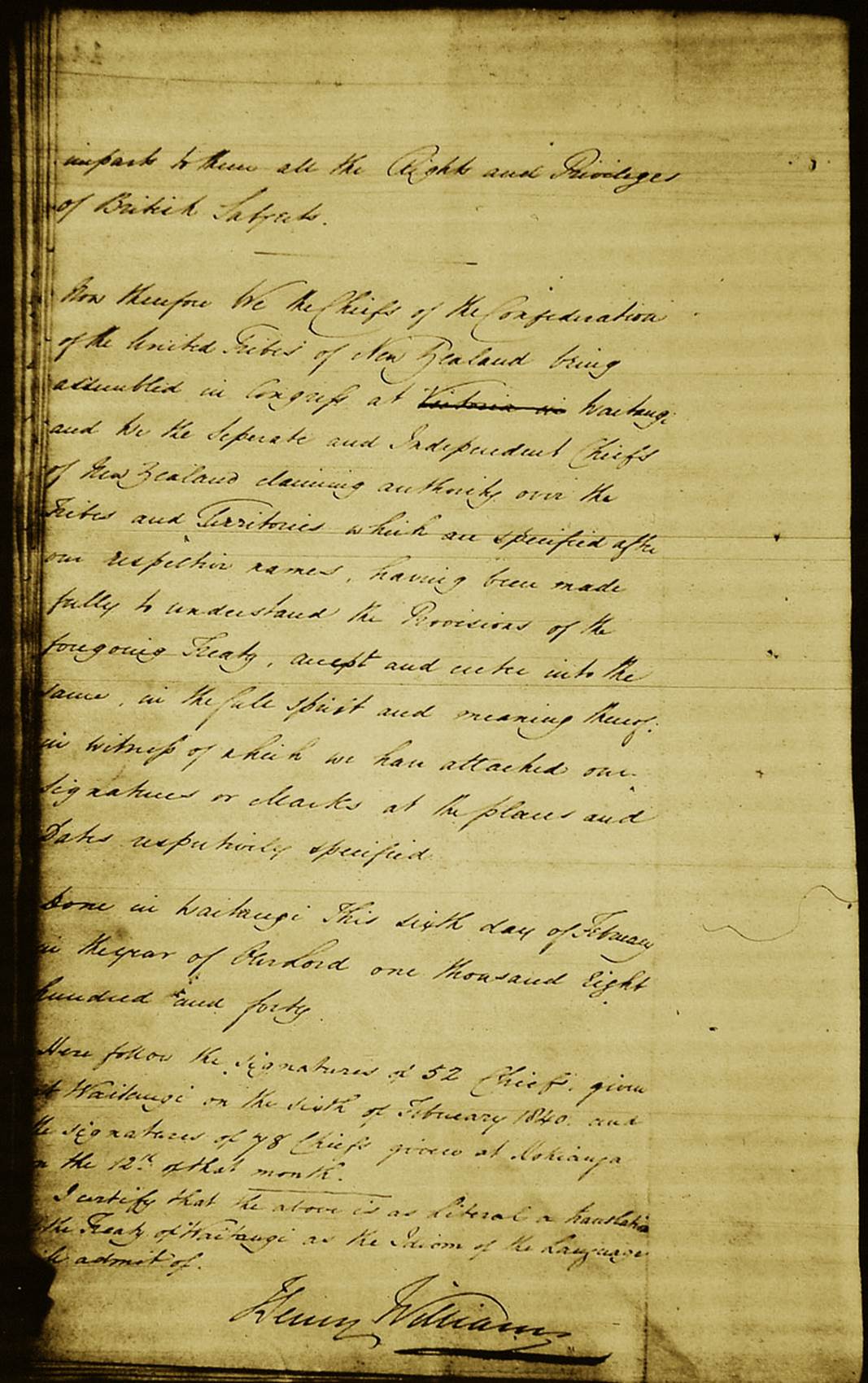
The poor quality, colourised and sharpened, microfilm copy of the final page of what has come to be known, in grievance industry vernacular, as the so-called 'certified copy' of the Treaty of Waitangi.
In the letter section penned by Freeman at the end of the document, Reverend Henry Williams is called upon to certify his TRANSLATION as being 'as literal a TRANSLATION of the Treaty of Waitangi as the idiom of language will admit of'.
Along with mention of the 130 signatures (52 +78) of chiefs appended to Freeman's "Royal Style" English treaty version, a Maori TRANSLATION document was also included.
The appended, printed Maori Tiriti version that went in the same enclosure is what Williams was certifying in the space allotted and designated by Freeman.
The large despatch of documents, including Freeman's Royal Style English treaty document and Williams' certified TRANSLATION, was not despatched until the 21st of February 1840 aboard the Martha. Because of a steady E.S.E. wind, the ships Herald (destination south) and the Martha (destination Australia) were both locked in the harbour of the Bay of Islands until the wind abated.
Felton Mathew’s letter to Sarah Mathew states:
‘Tuesday 18th Feby 1840. Yesterday dear Sarah I wrote you a few lines by the Martha, which is to sail tomorrow morning: expecting that ere this, we should have been on our way to the Thames [Hauraki Gulf, Auckland Isthmus]. It however has blown all day from the ESE...Here we must lie until the weather moderates.’ (See: The unpublished journal of Felton Mathew, Special Collections, Auckland Public Library).
As it turns out, the Martha didn’t manage to get away from the harbour until the 21st and Hobson’s final, completed despatches weren’t put aboard the Martha until the night of the 20th of February 1840.
So, what was Reverend Henry Williams certifying? It was certainly not the English text, as he was never its author. His function in the treaty drafting incentive was to act only as official translator. All he could ever certify was the work that he had undertaken in behalf of the government. He was called upon to assure all concerned that his translation of the finalised English text, handed to him at 4 p.m. on the afternoon of the 4th of February 1840, was as close ‘as the idiom of the language would admit of’.
James Stuart Freeman, as stated, wrote the foregoing English treaty document on the 17th of February 1840. On this same day Reverend William Colenso printed 200 official copies of Te Tiriti o Waitangi, based solely on the translation into Maori supplied by Reverend Henry Williams and his son, Edward.
On this same day Hobson and/ or other members of the government made a treaty presentation to chief Pomaré II, with James Reddy Clendon in attendance. Clendon, whose estate sat adjacent to the PA of chief Pomaré II, signed in behalf of the chief then added his own witnessing signature and the date. Clendon was given printed Maori treaty sheets, logically, on this day and, thereafter, wasted no time in sending his despatch No. 6 to the U.S. Secretary of State, John Forsyth.
He had, obviously, been waiting for this printing event, such that he had sufficient documentation to make up a complete despatch.
With regards to the two very large despatches that Hobson put together between about the 16th and 20th of February 1840, our historians, by omission of detail, leave the impression that he didn’t send even one printed copy of the Maori Tiriti o Waitangi overseas. Because of an unfavourable wind blowing directly onto the entrance of the harbour, Hobson was locked in a stalemate and couldn’t get away to the Thames [Hauraki Gulf, Auckland Isthmus] in H.M.S. Herald on the day appointed.
He took advantage of the available extra time to prepare the two large despatches, one for Lord Normanby in England and another for Governor Sir George Gipps in Australia. In Hobson’s letter of the 20th of February 1840, he stated to Lord Normanby:
‘The enclosed copies of letters that I have had the honour to address to his Excellency, Sir George Gipps, will put your Lordship in possession of the whole of my proceedings since my landing in New Zealand’.
One very important part of his ‘proceedings’ had been the printing events of two Proclamations and Te Tiriti o Waitangi. These demonstrated, very adequately, the competence of Hobson to his superiors and he was obliged to forward both handwritten and printed versions of the Maori Tiriti O Waitangi for placement within the Australian or British Parliamentary records.
As Ruth Ross correctly pointed out in 1972, there is a major problem with the general conclusion adhered to by establishment historians, as ‘A comparison of all five English versions [sent overseas] with the Maori text makes it clear that the Maori text was not a translation of any one of these English versions’. Williams had used some other, now missing, final draft, handed to him on the 4th of February 1840 and with it had achieved ‘as Literal a translation of the Treaty of Waitangi as the idiom of the Language will admit of’.
As stated, the Maori version documents, from three February despatches, do still exist within a beautifully bound volume at the National Archives of New Zealand, titled, Repatriated Despatches, G-30/1. Within this thick volume can be found the original handwritten or printed Maori texts that were sent to both Sir George Gipps in N.S.W Australia or to Lord Normanby in London, England on the 8th and 21st of February 1840. Yet other despatched original documents can be found in the volume G-36/1.
Let’s now look at Reverend Henry Williams’ true ‘certified treaty’…the one (in either handwritten or printed form) he, as official TRANSLATOR, was actually putting his signature to in the space provided by James Stuart Freeman.
In the February despatch to Lord Normanby in London or Sir George Gipps in Australia, wherein the above, certifying statement appeared, Reverend Henry Williams included a 3-page document in his own handwriting of his Maori language translation. This was his certification and would go on record in the British Government archives. The enclosures also contained printed copies of the Maori language text:
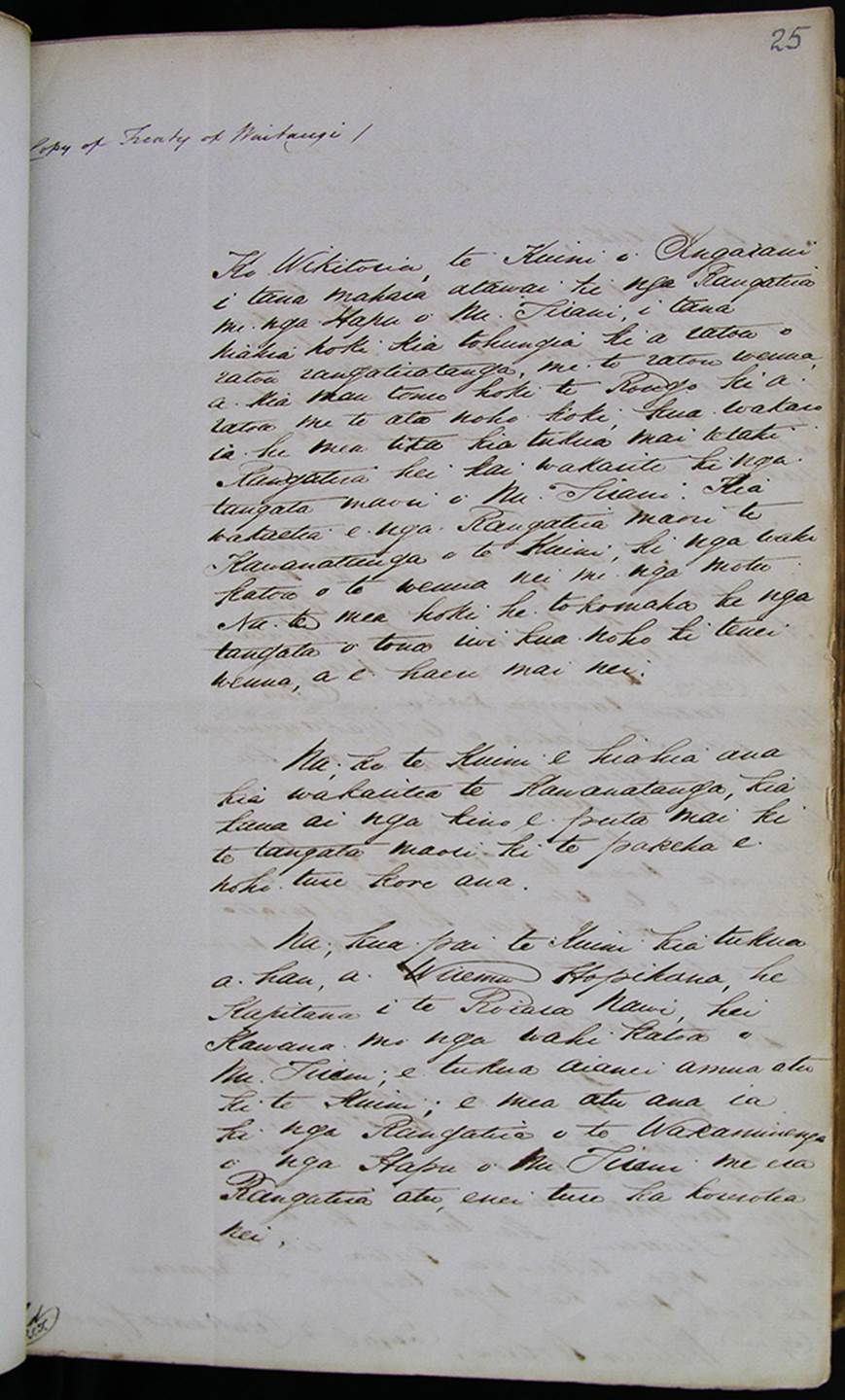
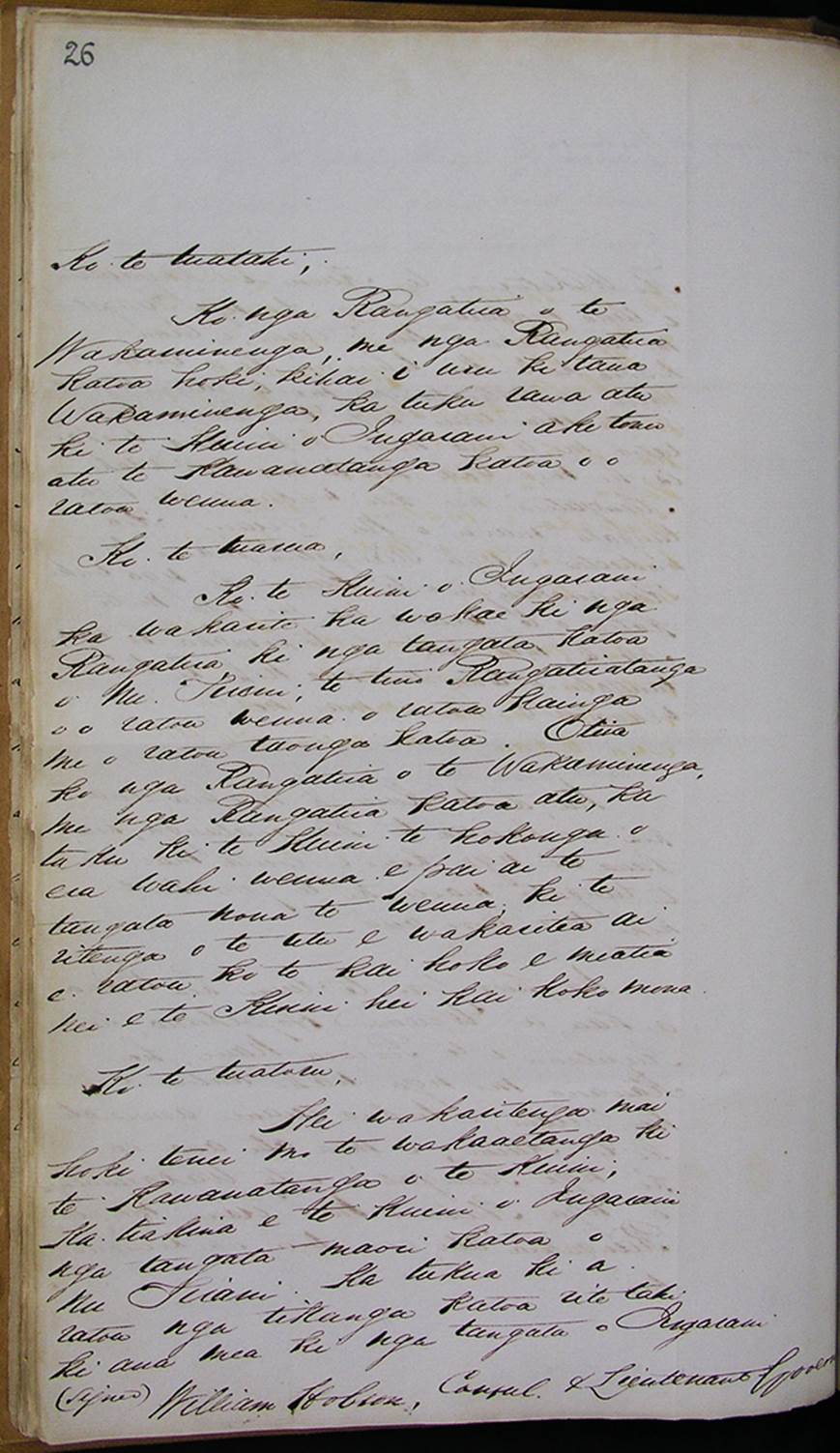
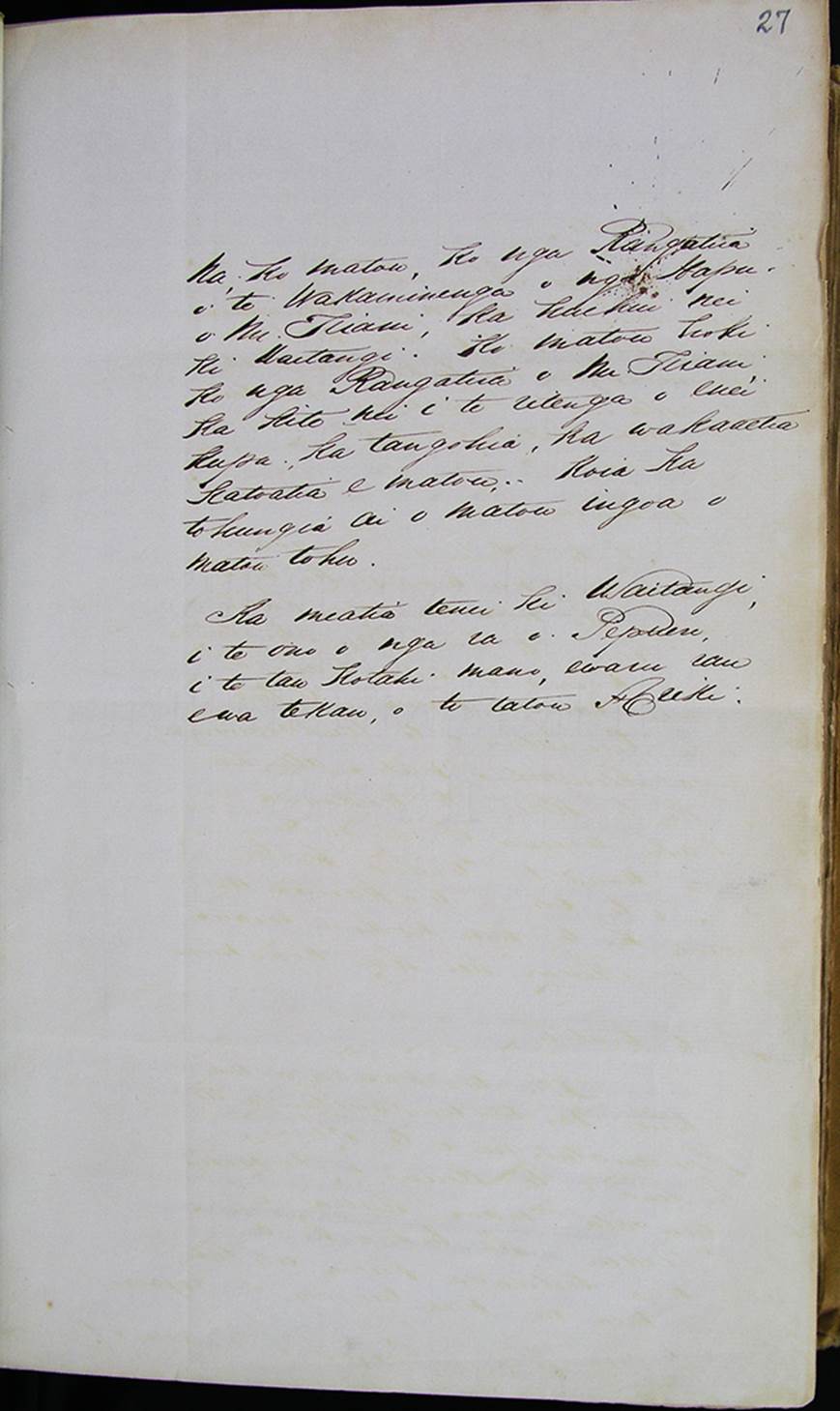
Reverend Henry Williams’ handwritten copy of Te Tiriti o Waitangi sent overseas. This is what he was certifying ... his translation. At the top of the first page, Freeman has written 'Copy of Treaty of Waitangi /'.
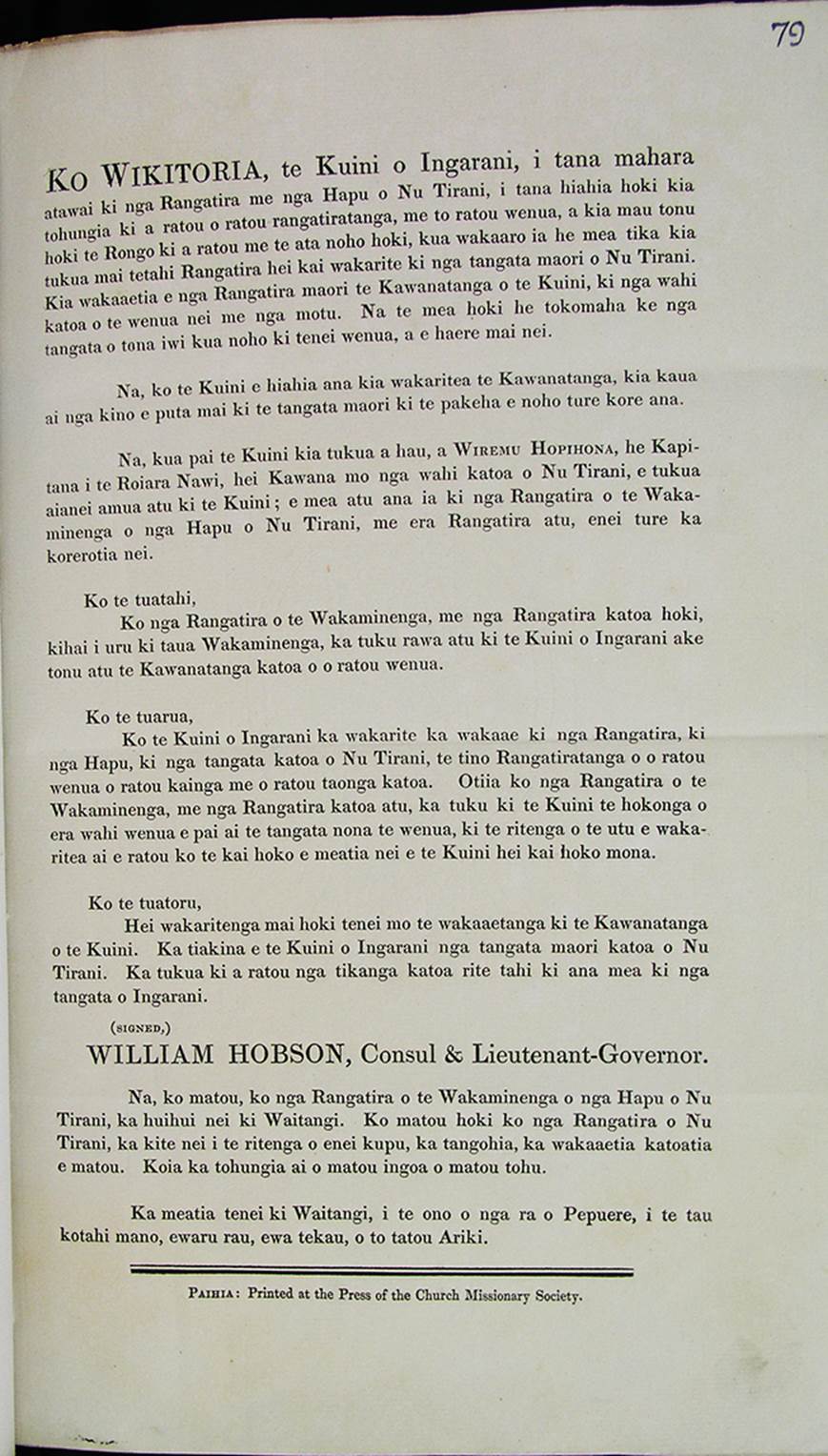
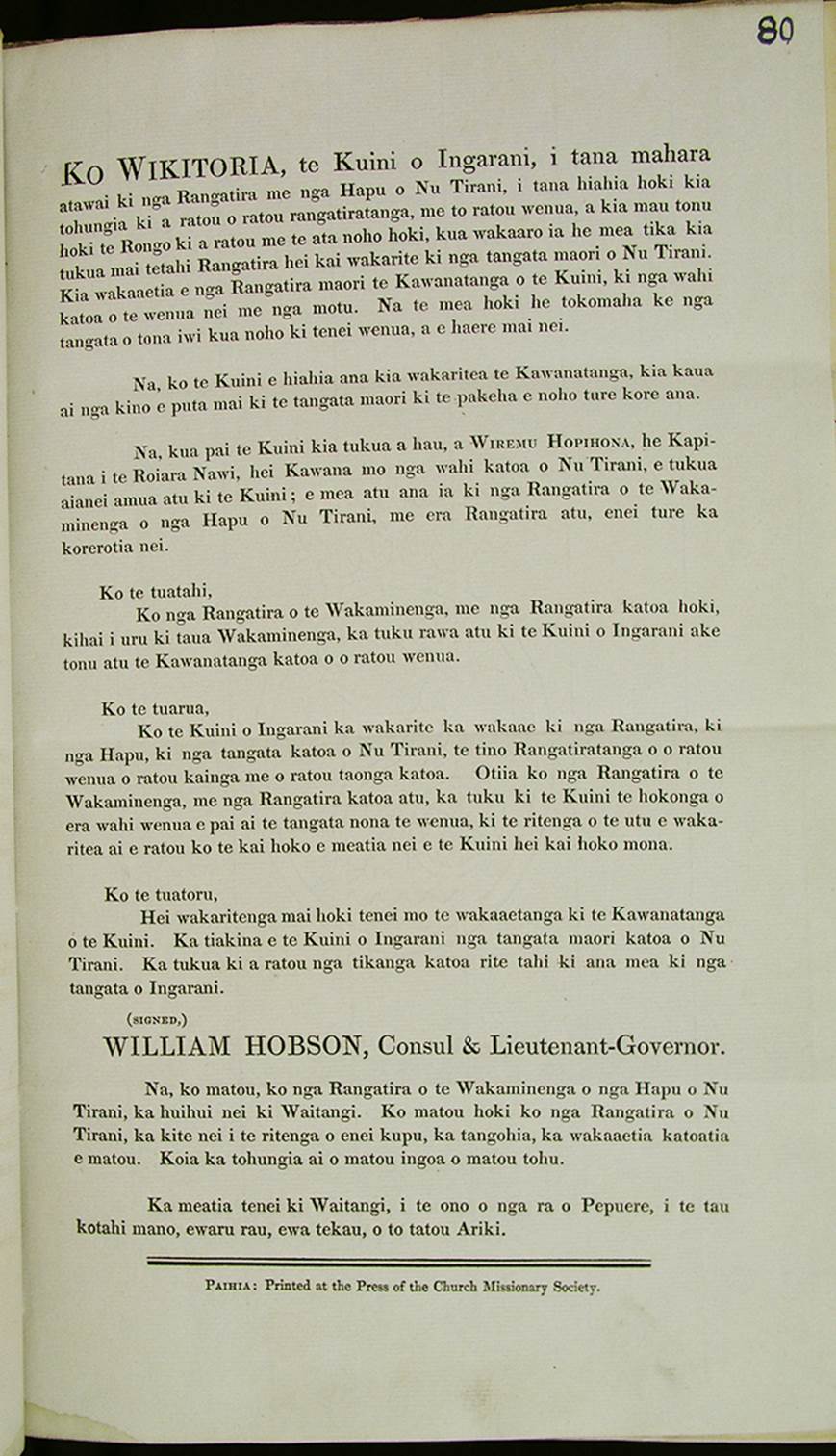
The Printed Maori te Tiriti o Waitangi sheets that were despatched in the 21st of February enclosures. This is what he was certifying ... his translation in either handwritten or printed form.
It should be obvious to anyone who considers the foregoing, documented evidence that New Zealanders have been subjected to an immense scam, designed to strip away their inalienable rights and protections, guaranteed equally to all, under the Articles of the Treaty of Waitangi.
This fraudulent treatment of the nation at the hands of Marxists, tribalists, the UN, multi-national corporations, traitorous politicians, social-historians, academics and a general rabble of social-engineers has been ongoing and relentless since the 1970s. Our first-stage, founding document, needed before a colony could be formed, has been fully revamped and reinvented in modern times by activists, to become something it was never intended to be, in the understandings of far-sighted, signatory chiefs who gifted us an egalitarian society in 1840.
Let Americans beware! You’re next if the globalists have their way. It’s very obvious to the rest of the world that your 2020 election was hijacked and that the Constitution of the United States is to be assailed and nullified (see: Forensic Audit into Election Fraud, Maricopa County, Arizona … with multiple other such forensic audits commencing to expose the electronic voting machine-switching of votes and international hacking of those machines linked to the Internet by routers.
Don’t allow what happened to us to happen to you!
Martin Doutré, Auckland, New Zealand, 24th of July 2021 ©